
Union Club
101 East 69th Street, New York City
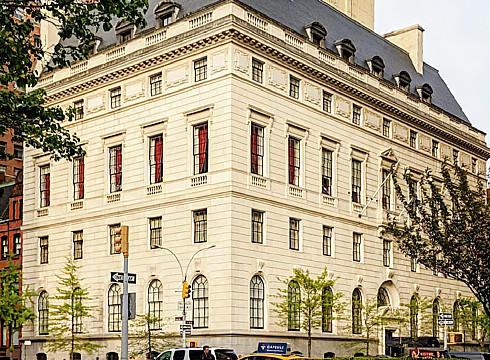
Founded in 1836, it is the oldest private club in New York City, although its present and conspicuous clubhouse on the corner of Park Avenue - designed by Delano & Aldrich in 1933 - is its sixth home. Being New York's oldest private club, over the years various of its members have peeled off for various reasons to create new clubs - notably the Union League Club, the Knickerbocker Club, and the Metropolitan Club - giving rise to its nickname as, "the mother of clubs." Since its inception, it has enjoyed the reputation of being (arguably), "the most thoroughly aristocratic private institution in the city," and it remains one of the most prestigious clubs in the western hemisphere....
In the Athenaeum Rooms at Broadway and Chambers Street, Chief Justice Samuel Jones (the club's first president) chaired a meeting on June 17, 1836, when a committee of formation was appointed to create a club and thirteen days later its constitution was officially adopted in the home of the club's first secretary, John L.H. McCrackan. Prospective members were invited to join at the invitation of the so-named formation committee: Samuel Jones, Thomas Jackson Oakley, Enos Thompson Throop, B.E. Brenner, Beverley Robinson, G.M. Wilkins, Philip Hone, B.C. Williams, William Beach Lawrence, Charles King, Ogden Hoffman, F. Sheldon, J. de Peyster Ogden, and John L.H. McCrackan.
The object was to, "promote social intercourse among its members, and to afford them the conveniences and advantages of a well-kept hotel, in conjunction with a reading room, library, and baths, in some proper house or apartments to be procured for the purpose, and in a manner combining elegance and comfort with order and economy." Philip Hone further explained, the intention was to create an establishment with 400-members "of our most distinguished citizens... similar in its plan and regulations to the great clubs of London, which give a tone and character to the society of the London metropolis."
Broadway Days (1836 to 1855)
Other founding members who played a significant role in the club's early days included: Commodore John Cox Stevens, Edward William Laight, Hamilton Wilkes, Charles Ludlow Livingston, George F. Talman, Jacob R. LeRoy, Robert Ray, David Cadwallader Colden, N.G. Harbright, John Van Buren, Thomas William Channing Moore, Clement Clarke Moore, and John Alsop King. When 135-members had signed up, the club rented the home of Jacob R. LeRoy at No. 343 Broadway, two doors down from Leonard Street. Converting the back parlor into a dining room and the front parlor into a reading room, billiard and card rooms were arranged on the upper floors. The club - complete with a chef from Paris and a cellar stocked with excellent wines - first opened its doors on June 23, 1837, with the initiation fee set at $200, and annual dues of $75.
By 1841, the club had already outgrown out its first home, and in the same year it moved two blocks north to 376 Broadway, a house originally built by William Cutting and then in the possession of William B. Astor. In 1849, it continued its journey north to 691 Broadway, opposite Great Jones Street, rented for five years from club member Joseph Kernochan at $2,500/yr. From 1855, to cease its wanderings and better serve its members who almost all lived in the vicinity of Fifth Avenue, the club paid $40,000 for a lot on the northwest corner of Fifth Avenue & 21st Street, building its first purpose-built home.
The First Home - Fifth Avenue & 21st (1855 to 1903)
The new clubhouse had cost something in the region of $180,000 to build and furnish. The 3-story Italianate brownstone was "admirably adapted to its uses" and enjoyed a 63-foot frontage on Fifth Avenue and 120-feet on 21st Street. Whist, All-Fours, Écarté, Bezique, Cribbage, Euchre, and Billiards were the games permitted within the club, but stakes were limited to no more than $20 a game. Of its interior, the Morning Courier crooned: "In the dining room with its carved black walnut panelling, and its beautiful paintings of game over the chimney pieces, an anchorite would be transformed into an epicure - the very light and air of that dining room seems to speak of good living. The parlor, the library, the reception room, the billiard room, are all in the highest style of luxurious comfort, and, having said this, we have nothing further to add in the way of description." However, it was later commented on that although possessing, "a splendid billiard room, a reading room, and a library... it has no gallery of art and owns very few paintings, engravings, and bits of statuary - scarcely enough in fact for the proper decoration of the walls of its different apartments, which are rather too bare for taste."
It opened its doors to 500-members in 1855, but not everyone was queuing up to join: It was strictly male only, and when James Gordon Bennett snubbed his invitation to join, he very publicly declared in his newspaper that, any "society without women is a farce." Nonetheless, its popularity blossomed among the leading men in law, politics, and finance, which "rather unsettled Bohemianism." Wealth quickly surpassed pedigree as a prerequisite for membership, and by the early 1860s men of literature were all but absent, and neither was journalism represented within the club. Manton Marble, the owner and editor of the New York World, was blackballed, but the anger of one very influential old member was such that the decision was reversed and Marble became the club's first representative of the daily press. Yet still by 1873, when the club had expanded to 1,000-members, it counted just one leading member of the dramatic arts, Lester Wallack.
"The Mother of Clubs"
During the Civil War in 1863, several members resigned when the club refused to expel its Confederate members, none more so than Judah P. Benjamin, one of the financial wizards of the Confederacy. A circular letter marked "confidential" was sent to several leading figures in New York proposing the formation of a club for the purpose of cultivating a profound love and respect for the Union, and the Union League Club was born.
After the Civil War, the club relaxed its admission policy, expanding to 1,000-members and permitting pipe-smoking and gambling. Eighteen members requested to have membership restricted solely to gentlemen of Knickerbocker descent, ie., restricted to true New Yorkers. After their request was rejected by the club's governing committee, those men founded their own club on October 31st, 1871 - the Knickerbocker Club.
In 1890, Erie Railroad president John King (sponsored by J.P. Morgan), and William Seward Webb (sponsored by William K. Vanderbilt) were blackballed from joining the club. Enraged, Morgan decided to form his own club and he was joined by several other displeased members. Twenty-five of New York's most distinguished millionaires were invited to serve as co-founders, and in 1891 the Metropolitan Club was formed.
The Palazzo - Fifth Avenue & 51st (1903 to 1933)
The idea of moving further up the avenue to escape encroaching trade had been mooted within the club since as early as the mid-1880s, and as for the building itself, "the plumbing was antiquated and falling to pieces, the ventilation poor and the lighting equally so." In 1891, they considered buying the A.T. Stewart Mansion, but on learning that the Manhattan Club was also interested, they respectfully stepped back. An annex was added on 21st Street, but this did little to satisfy the growing discontent, and in 1899 the club paid $700,000 for the site of the old Catholic Orphan Asylum on Fifth & 51st Street.
For the design of the new clubhouse, a competition was held among the club's architects and the decision came down to two: an Italian Renaissance palazzo, or - as favored by the old guard - an identical replica of the old clubhouse. To decide, the club called in Charles McKim of the celebrated architectural triumvirate McKim, Mead & White. He was emphatic in his choice: the old clubhouse should be replicated. But to the surprise of all, his professional opinion was overturned and in 1901 the club's building committee went ahead with Cass Gilbert's palazzo which was completed one year later for $450,000.
While the exterior was undoubtedly splendid, the interior, although extremely elegant - as McKim put it and many members felt - was "decidedly faulty" and the view from its rooms less than inspiring: the window of the principal room in which members reclined in leather chairs, smoked cigars, and discussed business looked directly onto... an alley.
Architecture aside, the club itself had never been more popular. According to The Evening World, it was "the most exclusive in the city... the club in which proud and happy fathers of the aristocracy enter their sons for prospective membership when the sons are but a few hours - or, in some instances, it is said - a few minutes old." By 1900, there were 1,500 members, and potential new members were presented by existing members. After an extensive vetting process and a vote, only then might membership be achieved. The fees remained surprisingly similar to those at its inception: $300 joining, annual dues of $75.
The object was to, "promote social intercourse among its members, and to afford them the conveniences and advantages of a well-kept hotel, in conjunction with a reading room, library, and baths, in some proper house or apartments to be procured for the purpose, and in a manner combining elegance and comfort with order and economy." Philip Hone further explained, the intention was to create an establishment with 400-members "of our most distinguished citizens... similar in its plan and regulations to the great clubs of London, which give a tone and character to the society of the London metropolis."
Broadway Days (1836 to 1855)
Other founding members who played a significant role in the club's early days included: Commodore John Cox Stevens, Edward William Laight, Hamilton Wilkes, Charles Ludlow Livingston, George F. Talman, Jacob R. LeRoy, Robert Ray, David Cadwallader Colden, N.G. Harbright, John Van Buren, Thomas William Channing Moore, Clement Clarke Moore, and John Alsop King. When 135-members had signed up, the club rented the home of Jacob R. LeRoy at No. 343 Broadway, two doors down from Leonard Street. Converting the back parlor into a dining room and the front parlor into a reading room, billiard and card rooms were arranged on the upper floors. The club - complete with a chef from Paris and a cellar stocked with excellent wines - first opened its doors on June 23, 1837, with the initiation fee set at $200, and annual dues of $75.
By 1841, the club had already outgrown out its first home, and in the same year it moved two blocks north to 376 Broadway, a house originally built by William Cutting and then in the possession of William B. Astor. In 1849, it continued its journey north to 691 Broadway, opposite Great Jones Street, rented for five years from club member Joseph Kernochan at $2,500/yr. From 1855, to cease its wanderings and better serve its members who almost all lived in the vicinity of Fifth Avenue, the club paid $40,000 for a lot on the northwest corner of Fifth Avenue & 21st Street, building its first purpose-built home.
The First Home - Fifth Avenue & 21st (1855 to 1903)
The new clubhouse had cost something in the region of $180,000 to build and furnish. The 3-story Italianate brownstone was "admirably adapted to its uses" and enjoyed a 63-foot frontage on Fifth Avenue and 120-feet on 21st Street. Whist, All-Fours, Écarté, Bezique, Cribbage, Euchre, and Billiards were the games permitted within the club, but stakes were limited to no more than $20 a game. Of its interior, the Morning Courier crooned: "In the dining room with its carved black walnut panelling, and its beautiful paintings of game over the chimney pieces, an anchorite would be transformed into an epicure - the very light and air of that dining room seems to speak of good living. The parlor, the library, the reception room, the billiard room, are all in the highest style of luxurious comfort, and, having said this, we have nothing further to add in the way of description." However, it was later commented on that although possessing, "a splendid billiard room, a reading room, and a library... it has no gallery of art and owns very few paintings, engravings, and bits of statuary - scarcely enough in fact for the proper decoration of the walls of its different apartments, which are rather too bare for taste."
It opened its doors to 500-members in 1855, but not everyone was queuing up to join: It was strictly male only, and when James Gordon Bennett snubbed his invitation to join, he very publicly declared in his newspaper that, any "society without women is a farce." Nonetheless, its popularity blossomed among the leading men in law, politics, and finance, which "rather unsettled Bohemianism." Wealth quickly surpassed pedigree as a prerequisite for membership, and by the early 1860s men of literature were all but absent, and neither was journalism represented within the club. Manton Marble, the owner and editor of the New York World, was blackballed, but the anger of one very influential old member was such that the decision was reversed and Marble became the club's first representative of the daily press. Yet still by 1873, when the club had expanded to 1,000-members, it counted just one leading member of the dramatic arts, Lester Wallack.
"The Mother of Clubs"
During the Civil War in 1863, several members resigned when the club refused to expel its Confederate members, none more so than Judah P. Benjamin, one of the financial wizards of the Confederacy. A circular letter marked "confidential" was sent to several leading figures in New York proposing the formation of a club for the purpose of cultivating a profound love and respect for the Union, and the Union League Club was born.
After the Civil War, the club relaxed its admission policy, expanding to 1,000-members and permitting pipe-smoking and gambling. Eighteen members requested to have membership restricted solely to gentlemen of Knickerbocker descent, ie., restricted to true New Yorkers. After their request was rejected by the club's governing committee, those men founded their own club on October 31st, 1871 - the Knickerbocker Club.
In 1890, Erie Railroad president John King (sponsored by J.P. Morgan), and William Seward Webb (sponsored by William K. Vanderbilt) were blackballed from joining the club. Enraged, Morgan decided to form his own club and he was joined by several other displeased members. Twenty-five of New York's most distinguished millionaires were invited to serve as co-founders, and in 1891 the Metropolitan Club was formed.
The Palazzo - Fifth Avenue & 51st (1903 to 1933)
The idea of moving further up the avenue to escape encroaching trade had been mooted within the club since as early as the mid-1880s, and as for the building itself, "the plumbing was antiquated and falling to pieces, the ventilation poor and the lighting equally so." In 1891, they considered buying the A.T. Stewart Mansion, but on learning that the Manhattan Club was also interested, they respectfully stepped back. An annex was added on 21st Street, but this did little to satisfy the growing discontent, and in 1899 the club paid $700,000 for the site of the old Catholic Orphan Asylum on Fifth & 51st Street.
For the design of the new clubhouse, a competition was held among the club's architects and the decision came down to two: an Italian Renaissance palazzo, or - as favored by the old guard - an identical replica of the old clubhouse. To decide, the club called in Charles McKim of the celebrated architectural triumvirate McKim, Mead & White. He was emphatic in his choice: the old clubhouse should be replicated. But to the surprise of all, his professional opinion was overturned and in 1901 the club's building committee went ahead with Cass Gilbert's palazzo which was completed one year later for $450,000.
While the exterior was undoubtedly splendid, the interior, although extremely elegant - as McKim put it and many members felt - was "decidedly faulty" and the view from its rooms less than inspiring: the window of the principal room in which members reclined in leather chairs, smoked cigars, and discussed business looked directly onto... an alley.
Architecture aside, the club itself had never been more popular. According to The Evening World, it was "the most exclusive in the city... the club in which proud and happy fathers of the aristocracy enter their sons for prospective membership when the sons are but a few hours - or, in some instances, it is said - a few minutes old." By 1900, there were 1,500 members, and potential new members were presented by existing members. After an extensive vetting process and a vote, only then might membership be achieved. The fees remained surprisingly similar to those at its inception: $300 joining, annual dues of $75.
Today - 701 Park Avenue & 69th (1933 to the Present Day)
Fifth Avenue's millionaires weren't used to losing, but for the second and final time they lost their battle to keep the last bastion of Fifth Avenue trade free. In 1927, the club purchased land “in a strictly residential district” on Park Avenue at the corner of 69th Street, occupied by the Redmond mansion designed by Stanford White. When the mansion was replaced by the new and not so dissimilar clubhouse, White's son (Lawrence Grant White) angrily suggested an inscription to be carved above the club’s entrance: "Conceived by the Genius of McKim, Mead & White. Destroyed by the Fury of Delano & Aldrich."
The new clubhouse was designed by Delano & Aldrich who had already - and very successfully - designed the Knickerbocker, Brook and Colony clubhouses. Sticking to his winning formula, Delano had presented the club with another simple design reminiscent of the mansion it would be replacing, but the club's building committee (again) felt they knew better, and, "insisted on a good deal of ornament inside and out." As a result, in stark contrast to the elegance of the other clubs, the Union clubhouse that opened its doors in 1933 was described in The New York Times as, "chunky with rusticated limestone and a huge angled mansard roof so big it looks like a Fifth Avenue mansion gone wild."
In a reverse of the old and the new, it was the exterior here that could be surmised as "decidedly faulty," whereas Delano later admitted that with the interior he, “had great fun in designing every detail - all the electric light fixtures, mantels, ventilators, etc.”
The entrance hall offers a glimpse up to the spectacular coffered-domed ceiling in the main hall, designed on the axis of a Greek Cross. To its left was the original lounge and writing room that runs the full length of the Park Avenue facade. To its right is the Card Room, the ceiling of which is fringed with a frieze of hearts, spades, diamonds and clubs, while carved into the marble mantelpiece are reliefs of face cards (jacks, queens, and kings). Similarly, in the Backgammon Room, the wall vents are patterned like backgammon boards, and in the Library the light fixtures are shaped like the planet Saturn - Saturn being colloquially known as "Father Time," it is often associated with academics, astrologically representing our ability to store and recall memories. But, perhaps the most memorable room is the lounge off the squash courts with its patterned ceiling in gold, buff, and green billows, conjuring up the impression of a sultan's tent, albeit without the inclusion of a harem - women are still withheld from membership.
There were five dining rooms, a humidor stocked with 100,000 cigars, and, according to The Herald-Tribune, by the the 1950s there was a television set, a radio in each room, and “much modernistic decorative art.” The only magazine made out in the library: Esquire.
The Depression of the 1930s made little impression on the club's by-then 1,300 members, many of whom were as prominent then as their forbears had been a hundred-plus years before. Nevertheless, the development of the suburbs and longer office hours saw the Union's membership drop to 950 in 1954, and in 1959 the Knickerbocker Club (down to 550-members) seriously considered merging with the Union that had lost a further fifty members within just four years. However that might have been viewed, it didn't come to pass, and as of today the Union Club and all its traditions is very much alive and strong.
You May Also Like...


Categories
Styles
Share
The Clubs of New York (1873), by Francis Fairfield; History of the Manhattan Club (1915) by Henry Watterson; Museum of the City of New York; History of New York City (1884), by Benson John Lossing; The Lost Union Club, 1903, by Tom Miller; Inside the Union Club, Jaws Drop (2007) by Christopher Gray for the New York Times; Architecture of Delano & Aldrich, by Pennoyer-Walker; The Memorial History of the City of New-York (1892), edited by James Grant Wilson
Presidents: Samuel Jones; John Cox Stevens; John Alsop King; Moses H. Grinnell; William M. Evarts; William Constable; John J. Townsend; Clarence A. Seward; Edward Cooper. Life Members (1873) Jonathan Meredith.
Presidents: Samuel Jones; John Cox Stevens; John Alsop King; Moses H. Grinnell; William M. Evarts; William Constable; John J. Townsend; Clarence A. Seward; Edward Cooper. Life Members (1873) Jonathan Meredith.