
Knickerbocker Club
2 East 62nd Street, New York City
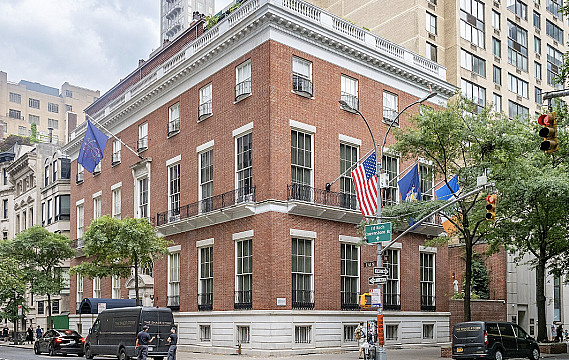
Founded in 1871 by a handful of New York's finest when it was felt that the Union Club - New York's oldest private gentleman's club - had become too inclusive. Informally referred to as “The Knick,” the clubhouse seen today is its third home, completed in 1915 by the architects Delano & Aldrich. Recognized as one of the city's best examples of the Neo-Federal style, it was given Landmark status in 1979. The club's distinctive name is derived from “Diedrich Knickerbocker,” the pseudonym first used by Washington Irving in 1809 for his book Knickerbocker's History of New York, when the term “Knickerbocker” became a byword for the descendants of the Dutch merchant princes of Manhattan. Similarly, the club's early members were the inspiration behind the moniker “Dude” (though its meaning was somewhat different back then), and in the 1880s the Knick was referred to as the “Dude Club.” It remains one of the city’s most exclusive clubs, with no website, no female members, and (reputedly) a code of secrecy....
The Union Club relaxed its admission policy after the Civil War, allowing for 1,000 members. Eighteen members requested to have membership restricted solely to gentlemen of Knickerbocker descent. After their request was rejected by the Union's governing committee, they founded their own club on Halloween, 1871. Membership was limited to 300 gentlemen who counted among them many of New York's oldest and most prominent names. At a meeting at Delmonico's Restaurant, the name given to the new club - chosen from a slate that included other suggestions such as Crescent, Half Moon and Federal - was “The Knickerbocker Club.” The initial joining fee was $300, the yearly membership fee was $100, but it was not exclusively limited to the descendants of Knickerbockers.
The 18-original founders were: Alexander Hamilton Jr. (the club's first president), Alonzo C. Monson, Johnston Livingston, Egerton L. Winthrop, August Belmont, John Jacob Astor, A. Lauderdale Duncan, S. Van Rensselaer Cruger, Robert J. Livingston, Charles Burrall Hoffman, William D. Morgan, Frederic W. Rhinelander, Andrew G. Bininger, Theodore Roosevelt, William Cutting, Charles de Rham, Mahlon Day Sands, & John L. Cadwalader.
249 Fifth Avenue (1871 to 1882)
In December, 1871, they paid William Butler Duncan $180,000 for his mansion at 249 Fifth Avenue, on the corner of 28th Street, where in the 1860s he'd entertained the Prince of Wales (later King Edward VII) and his younger brother, the Duke of Connaught. The house was carefully adapted to accommodate its new role: In 1876, the principal lounging and reading room was on the ground floor, fronting Fifth Avenue. The dining, billiard, and card rooms were described as, "cosy, comfortable, and home-like," - that is, home-like by way of comparison to the grandest homes in Gilded Age New York - and the cuisine was "excellent," while on the upper floors a few of the rooms were rented to members.
By 1879, with pipe-smoking and gambling still banned, younger members were becoming less enchanted not only with the club's premises, but its management. That year a faction left to found the Calumet Club, and while news of the general malcontent was successfully kept out of the press, it prompted the club's move up the avenue in 1882.
319 Fifth Avenue (1882 to 1915)
In 1882, the club moved to its second home, 319 Fifth Avenue, a four-story townhouse with its entrance on 32nd Street that had belonged to Peter Moller, and was home to Cornelius Vanderbilt II while his château was being completed at 1 West 57th Street. Costing $200,000, the brick house with brownstone trimmings was noted for its large much-loved bay window overlooking the activity of Fifth Avenue, similar to that at White's Club in London that was made famous by William Makepeace Thackeray in The Virginians. A further $50,000 was spent on a rear extension, a new covered entrance, and internal improvements: the billiard room, smoking rooms and café were on the ground floor. The second floor was comprised of various-sized dining rooms while the kitchen and servants' dining room were on the third floor. The fourth floor was for resident members.
By then, membership had risen to 450, and the English poet and cultural critic, Matthew Arnold (1822-88), wrote from the Knick in October 1883: "I have been invited to four clubs in New York... This is the smart club par excellence, and it is indeed a beautiful house, splendidly and luxuriously furnished. The wealth of New York strikes me very much." A menu from 1887 confirmed its continuing tradition for excellent cuisine: East River oysters, crème de petit pois aux croutons, terrapins à la Knickerbocker, saddle of mutton, string beans, potatoes hashed and fried, canvasback ducks, mousse café, cheese, fruit, nuts.
Dudes at the Dude Club
In 1883, Town Topics identified the Knickerbocker Club and its younger members as the inspiration for those which the Anglo-Irish wit, Robert Sale-Hill, had branded "Dudes" - “first cousin to the Dodo” - in his rhyming poem that was published in the New York World that January, poking fun at the rich and idle sons of New York's elite.
Sale-Hill was an active, military-born man, the grandson of one of Britain's most respected soldiers, General Sir Robert "Fighting Bob" Sale. He introduced "Dude" to the English language “after visiting the Knickerbocker Club,” where he was struck by the listlessness that prevailed within many of its members. In March, 1883, the Brooklyn Daily Eagle declared, "You can tell a Knickerbocker Club man as far as you can see him. He affects the English (accent) to an appalling degree, wears collars that reach to his ears, skin tight trousers, a single glass (monocle), a bell crowned hat, and toothpick shoes...". The World went on to explain: "a Dude is not necessarily a “masher,” not generally a snob, not exactly a fop - but a sort of compound of all three, with a delicious dash of simplicity and feeble-mindedness added which makes him a very amusing creature indeed... The chief characteristic of his personal architecture is a very empty garret... The Dude generally scorns personal exertion and activity. He has a rich father... they do no business to tire their flaccid intellects withal, and they carefully avoid conversation."
The club's younger members quickly acquired a reputation for being “Dudes,” and it wasn't long before the club became known as the “Dude Club,” a reputation and name that stuck for years. If hearsay is to be believed, then the original "Dude" was August Belmont Jr., a son of one of the original founders, who created a sensation when he paraded his “latest imported clothes” past the club windows on Fifth Avenue. But, despite the popular stereotype enjoyed by the public, it will be remembered that Theodore Roosevelt Jr., (another son of an original founder and himself a member too) drew several of his "Rough Riders" from the ranks of the Knickerbocker Club, and the cowboys out west who awaited the arrival of the "Fifth Avenue Dudes" were sorely disappointed when confronted with the skills of the fearless fox hunters and fiercely competitive polo players.
The 18-original founders were: Alexander Hamilton Jr. (the club's first president), Alonzo C. Monson, Johnston Livingston, Egerton L. Winthrop, August Belmont, John Jacob Astor, A. Lauderdale Duncan, S. Van Rensselaer Cruger, Robert J. Livingston, Charles Burrall Hoffman, William D. Morgan, Frederic W. Rhinelander, Andrew G. Bininger, Theodore Roosevelt, William Cutting, Charles de Rham, Mahlon Day Sands, & John L. Cadwalader.
249 Fifth Avenue (1871 to 1882)
In December, 1871, they paid William Butler Duncan $180,000 for his mansion at 249 Fifth Avenue, on the corner of 28th Street, where in the 1860s he'd entertained the Prince of Wales (later King Edward VII) and his younger brother, the Duke of Connaught. The house was carefully adapted to accommodate its new role: In 1876, the principal lounging and reading room was on the ground floor, fronting Fifth Avenue. The dining, billiard, and card rooms were described as, "cosy, comfortable, and home-like," - that is, home-like by way of comparison to the grandest homes in Gilded Age New York - and the cuisine was "excellent," while on the upper floors a few of the rooms were rented to members.
By 1879, with pipe-smoking and gambling still banned, younger members were becoming less enchanted not only with the club's premises, but its management. That year a faction left to found the Calumet Club, and while news of the general malcontent was successfully kept out of the press, it prompted the club's move up the avenue in 1882.
319 Fifth Avenue (1882 to 1915)
In 1882, the club moved to its second home, 319 Fifth Avenue, a four-story townhouse with its entrance on 32nd Street that had belonged to Peter Moller, and was home to Cornelius Vanderbilt II while his château was being completed at 1 West 57th Street. Costing $200,000, the brick house with brownstone trimmings was noted for its large much-loved bay window overlooking the activity of Fifth Avenue, similar to that at White's Club in London that was made famous by William Makepeace Thackeray in The Virginians. A further $50,000 was spent on a rear extension, a new covered entrance, and internal improvements: the billiard room, smoking rooms and café were on the ground floor. The second floor was comprised of various-sized dining rooms while the kitchen and servants' dining room were on the third floor. The fourth floor was for resident members.
By then, membership had risen to 450, and the English poet and cultural critic, Matthew Arnold (1822-88), wrote from the Knick in October 1883: "I have been invited to four clubs in New York... This is the smart club par excellence, and it is indeed a beautiful house, splendidly and luxuriously furnished. The wealth of New York strikes me very much." A menu from 1887 confirmed its continuing tradition for excellent cuisine: East River oysters, crème de petit pois aux croutons, terrapins à la Knickerbocker, saddle of mutton, string beans, potatoes hashed and fried, canvasback ducks, mousse café, cheese, fruit, nuts.
Dudes at the Dude Club
In 1883, Town Topics identified the Knickerbocker Club and its younger members as the inspiration for those which the Anglo-Irish wit, Robert Sale-Hill, had branded "Dudes" - “first cousin to the Dodo” - in his rhyming poem that was published in the New York World that January, poking fun at the rich and idle sons of New York's elite.
Sale-Hill was an active, military-born man, the grandson of one of Britain's most respected soldiers, General Sir Robert "Fighting Bob" Sale. He introduced "Dude" to the English language “after visiting the Knickerbocker Club,” where he was struck by the listlessness that prevailed within many of its members. In March, 1883, the Brooklyn Daily Eagle declared, "You can tell a Knickerbocker Club man as far as you can see him. He affects the English (accent) to an appalling degree, wears collars that reach to his ears, skin tight trousers, a single glass (monocle), a bell crowned hat, and toothpick shoes...". The World went on to explain: "a Dude is not necessarily a “masher,” not generally a snob, not exactly a fop - but a sort of compound of all three, with a delicious dash of simplicity and feeble-mindedness added which makes him a very amusing creature indeed... The chief characteristic of his personal architecture is a very empty garret... The Dude generally scorns personal exertion and activity. He has a rich father... they do no business to tire their flaccid intellects withal, and they carefully avoid conversation."
The club's younger members quickly acquired a reputation for being “Dudes,” and it wasn't long before the club became known as the “Dude Club,” a reputation and name that stuck for years. If hearsay is to be believed, then the original "Dude" was August Belmont Jr., a son of one of the original founders, who created a sensation when he paraded his “latest imported clothes” past the club windows on Fifth Avenue. But, despite the popular stereotype enjoyed by the public, it will be remembered that Theodore Roosevelt Jr., (another son of an original founder and himself a member too) drew several of his "Rough Riders" from the ranks of the Knickerbocker Club, and the cowboys out west who awaited the arrival of the "Fifth Avenue Dudes" were sorely disappointed when confronted with the skills of the fearless fox hunters and fiercely competitive polo players.
2 East 62nd Street (1915 to Present Day)
By the early 1900s, society was again on the move uptown as trade continued its assault on the lower rungs of Fifth Avenue. Although many of the members were against moving, it was accepted that the old clubhouse was proving expensive to maintain and it lacked modern conveniences such as an elevator for the older members.
Just as a splinter group from the Knick founded the Calumet Club (to discuss art and literature) shortly before their move to their second clubhouse, styling themselves as the “Foes of Finance,” in 1915 several club members led by Francis Crowninshield, Editor of Vanity Fair, founded The Coffee House (a club for New York's intellectual, artistic, literary, and theatrical circles), just as the Knick took up in their third clubhouse.
In 1914, the club purchased the chateau that stood at 807 Fifth Avenue on the corner of 62nd Street, along with its neighbor to the south. Both properties were demolished, giving rise to the current clubhouse designed by society architects Delano & Aldrich. Completed in 1915 at a cost of something in the region of $250,000, The New York Times commented approvingly: “There is a simplicity combined with rich dignity about the building which strikes the observer more forcibly than the more ornate exteriors of many Fifth Avenue homes. It is expressive of the conservatism, if not the traditional exclusiveness of the club.” Considered to be, “one of the city’s finest examples of the Neo-Federal style,” it was granted Landmark status in New York in 1979. As for the Knick, it continues to retain its social exclusivity, just ask the Rockefellers, it took them three generations to get in.
By the early 1900s, society was again on the move uptown as trade continued its assault on the lower rungs of Fifth Avenue. Although many of the members were against moving, it was accepted that the old clubhouse was proving expensive to maintain and it lacked modern conveniences such as an elevator for the older members.
Just as a splinter group from the Knick founded the Calumet Club (to discuss art and literature) shortly before their move to their second clubhouse, styling themselves as the “Foes of Finance,” in 1915 several club members led by Francis Crowninshield, Editor of Vanity Fair, founded The Coffee House (a club for New York's intellectual, artistic, literary, and theatrical circles), just as the Knick took up in their third clubhouse.
In 1914, the club purchased the chateau that stood at 807 Fifth Avenue on the corner of 62nd Street, along with its neighbor to the south. Both properties were demolished, giving rise to the current clubhouse designed by society architects Delano & Aldrich. Completed in 1915 at a cost of something in the region of $250,000, The New York Times commented approvingly: “There is a simplicity combined with rich dignity about the building which strikes the observer more forcibly than the more ornate exteriors of many Fifth Avenue homes. It is expressive of the conservatism, if not the traditional exclusiveness of the club.” Considered to be, “one of the city’s finest examples of the Neo-Federal style,” it was granted Landmark status in New York in 1979. As for the Knick, it continues to retain its social exclusivity, just ask the Rockefellers, it took them three generations to get in.
You May Also Like...


Categories
Styles
Share
The Galaxy, Volume 22, 1876; Letters of Matthew Arnold; Knickerbocker Club Building, Landmarks Preservation Commission (1979); Knickerbocker Dudes - a Window into the History and Origin of "Dude"; Archives of The New York Times; The Calumet Club of New York; The Coffee House Club