
Theodore Roosevelt (1858-1919)
"Teddy" Roosevelt, 26th President of the United States (1901-1909)
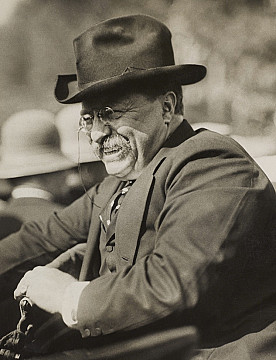
He was preceded in the Presidency by William McKinley, stepping in after he was assassinated in 1901. After serving two terms in office for the Republican Party he was succeeded in 1909 by William Howard Taft. Having originally been McKinley's Vice-President, he completed his first term without a Vice-President before appointing Charles W. Fairbanks for his second term. He is the only U.S. President to have been born in Manhattan, N.Y., and he was the uncle of First Lady Eleanor Roosevelt, wife of their distant cousin, U.S. President, Franklin D. Roosevelt. His career was marked by extraordinary energy, progressive reforms, and a dramatic rise from tragedy to triumph.
The Roosevelt family were an old and wealthy one, long established in New York. His mother's family were equally old and wealthy, but Southern, and whereas as his father had been committed to the Union cause in the Civil War, his mother's family were actively dedicated to the Confederate cause. "Teddy" himself overcame the asthma that plagued his childhood through rigorous physical activity, establishing the vigor that would define his public life. He entered politics at the age of 23 as a New York State Assemblyman, quickly gaining a reputation for fighting corruption. However, after the death of his first wife just three years later he threw it in to become a rancher in the Dakota Territory.
He returned to public service in 1895 as the New York City Police Commissioner, implementing significant reforms and walking beats at night to ensure officers were doing their jobs. His appointment as Assistant Secretary of the Navy in 1897 positioned him perfectly for the Spanish-American War. Roosevelt famously resigned to form the "Rough Riders," a volunteer cavalry regiment, and led the celebrated charge up San Juan Hill, catapulting him to national fame. This popularity helped him win the New York governorship in 1898, where his progressive agenda worried Republican Party bosses. They "kicked him upstairs" to the Vice Presidency in 1900, but President McKinley's assassination in 1901 made Roosevelt, at just 42 years old, the youngest president in American history - John F. Kennedy was the youngest president to win an election at 43.
The Roosevelt family were an old and wealthy one, long established in New York. His mother's family were equally old and wealthy, but Southern, and whereas as his father had been committed to the Union cause in the Civil War, his mother's family were actively dedicated to the Confederate cause. "Teddy" himself overcame the asthma that plagued his childhood through rigorous physical activity, establishing the vigor that would define his public life. He entered politics at the age of 23 as a New York State Assemblyman, quickly gaining a reputation for fighting corruption. However, after the death of his first wife just three years later he threw it in to become a rancher in the Dakota Territory.
He returned to public service in 1895 as the New York City Police Commissioner, implementing significant reforms and walking beats at night to ensure officers were doing their jobs. His appointment as Assistant Secretary of the Navy in 1897 positioned him perfectly for the Spanish-American War. Roosevelt famously resigned to form the "Rough Riders," a volunteer cavalry regiment, and led the celebrated charge up San Juan Hill, catapulting him to national fame. This popularity helped him win the New York governorship in 1898, where his progressive agenda worried Republican Party bosses. They "kicked him upstairs" to the Vice Presidency in 1900, but President McKinley's assassination in 1901 made Roosevelt, at just 42 years old, the youngest president in American history - John F. Kennedy was the youngest president to win an election at 43.
As president, Roosevelt championed progressive reforms including trust-busting, conservation, and consumer protection. He mediated the 1902 coal strike, established National Parks and Forests with Gifford Pinchot, and pushed through the Pure Food & Drug Act (1906) which put ingredients/contents on labels in a strong bid to put an end to "Quacks and Quackery." His foreign policy followed his motto - "Speak Softly and Carry a Big Stick," exemplified by his role in building the Panama Canal and winning the Nobel Peace Prize for mediating the end of the Russo-Japanese War.
After leaving office, he remained active in politics and exploration, notably taking part in a dangerous expedition through up the Amazon River. His dynamic personality and reformist vision fundamentally transformed both the presidency and American society, establishing the foundation for the modern activist president. In 1880, he married his first wife, Anna Lee, but she died in childbirth in 1884 survived by his eldest daughter, Alice. In 1886, he married Edith Carow and they were the parents of a further five children.
After leaving office, he remained active in politics and exploration, notably taking part in a dangerous expedition through up the Amazon River. His dynamic personality and reformist vision fundamentally transformed both the presidency and American society, establishing the foundation for the modern activist president. In 1880, he married his first wife, Anna Lee, but she died in childbirth in 1884 survived by his eldest daughter, Alice. In 1886, he married Edith Carow and they were the parents of a further five children.