
John D. Rockefeller (1839-1937)
Founder & President of the Standard Oil Company
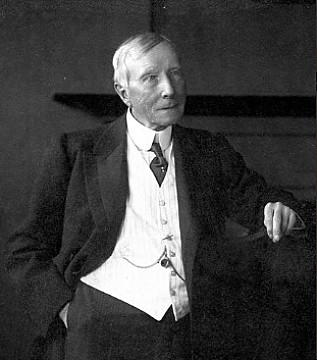
He was born John Davison Rockefeller in Richford, New York, to a family of modest means. His father was a traveling salesman and con artist, while his mother instilled him with strong Baptist values that would influence him throughout his life. The family moved frequently during his childhood before settling in Cleveland, Ohio. He began his business career as a bookkeeper when he was sixteen, demonstrating an early aptitude for numbers and finance. In 1863, he entered the oil refining business, recognizing the potential of Pennsylvania's oil boom. By 1870, he founded Standard Oil with his brother, William, which would become one of the most powerful monopolies in American history, and make him the world's first billionaire.
Through aggressive business tactics including horizontal integration, strategic partnerships, and often ruthless competition, Rockefeller built Standard Oil into a dominant force that controlled approximately 90% of U.S. oil refining by the 1880s. His methods included securing favorable railroad rates, undercutting competitors' prices, and acquiring rival companies. While these practices made him enormously wealthy, they also drew criticism and eventually led to antitrust legislation. Rockefeller revolutionized the oil industry through vertical integration, controlling everything from oil wells to retail distribution. His emphasis on efficiency and cost reduction helped make kerosene affordable for ordinary Americans, literally lighting homes across the nation.
Through aggressive business tactics including horizontal integration, strategic partnerships, and often ruthless competition, Rockefeller built Standard Oil into a dominant force that controlled approximately 90% of U.S. oil refining by the 1880s. His methods included securing favorable railroad rates, undercutting competitors' prices, and acquiring rival companies. While these practices made him enormously wealthy, they also drew criticism and eventually led to antitrust legislation. Rockefeller revolutionized the oil industry through vertical integration, controlling everything from oil wells to retail distribution. His emphasis on efficiency and cost reduction helped make kerosene affordable for ordinary Americans, literally lighting homes across the nation.
In 1911, the Supreme Court ordered Standard Oil's breakup under antitrust laws, but by then Rockefeller had already begun focusing on philanthropy. In 1918, with an estimated personal fortune of $1.2 billion, he topped the first ever Forbes Rich List, ahead of Frick and Carnegie who came in second and third. Despite that enormous sum, he still donated over $500 million during his lifetime, establishing the Rockefeller Foundation, funding medical research, education, and scientific advancement. His philanthropic efforts included founding the University of Chicago and supporting public health initiatives worldwide. He retired from active business management in the 1890s as history's first billionaire.
In 1868, Rockefeller built a mansion (see images) for his family in Cleveland on Euclid Avenue which was their principal home until 1884 when they moved to New York City and bought 4 West 54th Street (see images) from Arabella Huntington. In 1873, he built "The Homestead" (see images) at Forest Hill that overlooked both the city of Cleveland and Lake Erie, and while first intended to be a summer resort, it became their summer home until it burned down under mysterious circumstances in 1917. From 1916, the Rockefellers made their permanent home at Kykuit in the Pocantico Hills, 25-miles north of New York City. Later, Rockefeller sold the 235-acres that had been their summer estate in Ohio to his son for $2.8-million, who donated the land to the cities of Cleveland Heights and East Cleveland with the express stipulation that it become a public park, Forest Hill Park.
Rockefeller and his wife "Cettie" were the parents of five children. He was succeeded by his only son, John D. Rockefeller Jr., who turned away from business and dedicated his life to philanthropy. Rockefeller Sr. died at 97, leaving behind a complex legacy: a pioneering industrialist who helped fuel America's economic growth, but a controversial figure whose monopolistic practices forever changed how business and government would interact.
In 1868, Rockefeller built a mansion (see images) for his family in Cleveland on Euclid Avenue which was their principal home until 1884 when they moved to New York City and bought 4 West 54th Street (see images) from Arabella Huntington. In 1873, he built "The Homestead" (see images) at Forest Hill that overlooked both the city of Cleveland and Lake Erie, and while first intended to be a summer resort, it became their summer home until it burned down under mysterious circumstances in 1917. From 1916, the Rockefellers made their permanent home at Kykuit in the Pocantico Hills, 25-miles north of New York City. Later, Rockefeller sold the 235-acres that had been their summer estate in Ohio to his son for $2.8-million, who donated the land to the cities of Cleveland Heights and East Cleveland with the express stipulation that it become a public park, Forest Hill Park.
Rockefeller and his wife "Cettie" were the parents of five children. He was succeeded by his only son, John D. Rockefeller Jr., who turned away from business and dedicated his life to philanthropy. Rockefeller Sr. died at 97, leaving behind a complex legacy: a pioneering industrialist who helped fuel America's economic growth, but a controversial figure whose monopolistic practices forever changed how business and government would interact.