
John D. Rockefeller Jr. (1874-1960)
Philanthropist & Founder of the Rockefeller Foundation
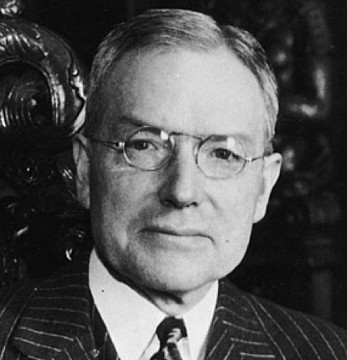
He was born in Cleveland, Ohio, and grew up in New York as the only son of the world's first billionaire. He inherited enormous wealth but chose to dedicate his life to philanthropy and public service rather than expanding the family empire. After graduating from Brown University in 1897, he moved back to New York where he became a director of Standard Oil - the core of the family business - and shortly afterwards was added to the board of J.P. Morgan's U.S. Steel Company. But, from 1910 he took the decision to divest himself from his commercial interests so that he could focus entirely on philanthropy without being accused of being self-serving or bias.
He became the first President of the Rockefeller Foundation that he co-founded in 1913 to benefit public health, education, and scientific research worldwide. During the Great Depression, he spearheaded the development of the Rockefeller Center, a massive commercial complex that became an iconic part of Manhattan's skyline and gave thousands work. He also donated the land for the United Nations headquarters. He had a special interest in conservation, and purchased and donated land for many American National Parks, including Grand Teton, Mesa Verde National Park, Acadia National Park, the Great Smoky Mountains, Yosemite, and Shenandoah. Another personal passion was historic preservation and conservation, and in addition to purchasing historic houses for the nation (eg., Sunnyside and Van Cortlandt Manor), he restored Colonial Williamsburg in Virginia, transforming it into a living history museum. In France, after the ravages of World War I, he helped restore Reims Cathedral, the Château de Fontainebleau and the Château de Versailles among others. He also funded excavations in Egypt and Agora, and built the Palestine Archaeological Museum in East Jerusalem – the Rockefeller Museum – which was home to the Dead Sea Scrolls until 1967, when the Israeli forces occupied East Jerusalem and rehoused the scrolls in the Israel Museum, in West Jerusalem.
He became the first President of the Rockefeller Foundation that he co-founded in 1913 to benefit public health, education, and scientific research worldwide. During the Great Depression, he spearheaded the development of the Rockefeller Center, a massive commercial complex that became an iconic part of Manhattan's skyline and gave thousands work. He also donated the land for the United Nations headquarters. He had a special interest in conservation, and purchased and donated land for many American National Parks, including Grand Teton, Mesa Verde National Park, Acadia National Park, the Great Smoky Mountains, Yosemite, and Shenandoah. Another personal passion was historic preservation and conservation, and in addition to purchasing historic houses for the nation (eg., Sunnyside and Van Cortlandt Manor), he restored Colonial Williamsburg in Virginia, transforming it into a living history museum. In France, after the ravages of World War I, he helped restore Reims Cathedral, the Château de Fontainebleau and the Château de Versailles among others. He also funded excavations in Egypt and Agora, and built the Palestine Archaeological Museum in East Jerusalem – the Rockefeller Museum – which was home to the Dead Sea Scrolls until 1967, when the Israeli forces occupied East Jerusalem and rehoused the scrolls in the Israel Museum, in West Jerusalem.
Over the course of his lifetime, he gave away over $537 million to a myriad of different causes in every corner of the world. In contrast to his father's reputation as a ruthless businessman, he was known for his progressive social views, supporting labor rights, racial equality, and women's suffrage. He established the Rockefeller family tradition for public service and philanthropy, famously saying: "I believe that every right implies a responsibility; every opportunity, an obligation; every possession, a duty." Although entirely independently, he and Julius Rosenwald shared the same approach to "giving while living," establishing a precedent that continues to influence philanthropists today.
In 1901, he married Abby Aldrich, daughter of Nelson Aldrich, the U.S. Senator from Rhode Island who co-founded the Federal Reserve System. She played a significant role in both encouraging and supporting his philanthropy, and is perhaps best remembered as one of the three (all female) founders of the Museum of Modern Art (MoMA). They were the parents of one daughter and five sons, including Nelson Rockefeller who President Gerald Ford nominated as his Vice President following Richard Nixon's fall from grace.
In 1912, he built a 102-foot tall mansion (see images) a few doors up from his father at No. 10 West 54th Street - the tallest private home ever built in New York - but downsized in 1938 to a 40-room triplex apartment at 740 Park Avenue (see video). He and his family divided their time between New York City, Kykuit in the Pocantico Hills - in the grounds of which he built "Abeyton Lodge" (see images) as a separate home from his parents - and his 65-room summer home "The Eyrie" (see images) overlooking Seal Harbor on Mount Desert Island, Maine, complete with Beatrix Farrand-designed gardens now known as the Abby Aldrich Rockefeller Gardens. In 1922, he inherited the 204-room Rockwood Hall from his uncle, William Rockefeller, but after it failed as a club he demolished it in 1941 and in 1998 his son, Laurance, gave the remaining land for the Rockefeller State Park Preserve.
In 1901, he married Abby Aldrich, daughter of Nelson Aldrich, the U.S. Senator from Rhode Island who co-founded the Federal Reserve System. She played a significant role in both encouraging and supporting his philanthropy, and is perhaps best remembered as one of the three (all female) founders of the Museum of Modern Art (MoMA). They were the parents of one daughter and five sons, including Nelson Rockefeller who President Gerald Ford nominated as his Vice President following Richard Nixon's fall from grace.
In 1912, he built a 102-foot tall mansion (see images) a few doors up from his father at No. 10 West 54th Street - the tallest private home ever built in New York - but downsized in 1938 to a 40-room triplex apartment at 740 Park Avenue (see video). He and his family divided their time between New York City, Kykuit in the Pocantico Hills - in the grounds of which he built "Abeyton Lodge" (see images) as a separate home from his parents - and his 65-room summer home "The Eyrie" (see images) overlooking Seal Harbor on Mount Desert Island, Maine, complete with Beatrix Farrand-designed gardens now known as the Abby Aldrich Rockefeller Gardens. In 1922, he inherited the 204-room Rockwood Hall from his uncle, William Rockefeller, but after it failed as a club he demolished it in 1941 and in 1998 his son, Laurance, gave the remaining land for the Rockefeller State Park Preserve.
Parents (2)


Spouse (1)

Children (6)

Abigail (Rockefeller) Mauzé
Mrs. "Babs" Abigail Aldrich (Rockefeller) Milton, Pardee, Mauzé
1903-1976


Nelson Aldrich Rockefeller
41st Vice-President of the United States & 49th Governor of New York
1908-1979


