
Nelson Aldrich Rockefeller (1908-1979)
41st Vice-President of the United States & 49th Governor of New York
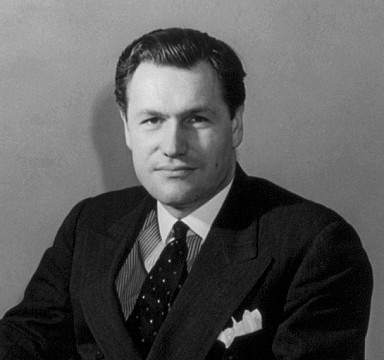
Born in Bar Harbor, Maine, he grew up predominantly between Manhattan and on the Kykuit estate as a grandson of the world's first billionaire, John D. Rockefeller, President of Standard Oil. After graduating from Dartmouth College (economics, 1930), "Rocky" worked for various banks and oil companies attached to the family empire, including the Creole Petroleum Corporation (a subsidiary of Standard Oil) in Venezuela when he learned to speak fluent Spanish. During World War II, he served in various government roles, including Coordinator of Inter-American Affairs, where he developed programs to counter Nazi influence in Latin America. His early career established him as an expert in Latin American relations and international development.
His political career began when he was elected Governor of New York in 1958. He championed liberal Republican policies, dramatically expanding state government programs in education, healthcare, housing, and environmental protection. He created the State University of New York system, launched major infrastructure projects including the Albany Mall (now officially known as the Governor Nelson A. Rockefeller Empire State Plaza) and supported civil rights legislation. His tenure was marked by significant increases in state spending and debt, reflecting his belief in activist government.
Despite his gubernatorial success, Rockefeller's presidential ambitions were repeatedly frustrated. He sought the Republican nomination in 1960, 1964, and 1968 but was unsuccessful each time, largely due to conservative opposition within the party. His moderate-to-liberal positions on social issues and support for big government spending put him at odds with the party's increasingly conservative base. Nonetheless, in 1974 President Gerald Ford nominated Rockefeller as Vice President following Richard Nixon's resignation. His confirmation process was lengthy due to concerns about his vast wealth (according to The New York Times in 1974 he valued his assets at $62-million plus the income from two trusts worth $120-million) and potential conflicts of interest. As Vice President, he had limited influence and chose not to seek the position again in 1976.
Rockefeller's legacy includes his contributions to New York's development, his patronage of the arts, and his representation of the liberal wing of the Republican Party during a period of significant political realignment. He was married twice and had seven children.
Parents (2)


Spouses (2)


Children (7)

Rodman Clark Rockefeller
of New York City; Chief Executive of the International Basic Economy Corporation
1932-2000

Michael Clark Rockefeller
Disappeared on an Anthropological Expedition with Harvard in Dutch New Guinea
1938-1961


