
Katherine (Duer) Mackay (1880-1930)
Mrs. "Kitty" Alexander (Duer) Mackay, Blake
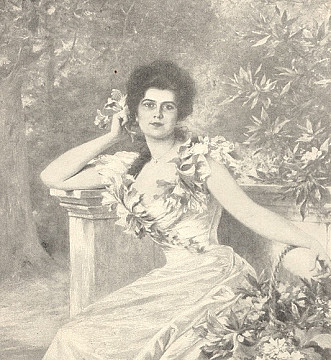
She was named for her great-great grandmother, Kitty Duer, wife of the disgraced William Duer, and she was a granddaughter of the famous wit, William Riggin Travers. Like her grandfather, she was well-known in society, and had a wicked sense of humor. In Paris, she won the heart of a Marquis but declined his invitation of marriage. Later, she was invited to England to stay at Blenheim Palace with her friend Consuelo Vanderbilt, then the Duchess of Marlborough, at whose wedding Kitty was described as one of the prettiest bridesmaids. While crossing the Atlantic, she met and fell in love with Clarence Mackay, heir to a $45-million estate. But, on arriving in London it was reported that Clive Wilson "of the famous baccarat Tranby Croft Wilson family" (brother of the better-known Muriel Wilson) had become an ardent suitor. However, she turned Wilson down, "because her heart was already in the keeping of Mr. Clarence Mackay," who coincidentally was half a head shorter than his prospective bride.
She and Mackay were married on March 14 1898 at her parents' home in New York, a special dispensation having been made on account of her husband's Catholic faith. Her bridesmaids were predicted to be "four of the loveliest belles of society," the Misses Evelyn Burden, May Goelet, Virginia Fair & Mabel Gerry, but on the day itself only Evelyn Burden was among those named, the others being the Misses Inez Telfener (her first cousin), Daisy Leiter & Lila Vanderbilt Sloane. As a wedding present, her parents bought the young couple Collis P. Huntington's New York townhouse (see images) for a reported $2-million, but between 1905 to 1910 they leased the late Theodore Havemeyer's mansion (see images) as their autumn and winter home. At their country home, Harbor Hill, Kitty is remembered for her role in public life, where she administered the public schools in Roslyn (she was the first woman elected to the Roslyn School Board serving from 1905 to 1910) and was active in charities that supported local hospitals. The Mackays were well-regarded in the community: they created jobs and looked after the children of their staff through providing education, paying doctors bills, and treating them to annual parties.
Described by Town Topics as, "the perfect specimen of willful, wistful beauty," by 1909 she was acknowledged as, "the leader of New York society, granted to be Mrs. Astor's successor, and a young woman of wonderful charm, whose countenance is radiant with animation, good nature and graciousness." In New York City, she co-founded the Girls' Branch of the Public School Athletic League, and she famously sent her daughters to public school, explaining: “If we wish to establish confidence in the public school system, it is necessary for the rich as well as the poor to patronize them. If we draw such caste distinctions as in the past, it is inconsistent to preach the benefits to be derived from government aid in education.” From 1908 she became actively involved in the women's suffragist movement. She founded and was the first President of the Equal Franchise Society (1908), hosted meetings, arranged a series of public lectures on women's rights, gave substantial financial donations, and perhaps most critically of all, she was responsible for introducing Alva Vanderbilt Belmont to the cause. It was said, "Mrs. Mackay and her friends have put the cachet of style upon a woman thinking for herself."
By 1911, rumors began to circulate that she was having an affair with her husband's physician, Dr. Joseph A. Blake. She and Mackay were divorced in February 1914, and in November she and Blake were married in Paris. Blake's first wife, Catharine Ketchum, failed in her attempt to sue Kitty for $1-million on charges of alienation of affection. When the claim was knocked out of court (it having been easily proved that the Blake's marriage had fallen apart sometime before Kitty arrived on the scene), the former Mrs. Blake delivered a caustic public message: "I wish her (Kitty) all the unhappiness that is her due." Kitty was dismissive of the comment: "She’s simply a victim of her own overpowering jealousy." Renouncing her American citizenship, Kitty's second marriage did however cost her custody of her three young children. In Paris, she continued her role as a leading figure in the women's suffrage movement, and threw herself into the war effort.
She and Blake returned to New York with four more children in 1919, but they were divorced soon afterwards. In 1930, she attempted to reconcile with her first husband, but she died in the same year in her penthouse apartment with a roof garden at 12 East 87th Street. She left an estate of $817,658 in trust to her three daughters by Blake - her son by Blake and her three children by Mackay having already been well provided for.
She and Mackay were married on March 14 1898 at her parents' home in New York, a special dispensation having been made on account of her husband's Catholic faith. Her bridesmaids were predicted to be "four of the loveliest belles of society," the Misses Evelyn Burden, May Goelet, Virginia Fair & Mabel Gerry, but on the day itself only Evelyn Burden was among those named, the others being the Misses Inez Telfener (her first cousin), Daisy Leiter & Lila Vanderbilt Sloane. As a wedding present, her parents bought the young couple Collis P. Huntington's New York townhouse (see images) for a reported $2-million, but between 1905 to 1910 they leased the late Theodore Havemeyer's mansion (see images) as their autumn and winter home. At their country home, Harbor Hill, Kitty is remembered for her role in public life, where she administered the public schools in Roslyn (she was the first woman elected to the Roslyn School Board serving from 1905 to 1910) and was active in charities that supported local hospitals. The Mackays were well-regarded in the community: they created jobs and looked after the children of their staff through providing education, paying doctors bills, and treating them to annual parties.
Described by Town Topics as, "the perfect specimen of willful, wistful beauty," by 1909 she was acknowledged as, "the leader of New York society, granted to be Mrs. Astor's successor, and a young woman of wonderful charm, whose countenance is radiant with animation, good nature and graciousness." In New York City, she co-founded the Girls' Branch of the Public School Athletic League, and she famously sent her daughters to public school, explaining: “If we wish to establish confidence in the public school system, it is necessary for the rich as well as the poor to patronize them. If we draw such caste distinctions as in the past, it is inconsistent to preach the benefits to be derived from government aid in education.” From 1908 she became actively involved in the women's suffragist movement. She founded and was the first President of the Equal Franchise Society (1908), hosted meetings, arranged a series of public lectures on women's rights, gave substantial financial donations, and perhaps most critically of all, she was responsible for introducing Alva Vanderbilt Belmont to the cause. It was said, "Mrs. Mackay and her friends have put the cachet of style upon a woman thinking for herself."
By 1911, rumors began to circulate that she was having an affair with her husband's physician, Dr. Joseph A. Blake. She and Mackay were divorced in February 1914, and in November she and Blake were married in Paris. Blake's first wife, Catharine Ketchum, failed in her attempt to sue Kitty for $1-million on charges of alienation of affection. When the claim was knocked out of court (it having been easily proved that the Blake's marriage had fallen apart sometime before Kitty arrived on the scene), the former Mrs. Blake delivered a caustic public message: "I wish her (Kitty) all the unhappiness that is her due." Kitty was dismissive of the comment: "She’s simply a victim of her own overpowering jealousy." Renouncing her American citizenship, Kitty's second marriage did however cost her custody of her three young children. In Paris, she continued her role as a leading figure in the women's suffrage movement, and threw herself into the war effort.
She and Blake returned to New York with four more children in 1919, but they were divorced soon afterwards. In 1930, she attempted to reconcile with her first husband, but she died in the same year in her penthouse apartment with a roof garden at 12 East 87th Street. She left an estate of $817,658 in trust to her three daughters by Blake - her son by Blake and her three children by Mackay having already been well provided for.