
Arthur Astor Carey (1857-1923)
of Boston, Massachusetts & "Creek Farm" Portsmouth, New Hampshire
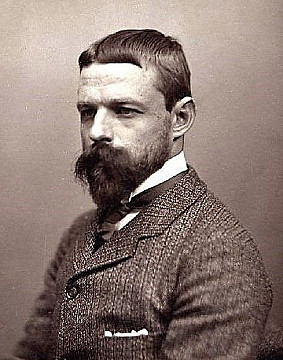
He was born in Rome, Italy, and graduated from Harvard (1879). Both his parents died in 1881, when he inherited $1.5-million. From 1881 to 1883, he studied art in Europe with J. Templeman Coolidge and visited Egypt with another college friend, Henry Chapman Mercer, before returning to Harvard as an Instructor of English. He lived at 28 Fayerweather Street in Cambridge, designed in 1882 by John Sturgis who incorporated architectural features from the demolished Hancock House. In 1887, he purchased 40-acres on Sagamore Creek - next to his friend J. Templeman Coolidge's summer home - and commissioned another former classmate, Alexander Wadsworth Longfellow (nephew of the poet Henry Wadsworth Longfellow) to build "Creek Farm" (see images) in the Colonial-Revival style as his summer home. His wife designed the beautifully handcrafted music room and the Italian formal garden with its Venetian stone lions. In 1905, they played host to President Theodore Roosevelt and delegates from Russia and Japan during the peace negotiations now known as the Treaty of Portsmouth.
He was an early founder of the Museum of Fine Arts in Boston, a devotee of the Arts & Crafts movement (founding Boston's Society of Arts & Crafts), and he served as President of Dedham Pottery, Massachusetts, in 1896. In 1912, he founded the first ever Sea Scouts troop in America and he is considered the first national Sea Scout Director. He was a frequent and generous donor to libraries, schools, and a home for disadvantaged children. Described as, "the originator of a unique philanthropy," he started a free reading room at Waltham (Massachusetts), a summer camp for boys and girls, and arranged for instruction in all branches of education for the youth or adults of Waltham. He also supplied a swimming pool and gymnasium. Each class formed was in one way at least self-supporting, by hiring its own instructors. Classes included those for millinery, arithmetic, and English: a drama club, an automobile class, and an aeroplane club.
Later in life, he began to suffer from an unidentified nervous disorder. His solution became meditation and prayer - a method that centered on following the life and teachings of Jesus. Through this practice, he began to discover his “spiritual manhood” which, to him, meant “pursuing self-knowledge, humility, gentleness, compassion, and... compromise.” His first book, titled New Nerves For Old (1914) sought to teach the reader to overcome depression by retraining neural pathways. His two other published works, The Scout Law in Practice (1915) and Boy Scouts at Sea (1921) focused on another one of his passions - the Boy Scouts of America. On October 15, 1889, he married Agnes Laura Mary Whiteside. She was Catholic with an Anglo-Irish father and an Italian mother. She'd been a governess to Empress Eugenie (wife of Napoleon III) before finding work as an escort to Arthur's nephews and niece when their mother sent them back to New York. His sister, Maggie, was soon to divorce her first husband, although Arthur would appear in court in defense of his brother-in-law - not his sister. He and Agnes went on to have four children (listed). Having maintained an apartment in Boston at 191 Commonwealth Avenue, in 1893 he purchased a turreted, red brick mansion at 29 Fairfield Street (see images) before settling back in Cambridge from 1899 at 10 Fayerweather Street.
He was an early founder of the Museum of Fine Arts in Boston, a devotee of the Arts & Crafts movement (founding Boston's Society of Arts & Crafts), and he served as President of Dedham Pottery, Massachusetts, in 1896. In 1912, he founded the first ever Sea Scouts troop in America and he is considered the first national Sea Scout Director. He was a frequent and generous donor to libraries, schools, and a home for disadvantaged children. Described as, "the originator of a unique philanthropy," he started a free reading room at Waltham (Massachusetts), a summer camp for boys and girls, and arranged for instruction in all branches of education for the youth or adults of Waltham. He also supplied a swimming pool and gymnasium. Each class formed was in one way at least self-supporting, by hiring its own instructors. Classes included those for millinery, arithmetic, and English: a drama club, an automobile class, and an aeroplane club.
Later in life, he began to suffer from an unidentified nervous disorder. His solution became meditation and prayer - a method that centered on following the life and teachings of Jesus. Through this practice, he began to discover his “spiritual manhood” which, to him, meant “pursuing self-knowledge, humility, gentleness, compassion, and... compromise.” His first book, titled New Nerves For Old (1914) sought to teach the reader to overcome depression by retraining neural pathways. His two other published works, The Scout Law in Practice (1915) and Boy Scouts at Sea (1921) focused on another one of his passions - the Boy Scouts of America. On October 15, 1889, he married Agnes Laura Mary Whiteside. She was Catholic with an Anglo-Irish father and an Italian mother. She'd been a governess to Empress Eugenie (wife of Napoleon III) before finding work as an escort to Arthur's nephews and niece when their mother sent them back to New York. His sister, Maggie, was soon to divorce her first husband, although Arthur would appear in court in defense of his brother-in-law - not his sister. He and Agnes went on to have four children (listed). Having maintained an apartment in Boston at 191 Commonwealth Avenue, in 1893 he purchased a turreted, red brick mansion at 29 Fairfield Street (see images) before settling back in Cambridge from 1899 at 10 Fayerweather Street.
Parents (2)





Categories
Share
https://goodworkseacoast.org/carey-cottage/history/; Discovering the Family of Miles Malleson 1888 to 1969, Andrew Malleson · 2012; https://backbayhouses.org/29-fairfield/