
Henry Chapman Mercer (1856-1930)
of "Fonthill" Doylestown, Pennsylvania; Archeologist, Collector & Ceramicist
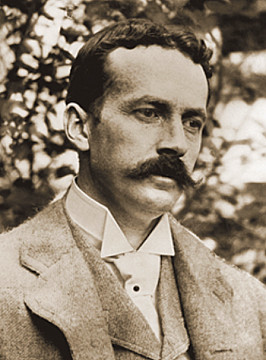
He was born and educated at Doylestown, where his family were well-established. Entering Harvard, he developed an interest in art history, taking classes with Charles Eliot Norton. He graduated in 1879 and continued his studies at the University of Pennsylvania Law School (1881). He read law in his uncle, Peter McCall's firm but as soon as he was certified to practice, he left to travel in Europe and the Far East with his old Harvard classmate, Arthur Astor Carey, who was instrumental in getting him involved in the Arts & Craft movement. They sailed down the Danube and the Nile and traveled extensively across England, France, Germany, Italy, Turkey and Egypt, during which time he established two lifelong passions: collecting and anthropology. On his return, he focused his attentions on building a collection of Colonial kitchen utensils, amassing nearly 30,000-pieces. Having already co-founded the Bucks County Historical Society, the University of Pennsylvania Museum appointed him Curator of American and Prehistoric Archeology, and he was elected to the American Philosophical Society in 1895.
Mercer believed that American society was being destroyed by industrialism, which inspired his search for American artefacts. His interest in redware pottery and the Arts & Craft movement led him to apprentice himself to a Pennsylvania German potter before founding the Moravian Pottery & Tile Works in 1898 (still working today). He was well known for his research and writings on ancient tool making, archaeology, ceramic tile creations, as well as engineering and architecture. He also painted, drew, and wrote poetry (November Night Tales - 1928), showcasing his fascination for rural life. But, he made a name for himself as a designer of mosaics. In the Pennsylvania State Capitol, Mercer created a series of mosaic images for the floor of the building. The series of 400-mosaics across 16,000 square feet of tile trace the history of the Commonwealth of Pennsylvania from prehistoric times, and is the largest single collection of Mercer's tiles. Others of his tiles can be found at the Rockefeller estate, Kykuit; in the Gothic Room at the Isabella Stewart Gardner Museum in Boston, Massachusetts; Grauman's Chinese Theatre in Hollywood, California; the Casino at Monte Carlo in Monaco; the St. Louis Public Library; and the former Morton (Richmond) High School Building in Richmond, Indiana.
He used his inheritance from an aunt (Mrs. Elizabeth Chapman Lawrence, the second more staid wife of the U.S. Consul-General to Italy) to purchase land in Doylestown and in 1908, using poured concrete, he began building "Fonthill Castle," his fantastical home with 44-rooms, 10-bathrooms, 5-bedrooms, and 18-fireplaces, featuring a mix of architectural styles such as Medieval, Gothic, and Byzantine. Fonthill was more than just his home, he used it to showcase his own tiles and those he collected from across the globe. The Bucks County Historical Society now owns "Fonthill" (which is open to the public) and the Mercer Museum that houses over 40,000 artefacts from early American society, while the Moravian Pottery & Tile Works is operated as a working history museum. These three buildings - all built by Mercer - make up "the Mercer Mile." Henry Ford once stated that the Mercer Museum was the only museum worth visiting in the United States.
Mercer believed that American society was being destroyed by industrialism, which inspired his search for American artefacts. His interest in redware pottery and the Arts & Craft movement led him to apprentice himself to a Pennsylvania German potter before founding the Moravian Pottery & Tile Works in 1898 (still working today). He was well known for his research and writings on ancient tool making, archaeology, ceramic tile creations, as well as engineering and architecture. He also painted, drew, and wrote poetry (November Night Tales - 1928), showcasing his fascination for rural life. But, he made a name for himself as a designer of mosaics. In the Pennsylvania State Capitol, Mercer created a series of mosaic images for the floor of the building. The series of 400-mosaics across 16,000 square feet of tile trace the history of the Commonwealth of Pennsylvania from prehistoric times, and is the largest single collection of Mercer's tiles. Others of his tiles can be found at the Rockefeller estate, Kykuit; in the Gothic Room at the Isabella Stewart Gardner Museum in Boston, Massachusetts; Grauman's Chinese Theatre in Hollywood, California; the Casino at Monte Carlo in Monaco; the St. Louis Public Library; and the former Morton (Richmond) High School Building in Richmond, Indiana.
He used his inheritance from an aunt (Mrs. Elizabeth Chapman Lawrence, the second more staid wife of the U.S. Consul-General to Italy) to purchase land in Doylestown and in 1908, using poured concrete, he began building "Fonthill Castle," his fantastical home with 44-rooms, 10-bathrooms, 5-bedrooms, and 18-fireplaces, featuring a mix of architectural styles such as Medieval, Gothic, and Byzantine. Fonthill was more than just his home, he used it to showcase his own tiles and those he collected from across the globe. The Bucks County Historical Society now owns "Fonthill" (which is open to the public) and the Mercer Museum that houses over 40,000 artefacts from early American society, while the Moravian Pottery & Tile Works is operated as a working history museum. These three buildings - all built by Mercer - make up "the Mercer Mile." Henry Ford once stated that the Mercer Museum was the only museum worth visiting in the United States.


