
William Averell Harriman (1891-1986)
W. Averell Harriman, 48th Governor of New York; Ambassador to the Soviet Union
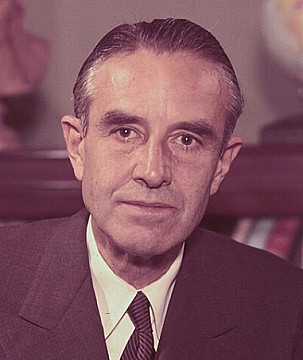
He was the son of railroad baron, E.H. Harriman, and was educated at Groton School and Yale University before going into business and diplomacy. In 1941, President Franklin D. Roosevelt appointed him as a special envoy to Europe and gave him the title "Defense Expediter" to help coordinate the Lend-Lease program - a crucial American aid initiative during World War II that allowed the United States to provide military equipment, supplies, and other resources to Allied nations fighting against the Axis powers, primarily before the U.S. had officially entered the war in December 1941. The program initially focused on Britain, which was running low on cash and after Germany invaded the Soviet Union in June 1941, the program was extended to include Russia. Eventually, over 40 nations received Lend-Lease aid worth some $50 billion. Having developed a close relationship with Churchill (which included an affair with his daughter-in-law, Pamela, to whom he was married decades later) and with Stalin, he was appointed U.S. Ambassador to the Soviet Union from 1943 to 1946.
He became one of America's leading experts on Soviet affairs and was instrumental in shaping early Cold War policy. He went on to hold several high-level positions throughout his career, including Secretary of Commerce under President Truman, and Governor of New York (1955-1958), as well as various ambassadorial roles in the Kennedy and Johnson administrations. He was particularly involved in arms control negotiations and served as ambassador-at-large during the Johnson years. Beyond diplomacy, he was a successful businessman with a particular interests in railroads. He authored several books about his diplomatic experiences, including works on U.S.-Russia relations and died in 1986 at age 94 in Yorktown Heights, New York, leaving behind a legacy as one of America's most influential diplomats during World War II and the Cold War, bridging the worlds of business and politics. He married three times and had two daughters by his first wife.
He became one of America's leading experts on Soviet affairs and was instrumental in shaping early Cold War policy. He went on to hold several high-level positions throughout his career, including Secretary of Commerce under President Truman, and Governor of New York (1955-1958), as well as various ambassadorial roles in the Kennedy and Johnson administrations. He was particularly involved in arms control negotiations and served as ambassador-at-large during the Johnson years. Beyond diplomacy, he was a successful businessman with a particular interests in railroads. He authored several books about his diplomatic experiences, including works on U.S.-Russia relations and died in 1986 at age 94 in Yorktown Heights, New York, leaving behind a legacy as one of America's most influential diplomats during World War II and the Cold War, bridging the worlds of business and politics. He married three times and had two daughters by his first wife.