
Lyndon B. Johnson (1908-1973)
36th President of the United States (1963-1969)
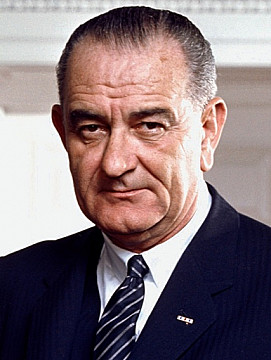
He was preceded in the Presidency by John F. Kennedy and as his Vice-President stepped in after Kennedy was assassinated in 1963. He was re-elected again for the Democrats in the 1964 election with Hubert Humphrey as his Vice-President. He was succeeded in 1969 by Richard Nixon. Lyndon Baines Johnson ("LBJ") was born impoverished in Stonewall, Texas. He possessed an extremely persuasive character which was first put to political use when he started his career as legislative secretary to Congressman Richard Kleberg in 1931. His natural political acumen saw him elected to the U.S. House of Representatives (1937-49) and then the U.S. Senate (1949-61). A master of legislative politics, Johnson served as Senate Majority Leader. His political skills were legendary - his ability to cajole, threaten, and persuade legislators earned him the nickname "Master of the Senate." Standing at 6'4", he was known for using his physical presence and his intimate knowledge of senators' personal lives to secure votes.
Johnson's presidency was defined by ambitious domestic reforms and the escalating Vietnam War. His "Great Society" program represented one of the most extensive domestic reform agendas since Roosevelt enacted his "New Deal". Key achievements included the Civil Rights Act of 1964, which outlawed discrimination based on race, color, religion, sex, or national origin, and the Voting Rights Act of 1965, which eliminated barriers preventing African-Americans from voting. Johnson also launched the "War on Poverty," creating programs like Medicare, Medicaid, Head Start, and food stamps that fundamentally expanded the federal government's role in addressing social issues.
Johnson's presidency was defined by ambitious domestic reforms and the escalating Vietnam War. His "Great Society" program represented one of the most extensive domestic reform agendas since Roosevelt enacted his "New Deal". Key achievements included the Civil Rights Act of 1964, which outlawed discrimination based on race, color, religion, sex, or national origin, and the Voting Rights Act of 1965, which eliminated barriers preventing African-Americans from voting. Johnson also launched the "War on Poverty," creating programs like Medicare, Medicaid, Head Start, and food stamps that fundamentally expanded the federal government's role in addressing social issues.
Despite these domestic successes, Johnson's presidency became increasingly consumed by the Vietnam War, and his inaction in 1967 when the Israelis attacked the USS Liberty killing 34 U.S. sailors and injuring 171 others. The ship's chief engineer, Richard Brooks, was emphatic: “it wasn’t a tragic accident. It was a deliberate attack.” In Vietnam, LBJ dramatically escalated American involvement, sending over 500,000 troops to southeast Asia. 58,000 were killed and 153,000 were severely wounded. The war's growing unpopularity, mounting casualties, and widespread protests ultimately undermined his presidency. The Tet Offensive in 1968 particularly damaged public confidence in his Vietnam strategy. Facing declining approval ratings and strong primary challenges, in March 1969 he announced that he would not be seeking re-election. He retired to his ranch in Texas (see images), where he died in 1973. Johnson's legacy remains complex: celebrated for advancing civil rights and social programs, yet haunted by the Vietnam War's tragic consequences. In 1934, he married Claudia "Lady Bird" Taylor who played a siginificant role as her husband's political partner. They were the parents of two daughters.