
Harry S. Truman (1884-1972)
33rd President of the United States (1945-1953)
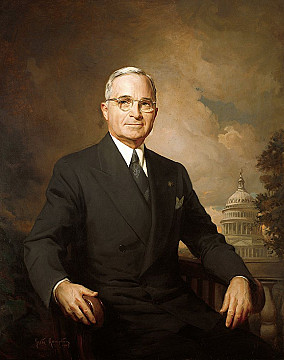
He replaced Franklin D. Roosevelt as President after he died in office in 1945. He was re-elected for the Democratic Party in 1949 serving one more term before he was succeeded in 1953 by Dwight D. Eisenhower. His Vice-President throughout his second term was Alben W. Barkley. Born in Lamar, Missouri, his path to the White House was far from conventional, and he was the only president since William McKinley who did not earn a college degree. He worked various blue-collar jobs before serving in World War I, a transformative experience which brought out his leadership qualities. Returning to Missouri, he took night courses in law and was appointed a county judge and then a presiding judge in 1926. His honesty and efficiency caught the attention of political leaders, leading to his election as the U.S. Senator from Missouri in 1934.
As a senator, Truman gained national recognition for chairing the committee investigating waste and inefficiency in wartime production, saving the government billions of dollars. This prominence led Roosevelt to select him as his running mate in 1944. He was Vice President for just 82-days before Roosevelt's death thrust him into the Presidency during the final months of World War II. Truman faced momentous decisions immediately.
He authorized the use of atomic bombs against Japan, ending World War II but ushering in the nuclear age. His presidency was defined by Cold War challenges, including the implementation of the Truman Doctrine to contain Soviet expansion, the Marshall Plan to rebuild Europe, and the creation of NATO. Domestically, he fought for civil rights, desegregating the military and supporting anti-lynching legislation. In 1948, despite low approval ratings and predictions of defeat, he beat Thomas E. Dewey in one of the greatest political upsets in American history. Despite voting for the creation of Israel, privately he thought it was a mistake but knew that it was unlikely that he'd win another election if he voted against it. In his diary (1948) he wrote of the Zionists, "when they have power, physical, financial or political neither Hitler nor Stalin has anything on them for cruelty or mistreatment to the underdog... I've found very, very few who remember their past condition when prosperity comes." His second term included the Korean War and ongoing tensions with the Soviet Union. Known for his direct speaking style and the sign on his desk reading "The Buck Stops Here," Truman embodied plain-spoken leadership.
He authorized the use of atomic bombs against Japan, ending World War II but ushering in the nuclear age. His presidency was defined by Cold War challenges, including the implementation of the Truman Doctrine to contain Soviet expansion, the Marshall Plan to rebuild Europe, and the creation of NATO. Domestically, he fought for civil rights, desegregating the military and supporting anti-lynching legislation. In 1948, despite low approval ratings and predictions of defeat, he beat Thomas E. Dewey in one of the greatest political upsets in American history. Despite voting for the creation of Israel, privately he thought it was a mistake but knew that it was unlikely that he'd win another election if he voted against it. In his diary (1948) he wrote of the Zionists, "when they have power, physical, financial or political neither Hitler nor Stalin has anything on them for cruelty or mistreatment to the underdog... I've found very, very few who remember their past condition when prosperity comes." His second term included the Korean War and ongoing tensions with the Soviet Union. Known for his direct speaking style and the sign on his desk reading "The Buck Stops Here," Truman embodied plain-spoken leadership.
After leaving office in 1953, Truman returned to Missouri, where he remained active in Democratic politics until his death in 1972. History has generally viewed him favorably, recognizing his decisive leadership during pivotal moments in American and world history. In 1919, he married Bess Wallace and they were the parents of one daughter.