
William Andrews Clark Jr. (1877-1934)
Founder of the Clark Library at U.C.L.A. & the Los Angeles Philharmonic Orchestra
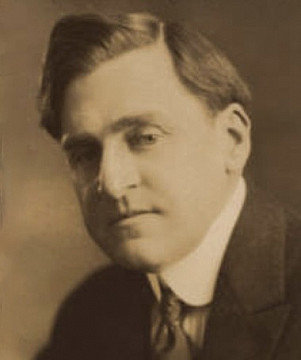
He was born at the Copper King Mansion in Butte, Montana, but went to Europe with his family at an early age so that his first language was actually French, and he remained a lifelong Francophile. Returning to America, he was educated in New York and California before graduating with a law degree from University of Virginia. After a brief stint as a lawyer, he joined his father's copper business in 1901. His elder brother, Charlie, was a bibliophile and encouraged his interest in book collecting, which also served as a comfort to him after the death of both his wives and his only son. His spectacular 16,000 volume collection eventually outgrew his comparatively modest home (see images) at 2205 Adams Boulevard, L.A., and a fire then prompted him to build the Clark Library at U.C.L.A. in 1924 - described as a “jeweled oasis in a city of stucco”.
In contrast to his neighbor, Henry E. Huntington, Clark was a studious, educated, and careful collector who focused on quality over quantity. He also took a delight in music, becoming an accomplished violinist himself, and in 1919 he organized and underwrote the Los Angeles Philharmonic Orchestra with whom he occasionally played - and perhaps not coincidentally, his sister Huguette owned six Stradivarius violins. By 1930, he had become tired of life in the U.S., and returned to the country of his childhood, France. By 1933, the Great Depression had taken its toll on his fortune, and he wrote from Paris, “things have come to such a point that I have to drastically cut down my expenses or face bankruptcy... I have bought no books for the Library and have spent very little on myself, but for two years and a half I have received no income of any kind.” He died the following year.
Lawrence Clark Powell - head librarian of the Clark Library from 1944 to 1961 - wrote, “William Andrews Clark, Jr., was not an impecunious book-collector; nor was he a Croesus. The fingers of two hands would more than number his millions, and, at his death... he left a library of 16,000 volumes. By willing his private collection, complete with building and grounds, to a public institution... Clark joined a select company of American book-collectors whose bequests are among the glories of our national library strength.”
In contrast to his neighbor, Henry E. Huntington, Clark was a studious, educated, and careful collector who focused on quality over quantity. He also took a delight in music, becoming an accomplished violinist himself, and in 1919 he organized and underwrote the Los Angeles Philharmonic Orchestra with whom he occasionally played - and perhaps not coincidentally, his sister Huguette owned six Stradivarius violins. By 1930, he had become tired of life in the U.S., and returned to the country of his childhood, France. By 1933, the Great Depression had taken its toll on his fortune, and he wrote from Paris, “things have come to such a point that I have to drastically cut down my expenses or face bankruptcy... I have bought no books for the Library and have spent very little on myself, but for two years and a half I have received no income of any kind.” He died the following year.
Lawrence Clark Powell - head librarian of the Clark Library from 1944 to 1961 - wrote, “William Andrews Clark, Jr., was not an impecunious book-collector; nor was he a Croesus. The fingers of two hands would more than number his millions, and, at his death... he left a library of 16,000 volumes. By willing his private collection, complete with building and grounds, to a public institution... Clark joined a select company of American book-collectors whose bequests are among the glories of our national library strength.”
Parents (2)


Spouses (2)



Categories
Share
https://ccdl.claremont.edu/digital/collection/p15831coll2/id/51
http://www.bookcollectinghistory.com/2013/08/montana-copper-transformed-into.html
https://adamsboulevardlosangeles.blogspot.com/2013/11/2205-west-adams-boulevard-please-also.html
http://www.bookcollectinghistory.com/2013/08/montana-copper-transformed-into.html
https://adamsboulevardlosangeles.blogspot.com/2013/11/2205-west-adams-boulevard-please-also.html