
William Andrews Clark (1839-1925)
"Copper King" & U.S. Senator from Montana
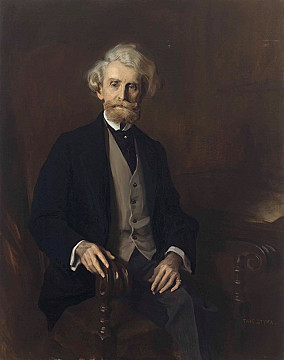
He was born in Pennsylvania and moved west during the Gold Rush era (1849-50), eventually settling in Montana Territory. He made his fortune through copper mining and evolved into banking and railroads (linking up Las Vegas), becoming a central figure in Montana's economic development. He was a key player in the infamous "War of the Copper Kings," a bitter rivalry with fellow mining magnate Marcus Daly that dominated Montana politics in the 1890s. His political ambitions led him to seek a seat in the U.S. Senate, which he finally won in 1901 after a previous attempt was marred by bribery scandals that forced his resignation. Mark Twain famously wrote of Clark: "He is as rotten a human being as can be found anywhere under the flag; he is a shame to the American nation, and no one has helped to send him to the Senate who did not know that his proper place was the penitentiary, with a ball and chain on his legs. To my mind he is the most disgusting creature that the republic has produced since Tweed's time."
Beyond business and politics, he was an art collector, amassing an impressive collection of European paintings and antiquities. He built a 121-room mansion (see images) at 962 Fifth Avenue, New York, where he died leaving $300-million and a complex legacy as both a robber baron and a patron of the arts. He was married twice and had eight children (listed). His youngest daughter, the eccentric recluse, Huguette, is the subject of Bill Dedham and Paul Clark Newell Jr.'s 's highly acclaimed book, Empty Mansions (2013).
Parents (2)
Spouses (2)


Children (8)

Mary Joaquina (Clark) de Brabant
Mrs. "May" Mary Joaquina (Clark) Culver, Kling, de Brabant
1870-1939

Charles Walker Clark
of "House-on-Hill" Hillsborough, California; Chairman of the United Verde Copper Co.
1871-1933


Associated Histories (2)


Categories
Share
Image Courtesy of the Frick Art Reference Library; Museum of the City of New York; the Smithsonian