
Thomas William Channing Moore (1794-1872)
Merchant, Art Collector, Antiquarian & Member of the New-York Historical Society
He was a merchant and banker who lived predominantly in New York City, but spent time in South America and Europe too. In 1824, he wrote to his father from Buenos Aires, sharing his views on the "Holy Alliance" between the right-wing rulers of Russia, Austria and Prussia who expressed their intention to preserve social order through strict Christian principles with an eye to expanding in/colonizing the Northern Pacific. Fear of this alliance led Britain’s then Foreign Secretary, George Canning, to encourage the independence of Latin American republics, and to open up free trade with them - which Moore supported wholeheartedly. It was the same fear of the Holy Alliance that saw the Monroe Doctrine come into force in the United States in 1823.
Moore travelled through the art galleries of Europe with Washington Irving and the British artist Sir David Wilkie. By 1828, he was resident in Hampstead, London, where he registered a patent, "having received a communication from a foreigner residing abroad, of an invention of an improved method or combination of machinery for manufacturing Hats or Caps." Often referred to as Thomas W. Channing Moore, he was described as a serious art collector, "a genuine antiquarian," and in 1851 he transcribed the memoirs of his father - "a favorite in society, a writer of pleasant satires on the men and women of the city, gay and convivial." He was one of the chief promoters of the New York Academy of Fine Arts, an enthusiastic supporter of both the New-York Historical Society and the New York Society Library, and an original member (1836) of the Union Club of the City of New York.
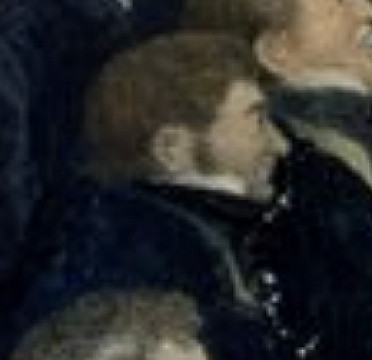
In 1848, Moore organized a key (see images) to identify the 84-people depicted in John Searle's watercolour showing the famous English comic, Charles Mathews, on stage at his celebrated debut in New York at the Park Theatre playing "Monsieur Morbleau" accompanied by Miss Johnston as "Madame Bellgarde," November 7th 1822. Commissioned by William Bayard, the 81-individual caricatures of the audience members represented among them the leading figures in New York at that time. Moore organized to have the painting copied by the engraver/photographer, Elias Dexter, and after Bayard's daughter, Mrs. Harriet Van Rensselear, died in 1875, her heirs presented the original painting and Moore's key to the New-York Historical Society in whose possession they remain today.
In Poughkeepsie, his mother had once neighbored her first cousin, Harry Livingston, and as Moore himself was friends with and related by marriage to Clement Clarke Moore (TWC's uncle, Thomas, married Clement's aunt), he was a key witness in the controversy concerning the authorship of The Night Before Christmas/A Visit from St. Nicholas. In 1862, Moore confirmed: "These lines were composed for his (Clement's) two daughters, as a Christmas present, about 40-years ago. They were copied by a relative of Dr. Moore's in her Album, from which a copy was made by a friend of hers, from Troy, and, much to the surprise of the Author, were published (for the first time) in a Newspaper of that city."
In his history of the Moore family, David Moore Hall wrote of T.W.C. Moore: "Old Cousin Tom," we were wont to call him. What a stream of memories, sweet childish memories, his name evokes! Can we forget him who never forgot his juvenile kindred, but made glad their hearts, not once but always, when his travels brought him to old Virginia. His portrait appears in the picture of the interior of the Park Theatre in the History of New York City, in the library of the Penn. Hist. Society. He spent much time in genealogical research and was a steadfast friend of Fitz-Greene Halleck. Peace to his ashes!" He died unmarried in 1872, bequeathing to the New-York Historical Society canvases by, among others, Snyders, Diego Velázquez, Juan de Valdés, Salvator Rosa, D. Brown, Matthias Withoos, Jean-François de Troy, Anthonie Stevens (Palamedes), Juan Carreño de Miranda, Sir Thomas Lawrence, Dominicus van Tol, Nicholaes Van Gelder, and Henry Inman.
Moore travelled through the art galleries of Europe with Washington Irving and the British artist Sir David Wilkie. By 1828, he was resident in Hampstead, London, where he registered a patent, "having received a communication from a foreigner residing abroad, of an invention of an improved method or combination of machinery for manufacturing Hats or Caps." Often referred to as Thomas W. Channing Moore, he was described as a serious art collector, "a genuine antiquarian," and in 1851 he transcribed the memoirs of his father - "a favorite in society, a writer of pleasant satires on the men and women of the city, gay and convivial." He was one of the chief promoters of the New York Academy of Fine Arts, an enthusiastic supporter of both the New-York Historical Society and the New York Society Library, and an original member (1836) of the Union Club of the City of New York.
In 1848, Moore organized a key (see images) to identify the 84-people depicted in John Searle's watercolour showing the famous English comic, Charles Mathews, on stage at his celebrated debut in New York at the Park Theatre playing "Monsieur Morbleau" accompanied by Miss Johnston as "Madame Bellgarde," November 7th 1822. Commissioned by William Bayard, the 81-individual caricatures of the audience members represented among them the leading figures in New York at that time. Moore organized to have the painting copied by the engraver/photographer, Elias Dexter, and after Bayard's daughter, Mrs. Harriet Van Rensselear, died in 1875, her heirs presented the original painting and Moore's key to the New-York Historical Society in whose possession they remain today.
In Poughkeepsie, his mother had once neighbored her first cousin, Harry Livingston, and as Moore himself was friends with and related by marriage to Clement Clarke Moore (TWC's uncle, Thomas, married Clement's aunt), he was a key witness in the controversy concerning the authorship of The Night Before Christmas/A Visit from St. Nicholas. In 1862, Moore confirmed: "These lines were composed for his (Clement's) two daughters, as a Christmas present, about 40-years ago. They were copied by a relative of Dr. Moore's in her Album, from which a copy was made by a friend of hers, from Troy, and, much to the surprise of the Author, were published (for the first time) in a Newspaper of that city."
In his history of the Moore family, David Moore Hall wrote of T.W.C. Moore: "Old Cousin Tom," we were wont to call him. What a stream of memories, sweet childish memories, his name evokes! Can we forget him who never forgot his juvenile kindred, but made glad their hearts, not once but always, when his travels brought him to old Virginia. His portrait appears in the picture of the interior of the Park Theatre in the History of New York City, in the library of the Penn. Hist. Society. He spent much time in genealogical research and was a steadfast friend of Fitz-Greene Halleck. Peace to his ashes!" He died unmarried in 1872, bequeathing to the New-York Historical Society canvases by, among others, Snyders, Diego Velázquez, Juan de Valdés, Salvator Rosa, D. Brown, Matthias Withoos, Jean-François de Troy, Anthonie Stevens (Palamedes), Juan Carreño de Miranda, Sir Thomas Lawrence, Dominicus van Tol, Nicholaes Van Gelder, and Henry Inman.
Parents (2)



Categories
Share
https://melvilliana.blogspot.com/2018/12/livingston-cousin-t-w-c-moore.html
https://melvilliana.blogspot.com/2018/02/key-witness-letter-by-livingston-cousin.html
https://www.google.fr/books/edition/History_of_the_City_of_New_York_History/ze0TAAAAYAAJ?hl=en&gbpv=1&dq=Thomas+william+Channing+Moore&pg=PA335&printsec=frontcover
https://www.geographicguide.com/united-states/nyc/antique/park-row/park-theatre/auditorium.htm
London Journal of Arts, Sciences and Manufacturers, and Repertory of Patent Inventions (1829).
https://melvilliana.blogspot.com/2018/02/key-witness-letter-by-livingston-cousin.html
https://www.google.fr/books/edition/History_of_the_City_of_New_York_History/ze0TAAAAYAAJ?hl=en&gbpv=1&dq=Thomas+william+Channing+Moore&pg=PA335&printsec=frontcover
https://www.geographicguide.com/united-states/nyc/antique/park-row/park-theatre/auditorium.htm
London Journal of Arts, Sciences and Manufacturers, and Repertory of Patent Inventions (1829).