
Samuel Breck Parkman Trowbridge (1862-1925)
Architect, of Trowbridge & Livingston, New York City
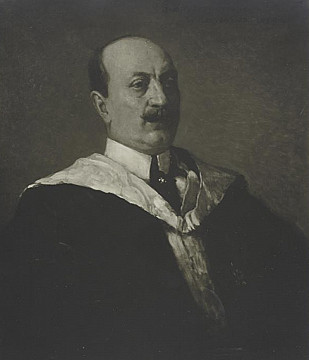
He was born in New York City and after receiving a grammar school education in New Haven, Connecticut, he graduated (1833) from Trinity College, Hartford. Three years later, he received an advanced degree in architecture from Columbia University. He then left for Athens in Greece where he supervised the construction of the American School of Classical Studies, and while there he developed a lifelong interest in archeology. From Athens, he continued his education in Paris at the École des Beaux-Arts. Returning to New York, he began a four-year association with George B. Post, and in 1896 formed a partnership with Goodhue Livingston, as Trowbridge & Livingston, of New York.
Their firm gained a reputation for public, institutional, and commercial buildings, though they also took on occasional private commissions such as for the Ross House in Montreal. Their best known works include: Banker's Trust Company Building at 14 Wall Street; Hayden Planetarium at the American Museum of Natural History; the J.P. Morgan Building at 23 Wall Street; the New York City Penitentiary on Riker's Island; and, the Oregon State Capital. They also worked on other buildings such as Trumbauer's Equitable Trust Building; Chemical National Bank Building; the St. Regis Hotel; The Knickerbocker Hotel; and, the Ardsley Club. He built his home at 123 East 70th Street, and was a member of the Century, Metropolitan, Racquet & Tennis, Union, St. Anthony, and Ardsley clubs.
President Roosevelt appointed him Chairman of the National Council of Fine Arts and he was a Member of the National Institute of Arts & Letters, the National Academy of Design, and the Architectural League of New York. He was also a trustee and Vice-President of the American Academy in Rome, an institution that he strongly supported. After his death, the Academy recalled his personal qualities: "He was a born clubman, had a distinguished personal presence and was always immaculately attired, which did not prevent him from roughing it in his hunting or fishing trips, or in rendering kindly manual service."
Their firm gained a reputation for public, institutional, and commercial buildings, though they also took on occasional private commissions such as for the Ross House in Montreal. Their best known works include: Banker's Trust Company Building at 14 Wall Street; Hayden Planetarium at the American Museum of Natural History; the J.P. Morgan Building at 23 Wall Street; the New York City Penitentiary on Riker's Island; and, the Oregon State Capital. They also worked on other buildings such as Trumbauer's Equitable Trust Building; Chemical National Bank Building; the St. Regis Hotel; The Knickerbocker Hotel; and, the Ardsley Club. He built his home at 123 East 70th Street, and was a member of the Century, Metropolitan, Racquet & Tennis, Union, St. Anthony, and Ardsley clubs.
President Roosevelt appointed him Chairman of the National Council of Fine Arts and he was a Member of the National Institute of Arts & Letters, the National Academy of Design, and the Architectural League of New York. He was also a trustee and Vice-President of the American Academy in Rome, an institution that he strongly supported. After his death, the Academy recalled his personal qualities: "He was a born clubman, had a distinguished personal presence and was always immaculately attired, which did not prevent him from roughing it in his hunting or fishing trips, or in rendering kindly manual service."