
Richard Worsam Meade (1778-1828)
of Philadelphia & Cadiz, Spain; Shipping Merchant, U.S. Naval Agent & Art Collector
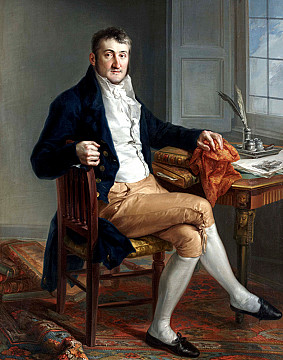
He was born in Chester County, Pennsylvania, during the British occupation of Philadelphia. He entered his father's business importing rum, sugar and slaves from Barbados to Philadelphia. As supercargo on board his father's ships he traveled to the West Indies, and in 1795 to Europe, returning the next year after touring England and France. Entering into business on his account at Hispaniola in the Caribbean, after three years he returned to Philadelphia a wealthy man, purchasing a house on High Street (see images). In 1803, he traveled to Spain to collect claims other merchants had against the Spanish government, which Meade estimated to be close to $1 million. He was unsuccessful, but he decided to move his business to the Port of Cádiz - at the center of the Trans-Atlantic trade - where his family relocated in 1804.
He lived at No. 4 de la Plaza de España (see images) in Cádiz from 1803 to 1820, and was appointed the U.S. Naval Agent. He used his wealth to assemble a valuable art collection, becoming one of the first serious American collectors of Old Masters. Sometimes accepting paintings or sculptures to satisfy debts, he acquired works by Titian, Correggio, Veronese, Rubens, Van Dyck, Velázquez, Domenichino, and Murillo. In addition, from the widow of the Spanish Ambassador to the United States, he also acquired a bust (see images) of George Washington carved in 1795 by the Italian sculptor Giuseppe Ceracchi. Mrs. Meade - who later instructed that her husband's art collection was to be sold - held on to Washington's bust until her death, when Gouverneur Kemble purchased it from her estate. It is now on display in the Metropolitan Museum in New York and is thought to be the only sculptural bust for which the notoriously impatient first president ever sat.
When Meade eventually lost favor with the Spanish he was imprisoned by his political enemies after the government became indebted to him during the Peninsular War. In the meantime, he'd shipped much of his art collection to the Pennsylvania Academy of the Fine Arts where it was installed in the southwest gallery, which came to be called the Meade Gallery. His collection was thought to have been the most important group of Italian, Spanish & Flemish pictures yet to have arrived on American soil, and in 1831 The New-York Mirror wrote: "He secured and transmitted to his native country a treasure of art, such as had never been before possessed by an American citizen. A collection of genuine, authentic specimens, from which we may form a judgment, and by which we may model a taste, founded on a comparison of the works of some of the most celebrated masters." When he was released from prison, to thank the U.S. government who led the negotiations on his behalf, he gifted the U.S. Legation in Madrid a copy of the Lansdowne portrait of George Washington - now seen in the U.S. Capitol's Statuary Hall.
On returning to Philadelphia he gave away much of his art collection (that was eventually entirely dispersed when it was sold at auction in 1853) and became a trustee of St. Mary's Roman Catholic Church. He was unsuccessful in his attempt to gain compensation from the U.S. government for the $370,000 in debts owed to him in Spain. The Meade claim became known for its longevity as his descendants continued to pursue it long after his death - it was still unpaid in 1927 when his descendants prepared to renew their efforts.
In 1801, he married Margaret, daughter of Anthony Butler, Shipowner, of Perth Amboy & Philadelphia, becoming the brother-in-law of U.S. Congressman James Parker, Collector of the Port of New Jersey. They were the parents of ten children including Gen. George Meade, the Commander of the Army of the Potomac whose decisive victory at the Battle of Gettysburg (1863) over Gen. Robert E. Lee marked the turning point in the Civil War.