
Gouverneur Kemble (1786-1875)
U.S. Congressman from New York & Co-Founder of the West Point Foundry
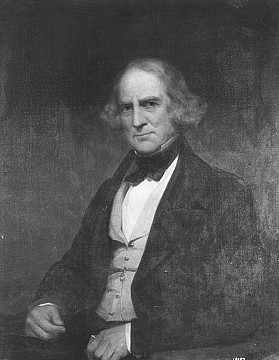
He was born and educated in New York City, graduating from Columbia (1803). He began his career in his father's shipping firm and was sent to the Mediterranean as a naval agent during the Second Barbary War (1815). In 1816, he was appointed U.S. Consul at Cádiz in Spain, when his attention was attracted to the Spanish government's state-of-the-art process of casting cannon. Returning to New York in 1817, with government backing he and his erudite brother, William, established the West Point Foundry at Cold Spring, manufacturing artillery for the U.S. Army. They eventually sold the foundry to their brother-in-law, Robert P. Parrott, inventor of the Parrott Gun. As a Democrat, Kemble served two terms as a U.S. Congressman from New York (1837-1841). He was an active supporter of the Hudson River Railroad, the Panama Railway, and one of the last surviving members of the Tontine Association.
He and his brother, William, were both collectors and patrons of the arts. They were among the 100-invitees (of whom only 42 are known) asked to found the Century Association in New York in 1847, and in 1854 he was elected into the National Academy of Design as an Honorary Academician. The Century's archives state: "As a member... Mr. Kemble deserves our gratitude as not the least active among the thirty who, with Mr. Verplanck and Mr. Bryant, gave it a foundation, and name and character. During its earlier years, he was a frequent visitor at its then humble dwelling, and partook of the enjoyment of its social hours." Among the fine pictures in his own collection was that of a Sappho by a Spanish master originally given to his sister-in-law, Mrs. Margaret Kemble, by the collector Richard Worsam Meade. Gouverneur later paid $5,000 for the painting and placed it in his gallery at "Marshmoor" that had since become his permanent home at Cold Spring. But most notably of all, was his purchase of Ceracchi's bust of George Washington from the estate of Meade's widow - thought to be the only sculptural bust for which the notoriously impatient first president ever sat, and now at The Met Museum in New York.
His dining room table sat thirty guests and Marian Gouverneur recalled that, "for many years (his home) was the scene of lavish hospitality. Gen. W. Scott once remarked that (Kemble) was 'the most perfect gentleman in the United States'. The most distinguished men of the day gathered around his table, and every Saturday night through the entire year a special dinner was served at five o'clock - Mr. Kemble despised the habitual three o'clock dinners of his neighbors - which in time became historic entertainments. This meal was always served in the picture gallery, an octagonal room filled with valuable paintings, while breakfast and luncheon were served in an adjoining room... General Scott (said) he would be willing to walk at least ten miles to be present at a dinner at Gouverneur Kemble's. His wines were always well selected as well as abundant."
A lifelong bachelor, he toured Europe with Martin Van Buren and frequently hosted house parties which on one occasion included the actress Fanny Kemble (no relation) and her father. He was a highly respected member of society, but he wasn't immune to being duped - in 1836 he was responsible for introducing "Count" Louis Tasistro to New York's finest. He was particularly close friends with Washington Irving, and Marian Gouverneur observed: "The intimate social relations existing between these two friends began in early life, and lasted throughout their careers... Mr. Kemble inherited from his relative (uncle), Nicholas Gouverneur (or according to other sources his mother's first cousin, Isaac Gouverneur), a fine old estate near Newark, New Jersey, which bore the name of "Mount Pleasant." Irving, however, rechristened the place "Cockloft Hall," and in a vein of mirth dubbed the bachelor-proprietor "The Patroon." Irving described this retreat in his (periodical) Salmagundi, and the characters there depicted which have been thought by many to be fanciful creations were in reality Gouverneur Kemble and his many friends."
The Memorial History of the City of New York (1892), described Kemble and his friends at Mount Pleasant aka, Cockloft Hall: "The merry blades who made the old mansion gay with their fun and frolic were the young owner who was dignified with the title of "the Patroon"; James K. Paulding, known as "Billy Taylor"; Henry Breevort, Jr., as "Nuncle"; Ebenezer Irving, as "Captain Great Heart"; "Sinbad" was the title given to David Porter; Richard McCall, familiarly known as Dick McCall, was dubbed "Ooromdates"; Henry Ogden was called "the Supercargo"; Peter Irving "the Doctor"; and his brother, Washington, who having no secondary title, it is believed, had furnished his companions with aliases. This roystering coterie of jolly young fellows were variously designated by Peter Irving as "the Nine Worthies," by Washington as the "Lads of Kilkenny," and by Paulding as the "Ancient and Honorable Order" and the "Ancient Club of New-York."
In regards to Kemble and Washington Irving, Marian Gouverneur continued in her memoirs, "it has always seemed to me that there was much pathos connected with their friendship. Both of them were bachelors and owned homes of more than passing historic interest on the Hudson. Irving called Kemble's residence at Cold Spring "Bachelor's Elysium," while to his own he applied the name of "Wolfert's Roost." In the spring of 1856 in writing to Kemble he said: "I am happy to learn that your lawn is green. I hope it will long continue so, and yourself likewise. I shall come up one of these days and have a roll on it with you"; and Kemble, upon another occasion, in urging Irving to visit him added as an inducement, "come and we will have a game of leap-frog." Referring to their last meeting Irving said of Kemble: "That is my friend of early life - always unchanged, always like a brother, one of the noblest beings that ever was created. His heart is pure gold." That was in the summer of 1859, before Irving died in November. Kemble died in 1875.


Categories
Share
- Image Courtesy of the Frick Art Reference Library
- https://centuryarchives.org/member-directory/?PersonID=1587
- https://www.nga.gov/artworks/34050-gouverneur-kemble
- https://www.gutenberg.org/cache/epub/28384/pg28384-images.html
- Art and the Empire City. New York, 1825-1861.