
Harold Stirling Vanderbilt (1884-1970)
C.B.E., of New York City, Newport, Virginia & Florida; died without children
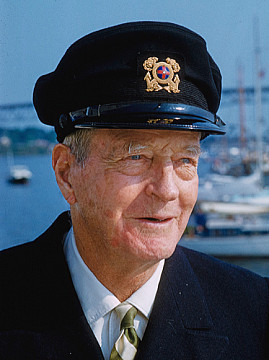
He was born at Idlehour in Oakdale, New York, a grandson of William Henry Vanderbilt who for a brief period was considered the richest man in the world. He inherited $21.7-million from his father in 1920. He graduated from Harvard (1907) and Harvard Law School (1910) before joining the family-owned New York Central Railroad. His father's interest in the railroad had began to wane when he moved to France in 1903, triggering the slow decline of the family's wealth and dominance. 'Mike' - as he was known to his friends - had been a director of 27-railroads and the First National Bank of New York. He was also the last Vanderbilt to serve as a director of the New York Central Railroad of which he had long been the financial power. He resigned in 1954 after he was defeated "in a titanic battle of proxies" by the rival financier, Robert R. Young.
As a yachtsman, he successfully defended the America's Cup three times (1930, 1934, 1937), racing his J-class yachts Enterprise, Rainbow, and Ranger, and establishing himself as one of the American greats. A drink popular with yachtsmen, the "Stirling Punch," was named for him, but far more critically he is credited as the designer of the famous "Park Avenue" boom which he attached to the Enterprise that helped him defeat Sir Thomas Lipton in 1930. From 1935, he was one of a small group of Americans who revised the yacht racing rules that were eventually adopted by the International Yacht Racing Union in 1960.
His other passion was the card game, Bridge, and he invented the variation, "Contract Bridge". During a Caribbean cruise in 1925, he refined the auction bridge scoring system, creating the modern game that became a worldwide phenomenon. He authored several book on both yachting and Bridge. He was a keen supporter of Vanderbilt University in Nashville (founded by his great-grandfather) and served as President of the Board of Trustees (1955-68) during a critical and divisive period as he oversaw the integration of African-American students. The university erected a statue in his honor in 1965.
In 1933, he married Gertrude Conaway, of Philadelphia, a prize-winning equestrienne, swimmer, tennis player, and golfer. They had no children but lived between (see images) their apartment at 230 Park Avenue, N.Y.C.; their 2,000-acre cattle farm "Dunmore Mount Airy" in Virginia; "Rock Cliff" in Newport, R.I.; and, their winter home "Eastover" at Manalapan, Florida. In 1947, he was honored by King George VI as an honorary Commander of the Order of the British Empire (C.B.E.) and in 1963, he purchased his mother's former home, Marble House, that he donated to the Preservation Society of Newport. In his will, he left $41-million to Vanderbilt University and $9-million to various other educational/charitable institutions in six states, although the bulk of that went to Harvard - $5.6 million to the university itself and another $1-million to its medical school.
As a yachtsman, he successfully defended the America's Cup three times (1930, 1934, 1937), racing his J-class yachts Enterprise, Rainbow, and Ranger, and establishing himself as one of the American greats. A drink popular with yachtsmen, the "Stirling Punch," was named for him, but far more critically he is credited as the designer of the famous "Park Avenue" boom which he attached to the Enterprise that helped him defeat Sir Thomas Lipton in 1930. From 1935, he was one of a small group of Americans who revised the yacht racing rules that were eventually adopted by the International Yacht Racing Union in 1960.
His other passion was the card game, Bridge, and he invented the variation, "Contract Bridge". During a Caribbean cruise in 1925, he refined the auction bridge scoring system, creating the modern game that became a worldwide phenomenon. He authored several book on both yachting and Bridge. He was a keen supporter of Vanderbilt University in Nashville (founded by his great-grandfather) and served as President of the Board of Trustees (1955-68) during a critical and divisive period as he oversaw the integration of African-American students. The university erected a statue in his honor in 1965.
In 1933, he married Gertrude Conaway, of Philadelphia, a prize-winning equestrienne, swimmer, tennis player, and golfer. They had no children but lived between (see images) their apartment at 230 Park Avenue, N.Y.C.; their 2,000-acre cattle farm "Dunmore Mount Airy" in Virginia; "Rock Cliff" in Newport, R.I.; and, their winter home "Eastover" at Manalapan, Florida. In 1947, he was honored by King George VI as an honorary Commander of the Order of the British Empire (C.B.E.) and in 1963, he purchased his mother's former home, Marble House, that he donated to the Preservation Society of Newport. In his will, he left $41-million to Vanderbilt University and $9-million to various other educational/charitable institutions in six states, although the bulk of that went to Harvard - $5.6 million to the university itself and another $1-million to its medical school.


