
Georgie Raoul-Duval (1866-1913)
Author, Hostess & Playwright of Paris; "Georgie" (Urquhart) Raoul-Duval
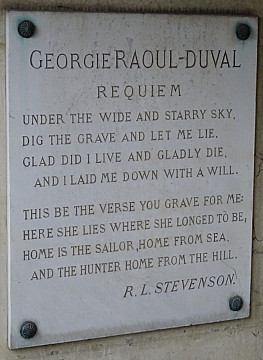
She was born Ginerva "Jeannie" Urquhart in the 16th arrondissement of Paris. She was the daughter of wealthy Americans from New Orleans who often frequented the French capital, where her aunt, Georgine Urquhart, was married to Robert Milligan McLane, later the U.S. Ambassador to France. Educated in Europe, in 1891 she was married in Paris to René Raoul-Duval, two of whose brothers also married Americans. Among those present at their wedding in the Protestant L'Étoile Church (built by the Duval family) were Whitelaw Reid and Princess (Clara Prentice-Huntington) von Hatzfeldt, and as a wedding present the Prince of Wales sent Georgie a diamond brooch. The couple moved in the best circles on both sides of the Atlantic and René arranged the union of the fortune hunter Boni de Castellane with the heiress Anna Gould. However, René was frequently away on mining business prompting "Georgie" (as she now styled herself) to start hosting some of most interesting literary salons from their home in Paris.
In 1901, Georgie began an affair with Colette, author of the newly published Claudine in Paris. Colette wrote of Georgie, “I loved her, if love is to desire until it burns... to dream of running away with her...". However, Georgie began - or it was likely she was already in the midst of - another affair with Willy, Colette's husband, quite unaware they were sharing the same mistress. Years later in his memoirs, Willy gave his version of how Colette and Georgie first got together: "Colette has claimed, as is only too natural, and I haven't prevented her, the high ground in this murky tale. She has described her anxious hesitations, her refusals that were bit by bit disarmed... Bull! Bull! In reality, it was she - seduced from the moment they met at the Muhlfelds, who courted Georgie, a passionate, brutal, and tenacious courtship whose impudence scandalized... all the literary couples."
When Colette first discovered that Willy was sleeping with her lover she was furious, but quickly accepted a threesome. A police report of May 1, 1901 described one such meeting: "We learn that the novelist Gauthier-Villars known as "Willy", author of Claudine in Paris, has been living on 93 Rue de Courcelles for five years, and has chosen for the afternoon of 29 April a small apartment on the fourth floor of a discreet house on Pasquier Street, with the aim of meeting two lesbians, his legitimate wife and a lady aged about thirty (Georgie), resident at 107 Rue de la Pompe (marital home of the Raoul-Duvals). The meeting of the novelist and the two ladies in question took place from three to six o'clock in the evening. Arriving first, the two ladies were left alone for an hour before Mr. Gauthier-Villars came to join them, continuing with him in their game."
In the summer of 1901, the trio left by car for the Bayreuth Music Festival in Germany, and the postcards they sent to their friends back home were nothing short of revealing: "The music is good, the food is mediocre... and Georgie is vivacious," wrote Colette. Willy was equally aroused ("Georgie - what a bitch!" he enthused), also describing her as, "dangerously seductive". He explained that Georgie loved taking risks and would summon him and Colette to see her individually in the same room, sometimes just an hour apart. Catching the scent of his wife's perfume on Georgie's skin, Willy cottoned on and warned Georgie that her game cold enrage Colette to the point that she might risk getting shot. By the time they were back in Paris, Colette too had learned of Georgie's subterfuge and the ménage-a-trois broke down suddenly and bitterly, and Georgie was ostracized.
In 1902, in an act of public revenge, Colette published Claudine Married (although still officially authored by Willy) in which Claudine has an affair with a beautiful, treacherous redhead from Vienna named Rézi, thinly disguised as Georgie, who betrays her with Renaud. To avoid the ensuing scandal, Georgie purchased the entire first run of the book and had it destroyed, but the second run was a "wild success" and sold 70,000 copies within months. Willy and Colette divorced in 1906, but in 1907 Colette was still not done with Georgie, characterizing her unfavoriably as 'Suzy' in La Retraite Sentimentale.
In 1905, Georgie began her own literary career, writing a play The Golden Light (under the pen-name George Daring) that her sister, socialite-turned-actress Cora Urquhart Brown-Potter, put on at the Savoy Theatre in London, but it was panned by the critics and closed after only a few days. Georgie's novels were: Shadows of Old Paris, a story of Paris for the American market; Written in the Sand, inspired by a trip to the Sahara; and, Little Miss, published posthumously in 1914 that featured a young heroine from Louisiana.
Georgie had further affairs with the writer Marie de Hérédia (wife of Henri de Régnier and mistress of Pierre Louÿs) as well as with José Maria Sert and Catherine Pozzi. Years later, Jean Cocteau - inspired by Georgie's beauty, charisma, caprice, and rampant narcissism - used her as his model for the mother in his play Les Parents Terribles. René divorced her and she died aged 47 at her then home, 27 Quai d'Orsay, Paris. No picture of her survives.
In 1901, Georgie began an affair with Colette, author of the newly published Claudine in Paris. Colette wrote of Georgie, “I loved her, if love is to desire until it burns... to dream of running away with her...". However, Georgie began - or it was likely she was already in the midst of - another affair with Willy, Colette's husband, quite unaware they were sharing the same mistress. Years later in his memoirs, Willy gave his version of how Colette and Georgie first got together: "Colette has claimed, as is only too natural, and I haven't prevented her, the high ground in this murky tale. She has described her anxious hesitations, her refusals that were bit by bit disarmed... Bull! Bull! In reality, it was she - seduced from the moment they met at the Muhlfelds, who courted Georgie, a passionate, brutal, and tenacious courtship whose impudence scandalized... all the literary couples."
When Colette first discovered that Willy was sleeping with her lover she was furious, but quickly accepted a threesome. A police report of May 1, 1901 described one such meeting: "We learn that the novelist Gauthier-Villars known as "Willy", author of Claudine in Paris, has been living on 93 Rue de Courcelles for five years, and has chosen for the afternoon of 29 April a small apartment on the fourth floor of a discreet house on Pasquier Street, with the aim of meeting two lesbians, his legitimate wife and a lady aged about thirty (Georgie), resident at 107 Rue de la Pompe (marital home of the Raoul-Duvals). The meeting of the novelist and the two ladies in question took place from three to six o'clock in the evening. Arriving first, the two ladies were left alone for an hour before Mr. Gauthier-Villars came to join them, continuing with him in their game."
In the summer of 1901, the trio left by car for the Bayreuth Music Festival in Germany, and the postcards they sent to their friends back home were nothing short of revealing: "The music is good, the food is mediocre... and Georgie is vivacious," wrote Colette. Willy was equally aroused ("Georgie - what a bitch!" he enthused), also describing her as, "dangerously seductive". He explained that Georgie loved taking risks and would summon him and Colette to see her individually in the same room, sometimes just an hour apart. Catching the scent of his wife's perfume on Georgie's skin, Willy cottoned on and warned Georgie that her game cold enrage Colette to the point that she might risk getting shot. By the time they were back in Paris, Colette too had learned of Georgie's subterfuge and the ménage-a-trois broke down suddenly and bitterly, and Georgie was ostracized.
In 1902, in an act of public revenge, Colette published Claudine Married (although still officially authored by Willy) in which Claudine has an affair with a beautiful, treacherous redhead from Vienna named Rézi, thinly disguised as Georgie, who betrays her with Renaud. To avoid the ensuing scandal, Georgie purchased the entire first run of the book and had it destroyed, but the second run was a "wild success" and sold 70,000 copies within months. Willy and Colette divorced in 1906, but in 1907 Colette was still not done with Georgie, characterizing her unfavoriably as 'Suzy' in La Retraite Sentimentale.
In 1905, Georgie began her own literary career, writing a play The Golden Light (under the pen-name George Daring) that her sister, socialite-turned-actress Cora Urquhart Brown-Potter, put on at the Savoy Theatre in London, but it was panned by the critics and closed after only a few days. Georgie's novels were: Shadows of Old Paris, a story of Paris for the American market; Written in the Sand, inspired by a trip to the Sahara; and, Little Miss, published posthumously in 1914 that featured a young heroine from Louisiana.
Georgie had further affairs with the writer Marie de Hérédia (wife of Henri de Régnier and mistress of Pierre Louÿs) as well as with José Maria Sert and Catherine Pozzi. Years later, Jean Cocteau - inspired by Georgie's beauty, charisma, caprice, and rampant narcissism - used her as his model for the mother in his play Les Parents Terribles. René divorced her and she died aged 47 at her then home, 27 Quai d'Orsay, Paris. No picture of her survives.


