
Cora (Urquhart) Brown Potter (1857-1936)
Society Leader & Stage Actress, of New York City, Staines & Beaulieu-sur-Mer
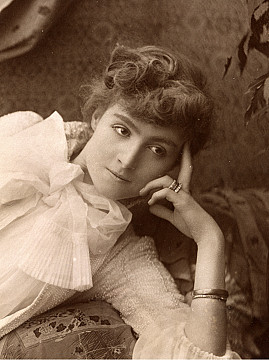
She was born in New Orleans and while her father fought with the Confederate Army during the Civil War she lived with her mother and siblings at their summer home in Flat Rock, North Carolina. After the war, the family went to Europe for several years before returning to New Orleans, living with Cora's maternal grandmother, Mrs. Slocomb, at the Slocomb House (see images). In the Panic of 1876, her father's bank failed and ruined not only his own fortunes, but those of his mother-in-law and brother's family. In the following year (1877), after a chance meeting during her debutante season at the Mardi Gras in New Orleans, Cora was married at her father's sugar plantation in St. James' Parish to James Potter Brown, of New York City, a grandson of both Alonzo Potter, Bishop of Pennsylvania, and James Brown, of Brown Bros. & Co.
Naturally talented and already privately in demand, it was her parents' impoverished situation that first inspired Cora to take to the stage professionally. Cora had been involved with society fundraising in amateur theatricals from the 1880s, but it was in Washington D.C. in 1886 that her recitation of "Ostler Joe" - a lurid tale of adultery - scandalised Gilded Age society, notably President Cleveland’s sister, Rose (daughter of a minister), but Cora used the publicity to launch her professional career. In the same year, the Brown-Potters visited England where she met the Prince of Wales and the couple were invited to spend a weekend with him at Sandringham. James returned to the States with their daughter Fifi, while Cora remained in England to pursue a career on stage.
Cora was the first American society lady to turn to the stage which cost her both her husband and daughter (he won custody), and it drew a constant stream of ire from the press.
In 1900, when their daughter turned twenty-one, Cora's husband divorced her on the grounds of "desertion for more than five years and living apart for more than ten years". In 1902, to the design of R. Clifton Davy, she built Bray Lodge, her home on the River Thames near Maidenhead. After her ownership of the Savoy Theatre failed, she sold Bray and moved to "Burleigh House" 16 Blenheim Road, London N.W., and from at least 1909 she lived with her mother at Ye Olde Bridge House, Staines-on-Thames - not a stone lodge as is often told, but a red brick Elizabethan building with a Georgian wing. She retired from the stage in 1912 and gave one last charity performance in 1919. She published three books: My Recitations (1887), a collection of poems she had previously recited privately at social events; The Secrets of Beauty & Mysteries of Health (1908), and The Age of Innocence and I (1933). By the time her mother died in 1919, her long-admired red hair had turned to a snowy white and she moved to a home 'set in the loveliest garden' on Guernsey before buying (1926) her final home, "Villa Les Bambous" at Beaulieu-sur-Mer.
Naturally talented and already privately in demand, it was her parents' impoverished situation that first inspired Cora to take to the stage professionally. Cora had been involved with society fundraising in amateur theatricals from the 1880s, but it was in Washington D.C. in 1886 that her recitation of "Ostler Joe" - a lurid tale of adultery - scandalised Gilded Age society, notably President Cleveland’s sister, Rose (daughter of a minister), but Cora used the publicity to launch her professional career. In the same year, the Brown-Potters visited England where she met the Prince of Wales and the couple were invited to spend a weekend with him at Sandringham. James returned to the States with their daughter Fifi, while Cora remained in England to pursue a career on stage.
Cora was the first American society lady to turn to the stage which cost her both her husband and daughter (he won custody), and it drew a constant stream of ire from the press.
In 1900, when their daughter turned twenty-one, Cora's husband divorced her on the grounds of "desertion for more than five years and living apart for more than ten years". In 1902, to the design of R. Clifton Davy, she built Bray Lodge, her home on the River Thames near Maidenhead. After her ownership of the Savoy Theatre failed, she sold Bray and moved to "Burleigh House" 16 Blenheim Road, London N.W., and from at least 1909 she lived with her mother at Ye Olde Bridge House, Staines-on-Thames - not a stone lodge as is often told, but a red brick Elizabethan building with a Georgian wing. She retired from the stage in 1912 and gave one last charity performance in 1919. She published three books: My Recitations (1887), a collection of poems she had previously recited privately at social events; The Secrets of Beauty & Mysteries of Health (1908), and The Age of Innocence and I (1933). By the time her mother died in 1919, her long-admired red hair had turned to a snowy white and she moved to a home 'set in the loveliest garden' on Guernsey before buying (1926) her final home, "Villa Les Bambous" at Beaulieu-sur-Mer.