
Grover Cleveland (1836-1908)
22nd & 24th President of the United States (1885-1889 & 1893-1897)
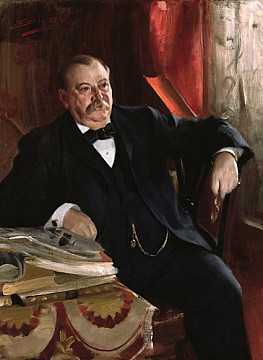
He was first preceded in the Presidency by Chester A. Arthur and served his first term for the Democrats with Thomas A. Hendricks as his Vice-President. After losing the 1889 election to Benjamin Harrison he was re-elected again with the Democrats in 1893 with Adlai Stevenson as his Vice-President. He was succeeded in 1897 by William McKinley. He was the first president to serve non-consecutive terms (1885-1889 and 1893-1897). Born in Caldwell, New Jersey, he became a lawyer and started his political career as Mayor of Buffalo in 1881, gaining a reputation for fighting corruption.
He quickly rose to become Governor of New York in 1883 before winning the presidency as a Democrat, narrowly defeating James G. Blaine, despite the "Ma, Ma, Where's My Pa?" scandal when he admitted to having fathered an illegitimate child. His first term was marked by civil service reform and his opposition to high protective tariffs. He lost re-election to Benjamin Harrison in 1888 despite winning the popular vote. Returning to office in 1893, he faced the severe economic depression known as the Panic of 1893. His response included repealing the Sherman Silver Purchase Act and maintaining the Gold Standard, though these measures were controversial, contributing to high unemployment and accusations that he was out of touch with common Americans. Throughout both terms, he was known for his fiscal conservatism and commitment to limited government. He vetoed hundreds of bills he deemed wasteful or unconstitutional. His presidency was however marred by the Pullman Strike of 1894, which he ended by over-riding the Governor of Illinois and sending in Federal troops who shot dead 34-strikers.
Cleveland's principled but often unpopular stands defined his legacy as an independent-minded leader who prioritized his convictions over political expediency, but he faced criticism for his extensive use of federal patronage despite campaigning as a reformer, and for his sometimes brusque treatment of office seekers and political allies, which earned him enemies within his own party. Cleveland Park in Washington D.C. is named for him after the house (see images) he remodelled with distinctive red roofs in 1886. After leaving office for the last time in 1897, he was worth some $350,000 and lived out his remaining days at the Westland Mansion (see images) in Princeton, New Jersey. In 1886 he married Frances Folsom and had five children, four of whom survived to adulthood.
He quickly rose to become Governor of New York in 1883 before winning the presidency as a Democrat, narrowly defeating James G. Blaine, despite the "Ma, Ma, Where's My Pa?" scandal when he admitted to having fathered an illegitimate child. His first term was marked by civil service reform and his opposition to high protective tariffs. He lost re-election to Benjamin Harrison in 1888 despite winning the popular vote. Returning to office in 1893, he faced the severe economic depression known as the Panic of 1893. His response included repealing the Sherman Silver Purchase Act and maintaining the Gold Standard, though these measures were controversial, contributing to high unemployment and accusations that he was out of touch with common Americans. Throughout both terms, he was known for his fiscal conservatism and commitment to limited government. He vetoed hundreds of bills he deemed wasteful or unconstitutional. His presidency was however marred by the Pullman Strike of 1894, which he ended by over-riding the Governor of Illinois and sending in Federal troops who shot dead 34-strikers.
Cleveland's principled but often unpopular stands defined his legacy as an independent-minded leader who prioritized his convictions over political expediency, but he faced criticism for his extensive use of federal patronage despite campaigning as a reformer, and for his sometimes brusque treatment of office seekers and political allies, which earned him enemies within his own party. Cleveland Park in Washington D.C. is named for him after the house (see images) he remodelled with distinctive red roofs in 1886. After leaving office for the last time in 1897, he was worth some $350,000 and lived out his remaining days at the Westland Mansion (see images) in Princeton, New Jersey. In 1886 he married Frances Folsom and had five children, four of whom survived to adulthood.