
George Curzon, 1st Marquess Curzon (1859-1925)
Viceroy of India, Leader of the House of Lords, Secretary of State for Foreign Affairs...
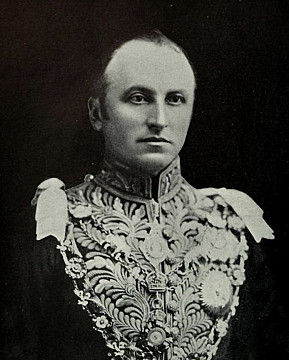
He was born at Kedleston Hall, Derbyshire, on land that his family had owned since the 12th century. He was educated at Eton and Balliol College, Oxford. In 1885, he was elected to Parliament as a Conservative and in the following years he travelled extensively through Russia, Central Asia and the Far East, publishing several books on the region in which he detailed his geopolitical outlook and underlined the Russian threat to British control of India, aka "The Great Game". In 1891, he was named Under-Secretary of State for India, before his appointment as Viceroy of India (1899 to 1905). As Viceroy, he pursued reforms, attempted to address the British maltreatment of Indians, undertook the restoration of the Taj Mahal, and sent a British expedition to Tibet to counter Russian ambitions. In 1905, he presided over the partition of Bengal and came into conflict with Lord Kitchener over issues of military organisation. Unable to secure the backing of the government in London, he resigned later that year and returned to England.
In 1907, he became Chancellor of Oxford University, and the following year he was elected to the House of Lords as an Irish representative peer. During WWI he served in Herbert Asquith's coalition cabinet as Lord Privy Seal, and from late 1916 he was Leader of the House of Lords and served in the war cabinet of Prime Minister David Lloyd George. He was appointed Secretary of State for Foreign Affairs in 1919 and lent his name to Britain's proposed Soviet-Polish boundary, "the Curzon Line." He oversaw the division of the British Mandate of Palestine and the creation of the Emirate of Transjordan, and was the chief Allied negotiator of the 1922 Treaty of Lausanne which defined the borders of modern Turkey. In 1921, he was created a Marquess, and on Bonar Law's retirement as Prime Minister in 1923, he was a contender for the office but was passed over in favor of Stanley Baldwin. He remained as Foreign Secretary until 1924 and died a year later.


