
Elinor Glyn (1864-1943)
Pioneer of Erotic Fiction & Inventor of the "It" Girl; Mrs. Elinor (Sutherland) Glyn
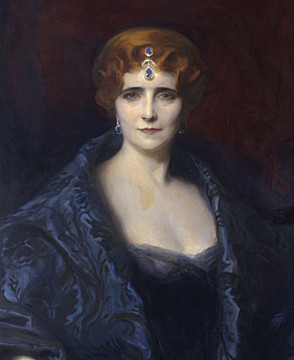
She authored Three Weeks (1907) in which she described a particularly passionate bout of love-making that took place on a tiger skin. When the book was made into a play the following year, the performance at the Adelphi Theatre in London prompted Lord Curzon (the recently returned Viceroy of India) to send her a tiger skin, sparking their nine year on-off affair. As for the book itself, in its first nine years it sold two million copies across Britain, the Empire, and America, and was translated into every European language, producing one of the era's most famous quips: "Would you like to sin with Elinor Glyn on a tiger skin? Or would you prefer to err with her on some other fur?"
She was born on the Island of Jersey to Canadian parents, her father (an engineer) died in London when she was two months old and her mother returned to Guelph, Ontario. It was there that her maternal grandmother, Mrs. Saunders, instructed her in the manners and mannerisms of British upper-class society which led to her and her sister - Titanic survivor Lady Duff-Gordon - becoming authorities on style and good taste, something Elinor would capitalise on in her writing. In 1872, her mother remarried another Scots-Canadian and returned to Jersey where Elinor's education was continued by a governess.
Determined to escape the “quaint and faintly pathetic little Island” of her birth, she enjoyed a whirlwind affair with Paris before 1892 when she settled to marry Clayton Glyn, who a few years before had succeeded to Durrington House (see images) in Essex, built by his grandfather (and more recently home to the raspy-voiced rocker, Rod Stewart). They had two daughters (both of whom would marry newly created Baronets), but as a couple they were thoroughly incompatible. He was a profligate drunk and gambler, while she pursued affairs with various aristocrats. Using these experiences to inspire her early written work, her writing career began officially in 1900 and when her husband fell into debt in 1908 she became the family breadwinner in order to maintain their lifestyles.
Sharing the same literary agent (Hughes Massie) as the "Queen of Crime" Agatha Christie, she wrote risqué romantic fiction, and popularised the concept of the 'It-girl' - those who possess "that subtle, mysterious force which makes them irresistible." Her success took her on a lavish tour of Imperial Russia and in America she was adored by all classes, and took tea with Mark Twain. She quickly became a household name and had a defining influence on early 20th century popular culture and the careers of several early Hollywood stars. In 1927, a verse from the song "My Heart Stood Still" in the London West End musical One Damn Thing After Another reflected both Elinor's reputation and star status: "I read my Plato; Love, I thought a sin; But since your kiss; I'm reading Missus Glyn!"
She was born on the Island of Jersey to Canadian parents, her father (an engineer) died in London when she was two months old and her mother returned to Guelph, Ontario. It was there that her maternal grandmother, Mrs. Saunders, instructed her in the manners and mannerisms of British upper-class society which led to her and her sister - Titanic survivor Lady Duff-Gordon - becoming authorities on style and good taste, something Elinor would capitalise on in her writing. In 1872, her mother remarried another Scots-Canadian and returned to Jersey where Elinor's education was continued by a governess.
Determined to escape the “quaint and faintly pathetic little Island” of her birth, she enjoyed a whirlwind affair with Paris before 1892 when she settled to marry Clayton Glyn, who a few years before had succeeded to Durrington House (see images) in Essex, built by his grandfather (and more recently home to the raspy-voiced rocker, Rod Stewart). They had two daughters (both of whom would marry newly created Baronets), but as a couple they were thoroughly incompatible. He was a profligate drunk and gambler, while she pursued affairs with various aristocrats. Using these experiences to inspire her early written work, her writing career began officially in 1900 and when her husband fell into debt in 1908 she became the family breadwinner in order to maintain their lifestyles.
Sharing the same literary agent (Hughes Massie) as the "Queen of Crime" Agatha Christie, she wrote risqué romantic fiction, and popularised the concept of the 'It-girl' - those who possess "that subtle, mysterious force which makes them irresistible." Her success took her on a lavish tour of Imperial Russia and in America she was adored by all classes, and took tea with Mark Twain. She quickly became a household name and had a defining influence on early 20th century popular culture and the careers of several early Hollywood stars. In 1927, a verse from the song "My Heart Stood Still" in the London West End musical One Damn Thing After Another reflected both Elinor's reputation and star status: "I read my Plato; Love, I thought a sin; But since your kiss; I'm reading Missus Glyn!"
Her husband died an alcoholic in 1915. During World War I, Elinor became a war correspondent, and she was one of just two women present at the signing of the Treaty of Versailles in 1919. Later that year, she signed a contract with William Randolph Hearst’s International Magazine Company. Brought over to the States by the Famous Players-Lasky Production Company to write screenplays, she also wrote for Cosmopolitan magazine, and the screenplay of her novel “It” lit the path to her rise to fame as a screenwriter. In 1920, she moved to Hollywood where she became one of the most famous female screenwriters of the 1920s working with MGM and Paramount, clocking up 28 story or screenwriting credits, three producing credits, and two credits for directing.
After ten years in America she returned to England in 1929, partly because of tax demands. She set up her own production company – Elinor Glyn Ltd. – but after making a couple of less than spectacular films, it failed and she returned to her first passion: writing novels. In 1938, Freya Stark recalled an evening with her: "Elinor Glyn is seventy-four, without a wrinkle, red hair, green velvet and pearls, lovely eyes heavily kohled, and an emotional very delicate manner. And she told us all what we were in our former lives. It was rather trying...". She never remarried, but remained devoted to her three large yellow Persian cats, who obeyed her every word. In 1939, she went to a literary lunch wearing, "with fine panache, her huge Persian cat, Candide, asleep round her neck," only opening its eyes when its being was questioned. She died at her home in London, 39 Royal Avenue, Chelsea.