
Lucy (Sutherland) Duff-Gordon (1863-1935)
Fashion Designer; Lucy Christiana (Sutherland) Mrs. Wallace, Lady Duff-Gordon
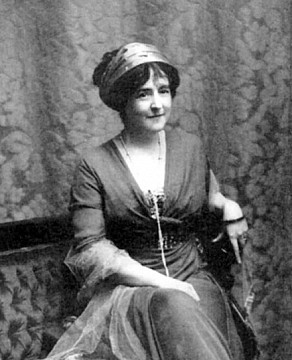
She was the first British-based fashion designer to achieve international acclaim. Her fashion house, "Lucile Ltd." of London opened branches in Chicago, New York City, and Paris, becoming the first global couture brand, dressing a trend-setting clientele of royalty, nobility, and stage and film personalities. Born in London to Canadian parents, her father died in London when she was one years old and her mother returned to Guelph, Ontario. It was there that her maternal grandmother, Mrs. Saunders, instructed her in the manners and mannerisms of British upper-class society which led to her and her sister - the scandalous Elinor Glyn - becoming authorities on style and good taste. In 1872, her mother remarried another Scots-Canadian and returned to Jersey.
In order to support herself and her daughter after the end of her first marriage, she began working as a dressmaker from home. In 1893, she opened Maison Lucile at 24 Old Burlington Street in London's Mayfair. She became a fashion icon herself and was widely acknowledged as an innovator in couture styles as well as in fashion PR. In addition to originating the "mannequin parade," a precursor to the modern fashion show, and training the first professional models, she launched slit skirts and low necklines, popularized less restrictive corsets, and promoted alluring and pared-down lingerie. She designed dresses to match the personalities of her clients, and after a meeting with the actress Ellen Terry she began designing stage costumes, which spread her name internationally. Her empire also included perfumes, cosmetics and accessories, and later a pioneering mail-order fashion line for Sears-Roebuck. But, after WWI, her romantic and elaborate gowns felt out of touch with the new age and Lucile Ltd. went bankrupt in 1923.
In 1900, she remarried Sir Cosmo Duff-Gordon, and they were among the survivors when the Titanic went down in 1912. They became estranged in 1915, but they never divorced and remained friends. She died in a nursing home in Putney, survived by her daughter.
In order to support herself and her daughter after the end of her first marriage, she began working as a dressmaker from home. In 1893, she opened Maison Lucile at 24 Old Burlington Street in London's Mayfair. She became a fashion icon herself and was widely acknowledged as an innovator in couture styles as well as in fashion PR. In addition to originating the "mannequin parade," a precursor to the modern fashion show, and training the first professional models, she launched slit skirts and low necklines, popularized less restrictive corsets, and promoted alluring and pared-down lingerie. She designed dresses to match the personalities of her clients, and after a meeting with the actress Ellen Terry she began designing stage costumes, which spread her name internationally. Her empire also included perfumes, cosmetics and accessories, and later a pioneering mail-order fashion line for Sears-Roebuck. But, after WWI, her romantic and elaborate gowns felt out of touch with the new age and Lucile Ltd. went bankrupt in 1923.
In 1900, she remarried Sir Cosmo Duff-Gordon, and they were among the survivors when the Titanic went down in 1912. They became estranged in 1915, but they never divorced and remained friends. She died in a nursing home in Putney, survived by her daughter.