
Frank Gray Griswold (1854-1937)
F. Gray Griswold, of 783 Park Avenue, New York City & East Williston, L.I.
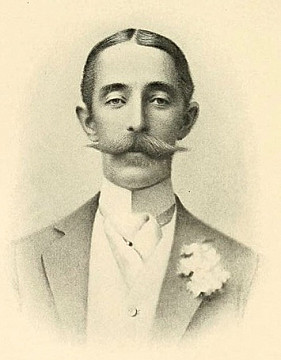
He was born in New York City, but spent most of his childhood in Europe, first in Vienna, and then Dresden (graduating from the Handelsschule in 1875), France, and England. It was during his time in England that he developed his lifelong love for - and knowledge of - horses and hunting, becoming an acknowledged leader in the American horse world whose opinion was consulted as that of an expert. In New York, he was a longtime Director of the Metropolitan Opera Company, and being a close friend of Pierre Lorillard, he was also a Director and an important executive of the Lorillard Tobacco Company from 1879 to 1893. It was said that back in those days, "it was quite the usual thing for him to kill a fox on Long Island before breakfast, and be on the train for New York by 8:30 and at his desk in the tobacco factories in Jersey City by 10."
He imported hounds from England and formed the Queen's County Hounds (Long Island), for which he served as Master for many years. In 1901, an article in The New York Herald by someone using the nom de plume of "Pendennis" stated that: “Among the first to introduce fox hunting in the suburbs of New York was F. Gray Griswold. In 1894 he was Master of Hounds of the Meadow Brook Club, then of the Rockaway Hunt, and also of the Newport Hunt for several seasons. He was one of the first to import a pack of foxhounds to this country, and usually had his own at his residence in East Williston. In appearance he is an ideal weight and figure for riding. Tall, slender, lithe, with an anglicized drooping mustache, a manner that is courteously indifferent, and a way of talking that insinuates worldliness and assurance. Mr. Griswold is probably the most accomplished Master of Hounds in America and the most experienced. He has 'run to hounds' in Leicestershire, in the South of France, in any place where fox hunting is encouraged... Mr. Griswold actually rides with great caution while appearing to be indifferent, and if by any rare chance his horse falls he tumbles so that no bones are broken. When he gave up his hounds at Williston he presented them to the Meadow Brook Hunt Club.”
He imported hounds from England and formed the Queen's County Hounds (Long Island), for which he served as Master for many years. In 1901, an article in The New York Herald by someone using the nom de plume of "Pendennis" stated that: “Among the first to introduce fox hunting in the suburbs of New York was F. Gray Griswold. In 1894 he was Master of Hounds of the Meadow Brook Club, then of the Rockaway Hunt, and also of the Newport Hunt for several seasons. He was one of the first to import a pack of foxhounds to this country, and usually had his own at his residence in East Williston. In appearance he is an ideal weight and figure for riding. Tall, slender, lithe, with an anglicized drooping mustache, a manner that is courteously indifferent, and a way of talking that insinuates worldliness and assurance. Mr. Griswold is probably the most accomplished Master of Hounds in America and the most experienced. He has 'run to hounds' in Leicestershire, in the South of France, in any place where fox hunting is encouraged... Mr. Griswold actually rides with great caution while appearing to be indifferent, and if by any rare chance his horse falls he tumbles so that no bones are broken. When he gave up his hounds at Williston he presented them to the Meadow Brook Hunt Club.”
He was one of the first stewards of the Jockey Club and a Director of the Coney Island Jockey Club, and the Horse Show. When Mr. Lorillard went to England to race in partnership with Lord William Beresford, he became, for a time, a less familiar figure in American racing and was seen more at Ascot, Newmarket, Epsom and Sandown than at Sheepshead and Morris Park. In his later years, his sporting activities were centered around fishing, in which he made himself an authority, especially salmon fishing.
Between 1913 and 1923 he wrote and published privately "Sports on Land and Water," in six volumes. He also wrote, and issued in the same manner, “Stolen Kisses,' "Some Fish and Some Fishing,' "Observations on a Salmon River," "Fish Facts and Fancies,' and "Race Horses and Racing." In March, 1936, Harpers published his book of reminiscences, "After Thoughts," which bore the subtitle "Personal Memories of New York from 1860 to the Present." He occasionally wrote under the pseudonym "Anthony Ashley, Jr.". He was a member of the Union, Knickerbocker, Brook, Meadow Brook and New York Yacht Clubs, the Jockey Club, the Sons of the Revolution, and the Newport Country Club.
In 1907, he married the noted beauty Josephine Houghteling, widow of A. Cass Canfield, who had been prominent in the social life of Bar Harbor, Long Island and Aiken, S.C. They were married at St. Andrew's Church in London, and included among the half-dozen guests were Ambassador Whitelaw Reid and Secretary Carter of the United States Embassy. He died at 783 Park Avenue without children of his own but was survived by his widow and 3-stepchildren, notably Cass Canfield, President of Harper & Bros., Publishers.