
Eleanora, Princess Cenci de Vicovaro (1851-1915)
Eleanora Lorillard (Spencer), Princess Cenci-Bolognetti de Vicovaro
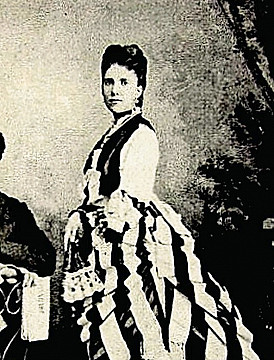
She was born in New York City and moved to Europe with her family in 1866. She was married in Paris in 1870 to the 7th Prince de Vicovaro, Grand Chamberlain to the King of Italy, and through him became Lady-in-Waiting to Queen Margherita. They lived in Rome and frequently visited Paris, where her family lived. As such, they wanted a country retreat for the summer halfway between the two cities. Lucerne/Luzern in Switzerland was a 16-hour journey each way by steam train and, "as popular with the travel-loving upper class as New York, London, Paris, Nice, and Rome" Initially, they stayed at Heidegg Castle or with the Bodmer-de Muralt family at Villa Bellerive, but in 1890 Eleonora and her mother paid 305,000 Swiss Francs for an estate on the sun-drenched "Dreilinden" (or "Drei Linden") hill with its stunning views over the lake and the Alps. Dreilinden was named for the three (drei) linden trees on top of the hill.
On the Dreilinden estate, Eleonora commissioned Edward Hewetson, the great English architect who specialized in the Gothic-Revival style, to build "Villa Vicavaro" (see images) for her and her husband, and the smaller "Villa Griswolden" for her mother. Her villa was surrounded by an extensive landscaped garden featuring exotic trees, rose gardens, water features, and winding paths. It was modelled after Vinland in Newport, Rhode Island, which was built in 1883 for Eleonora's notable cousin, Catharine Lorillard Wolfe. They moved into the villa in 1893, the same year German Kaiser Wilhelm II visited Lucerne.
In 1905, Eleonora's mother died in Paris, and in 1909, her husband died in Lyon. According to legend, shortly before Eleanora's brother, William Augustus Spencer, went down with the Titanic, he visited her at Dreilinden. His ghost is said to have haunted the villa, witnesses reporting that a light was always burning in one of the northern attic rooms, where he was said to have last spent the night. Eleanora died at 82 Avenue Marceau, Paris, in 1915, and in 1923 her only surviving daughter, Fiorenza (died unmarried in 1955), sold Dreilinden to Charles Kiefer-Halblitzel who made various structural alterations to the Villa Vicovaro - today home to the Academy of Music while the estate is Lucerne's largest public park. Fiorenza inherited her mother's $1-million fortune plus Dreilinden, shares in New York real estate, and two palazzi in Vicovaro and Rome. Fiorenza endowed a foundation to benefit the University of Rome and established a Louis Pasteur Institute.
On the Dreilinden estate, Eleonora commissioned Edward Hewetson, the great English architect who specialized in the Gothic-Revival style, to build "Villa Vicavaro" (see images) for her and her husband, and the smaller "Villa Griswolden" for her mother. Her villa was surrounded by an extensive landscaped garden featuring exotic trees, rose gardens, water features, and winding paths. It was modelled after Vinland in Newport, Rhode Island, which was built in 1883 for Eleonora's notable cousin, Catharine Lorillard Wolfe. They moved into the villa in 1893, the same year German Kaiser Wilhelm II visited Lucerne.
In 1905, Eleonora's mother died in Paris, and in 1909, her husband died in Lyon. According to legend, shortly before Eleanora's brother, William Augustus Spencer, went down with the Titanic, he visited her at Dreilinden. His ghost is said to have haunted the villa, witnesses reporting that a light was always burning in one of the northern attic rooms, where he was said to have last spent the night. Eleanora died at 82 Avenue Marceau, Paris, in 1915, and in 1923 her only surviving daughter, Fiorenza (died unmarried in 1955), sold Dreilinden to Charles Kiefer-Halblitzel who made various structural alterations to the Villa Vicovaro - today home to the Academy of Music while the estate is Lucerne's largest public park. Fiorenza inherited her mother's $1-million fortune plus Dreilinden, shares in New York real estate, and two palazzi in Vicovaro and Rome. Fiorenza endowed a foundation to benefit the University of Rome and established a Louis Pasteur Institute.