
Dominick Lynch (1786-1837)
Wine Merchant, Epicurean, & Promotor of Italian Opera, of New York City
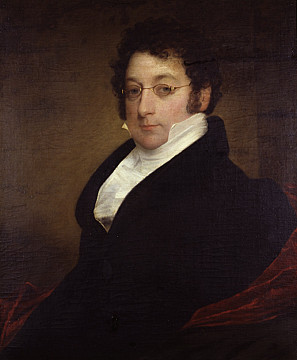
Born in New York, he attended Georgetown College (later Georgetown University) in the late 1790s and by 1809 had returned to his native city to become a wine merchant. He was described in the Old Merchants of New York as, "one of the most extraordinary men of his day... a merchant of wines - an extensive importer and a connoisseur in all nice things. He was a perfect gentleman, and (in his day) the envy of all the ambitious youths of New York. Whatever Dominick Lynch said was 'good,' must have been. He was the most fashionable man in New York. His taste of wines was exquisite, and he made mere common clay pay for his own unequaled wisdom and judgment." When his niece married 'Count' Louis Fitzgerald Tasistro, Lynch - "a perfect living dictionary of the European as well as the American peerage" - exposed him as a fraud, as few else could.
He had a large wine store on William Street, three doors down from Wall Street, opposite the Merchant's Exchange, but lost all his stock in a fire in 1829. An onlooker observed, "never did the firemen of New York suck such delicious wines as then." Lynch was undaunted, and with renewed vigor he embarked on his most famous and profitable venture: From 1830, he introduced Bordeaux wine from Château Margaux to the American market and, "a man was nobody in those days if he had not subscribed for a box of that almost inaccessible wine to anybody but Lynch. The subscription list for 300-cases contained all the principal people of New York" - and Lynch moved in the smartest set with Washington Irving, etc. The cases were about 3-feet long and 4-feet round, and contained four dozen (48) quart bottles for $75, and a smaller size contained four dozen pints. In addition to Lynch's "Château Margaux" he was also famous for his "Sauternes," and - notably - his "Lucca Oil" (Italian Olive Oil), which "commanded an unheard of price". The oil was, "put up in 'bettys,' and... used as if it had been strained honey."
Aside from first class wines, Dominick Lynch is also remembered for his frequent travels to London to recruit opera singers. A close friend of Lorenzo da Ponte, for New York's first season of Grand Opera he succeeded in bringing the first Italian opera troupe to America in 1825 of which Manuel Garcia (the greatest tenor then living), Carlo Angrisani (the greatest basso), and Maria - then Maria Garcia - Malibran (the greatest prima donne) were members. In addition, Lynch served as Secretary of the American Society for the Encouragement of Domestic Manufacturers (1816-20), Secretary of the North River Steamboat Company, and as a Director of the North River Insurance Company and the New York branch of the Second Bank of the United States. In 1824, Washington Irving wrote to his old friend Henry Brevoort from 89 Rue de Richelieu in Paris: "I cannot tell you what pleasure I have received from chats with Lynch about old times and old associates. His animated and descriptive manner has put all New York before me".
He kept a townhouse (which he valued at $12,000 in 1822) at No. 1 Greenwich Street, opposite the Battery, which by 1836 he had sold to Abraham Schermerhorn. His second home was at New Brighton on Staten Island, next to the Pavilion Hotel. His homes attracted the best amateur and professional musical talent in the city, and he himself was an accomplished musician, a gifted vocalist (tenor), and musical critic. While he made a considerable fortune, he spent it "with the freedom of a prince... He was a high liver, gave royal dinners, and went into the best society. He was an extraordinary judge of wines." The New-York Historical Society acknowledged him as the "head of the fashionable and festive board, a gentleman of the ton." Others referred to him as "the Count Almaviva of New York Society," and years later Ward McAllister called him, "the greatest swell and beau" the city had ever known. But, despite all his social prominence and his business successes, he never saved anything and died in poverty in Paris, July 31, 1837, of dropsy.
Philip Hone wrote in his diary: "How deeply impressive should be the decease of such a man! How many happy hours I have passed in his society! No man has ever contributed so much to the refined enjoyment of the circle in which he moved. He sang and played beautifully, was the ornament of female society, and infused spirit and joviality into the dinner parties of his male friends, where he was a constant and favoured guest... He also was the master-spirit who established and conducted the musical soirées, a few years since - the most refined entertainments we ever had." He married Margaret Lea, maternal granddaughter of Chief Justice Edward Shippen, and they had six children, yet although he and his father were strong Catholics, his children were raised as/married Protestants.
He had a large wine store on William Street, three doors down from Wall Street, opposite the Merchant's Exchange, but lost all his stock in a fire in 1829. An onlooker observed, "never did the firemen of New York suck such delicious wines as then." Lynch was undaunted, and with renewed vigor he embarked on his most famous and profitable venture: From 1830, he introduced Bordeaux wine from Château Margaux to the American market and, "a man was nobody in those days if he had not subscribed for a box of that almost inaccessible wine to anybody but Lynch. The subscription list for 300-cases contained all the principal people of New York" - and Lynch moved in the smartest set with Washington Irving, etc. The cases were about 3-feet long and 4-feet round, and contained four dozen (48) quart bottles for $75, and a smaller size contained four dozen pints. In addition to Lynch's "Château Margaux" he was also famous for his "Sauternes," and - notably - his "Lucca Oil" (Italian Olive Oil), which "commanded an unheard of price". The oil was, "put up in 'bettys,' and... used as if it had been strained honey."
Aside from first class wines, Dominick Lynch is also remembered for his frequent travels to London to recruit opera singers. A close friend of Lorenzo da Ponte, for New York's first season of Grand Opera he succeeded in bringing the first Italian opera troupe to America in 1825 of which Manuel Garcia (the greatest tenor then living), Carlo Angrisani (the greatest basso), and Maria - then Maria Garcia - Malibran (the greatest prima donne) were members. In addition, Lynch served as Secretary of the American Society for the Encouragement of Domestic Manufacturers (1816-20), Secretary of the North River Steamboat Company, and as a Director of the North River Insurance Company and the New York branch of the Second Bank of the United States. In 1824, Washington Irving wrote to his old friend Henry Brevoort from 89 Rue de Richelieu in Paris: "I cannot tell you what pleasure I have received from chats with Lynch about old times and old associates. His animated and descriptive manner has put all New York before me".
He kept a townhouse (which he valued at $12,000 in 1822) at No. 1 Greenwich Street, opposite the Battery, which by 1836 he had sold to Abraham Schermerhorn. His second home was at New Brighton on Staten Island, next to the Pavilion Hotel. His homes attracted the best amateur and professional musical talent in the city, and he himself was an accomplished musician, a gifted vocalist (tenor), and musical critic. While he made a considerable fortune, he spent it "with the freedom of a prince... He was a high liver, gave royal dinners, and went into the best society. He was an extraordinary judge of wines." The New-York Historical Society acknowledged him as the "head of the fashionable and festive board, a gentleman of the ton." Others referred to him as "the Count Almaviva of New York Society," and years later Ward McAllister called him, "the greatest swell and beau" the city had ever known. But, despite all his social prominence and his business successes, he never saved anything and died in poverty in Paris, July 31, 1837, of dropsy.
Philip Hone wrote in his diary: "How deeply impressive should be the decease of such a man! How many happy hours I have passed in his society! No man has ever contributed so much to the refined enjoyment of the circle in which he moved. He sang and played beautifully, was the ornament of female society, and infused spirit and joviality into the dinner parties of his male friends, where he was a constant and favoured guest... He also was the master-spirit who established and conducted the musical soirées, a few years since - the most refined entertainments we ever had." He married Margaret Lea, maternal granddaughter of Chief Justice Edward Shippen, and they had six children, yet although he and his father were strong Catholics, his children were raised as/married Protestants.
Parents (2)


Children (6)




Categories
Share
Image Courtesy of the Frick Art Reference Library
https://www.google.fr/books/edition/The_Provincial_Councillors_of_Pennsylvan/AbA-AAAAYAAJ?hl=en&gbpv=1&dq=dominick+lynch+paris&pg=PA59&printsec=frontcover
https://www.google.fr/books/edition/The_Provincial_Councillors_of_Pennsylvan/AbA-AAAAYAAJ?hl=en&gbpv=1&dq=dominick+lynch+paris&pg=PA59&printsec=frontcover