
William Kemble (1795-1881)
of 92 West 25th Street, New York City; Co-Owner of the West Point Foundry
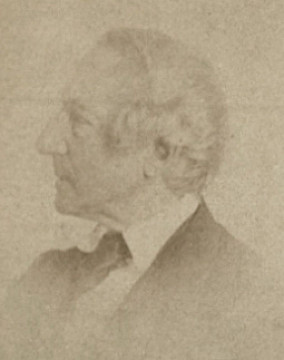
He was born in New York City and after graduating from Columbia College became a commission merchant. In 1817, he went into business with his brother (future U.S. Congressman) Gouverneur Kemble, establishing the West Point Foundry at Cold Spring with government backing. They manufactured artillery for the army and during the Civil War their brother-in-law, Captain Robert P. Parrott, oversaw the foundry's production of the Parrott Guns. When steam navigation became firmly established on the Hudson, the West Point Foundry Association (of which he was agent) erected its machine shops at the foot of Beach Street in New York. Under Kemble's direction, the engines of many of the steamboats that plied their trade on the river before 1838 were built. In that year, the engine shops were moved to Cold Spring and consolidated with the foundry. He was also one of the founders of the Ulster Iron Works and agent for the Pennsylvania Rolling Mills, finally retiring from business in 1867.
William Kemble was a well-known patron of the arts and his home in New York was a popular gathering place for those interested in the arts. Familiar faces included William Cullen Bryant, Washington Irving, James K. Paulding, Gulian C. Verplanck, Henry Brevoort, Asher B. Durand, and John Gadsby Chapman. He owned a number of fine pictures among which was a Sappho by a Spanish master given to his wife by the collector Richard W. Meade. When the Kemble family left their townhouse on Beach Street and moved to 92 West 25th Street (where he died) this picture was sold to his brother Gouverneur Kemble for $5,000, and placed in his extensive picture gallery at Cold Spring. William was a life member of the Academy of Design and one of the 100-invitees (of whom only 42 are known) asked to found the Century Association in New York in 1847.
In 1826, he built "The Cottage" (see images) near the permanent home of his brother at Cold Spring. Kemble's summer home was in, "a large grove of trees at Cold Spring and life under its roof was indeed an ideal existence... it was a simple life (and) it teemed with beauty and interest." The Kembles were enthusiastic rowers and "spent many hours on the Hudson." Dinner parties were an almost daily occurrence and William Kemble's hospitality was famous. In 1819, he married Margaret Seth, "a woman of marked ability and an able raconteurse. Early in life she had been left an orphan and was brought up by her maternal uncle, Dr. Thomas Tillotson of the Eastern shore of Maryland, whose wife was Margaret Livingston." Six of their seven children (listed) survived to adulthood and their son Peter married Victorine, daughter and co-heiress of Alfred Victor du Pont.


