
William Henry Riggs (1837-1924)
of 13 Rue Murillo, Paris & Bagnères-de-Luchon; Collector of Arms & Armor
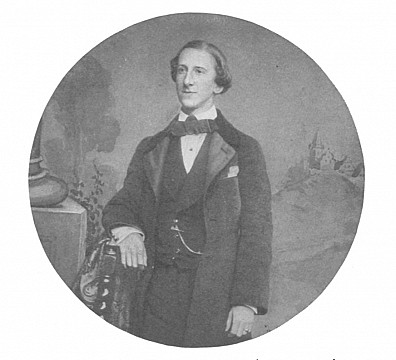
He was born at his father's home, 6 Bowling Green, New York City, where as a boy he had his own museum on the top floor in which he'd arrange and display various specimens. From about 1852, he began to take an interest in Native American arms and costumes, and in the following year, when he was sixteen, he accompanied his elder brother, Elisha, on the Benton-Beale Expedition, surveying an overland route from Colorado and Utah to Los Angeles. During the expedition, he met with 800 war-painted Pawnees who gave him the choice of their weapons, and on another occasion he was nearly killed in a buffalo stampede. Over the course of their travels, he gathered a large assortment of Indian weapons etc. that he sent back to New York.
He had expected to study at Columbia College in New York, but when his father died in 1853 he went to Europe to gain technical training that would enable him to take charge of the coal and iron mines his father had acquired in Pennsylvania's Alleghany Mountains. He arrived with letters of introduction to the Duc de Loubat in Paris, and was advised to enrol at the prestigious Institution Sillig in Vevey, Switzerland, where - through their shared passion for collecting - he formed a lifelong friendship with J.P. Morgan. It was with Morgan that he acquired some of his first European pieces, and he continued to grow his collection when he moved to Dresden where he took an engineering course at the Technische Hochschule before continuing his education at the University of Heidelberg.
Influenced by the Royal Collection in Zwinger, he became intensely interested in Medieval and Renaissance arms and armor, and he quickly established himself as both a knowledgeable and popular collector, forging close friendships with royalty, noblemen, dealers, and other collectors. His natural charm was such that many of those he befriended on his travels through Germany, Italy, France and Spain presented him with valuable gifts from their own collections; and, when he was held up in Spain by the infamous "Bandit of Ronda," he too was so taken by the young collector that he not only released him without ransom, but gave him an old dagger to add to his collection. In addition to Europe, he also travelled in the Orient, adding further diverse pieces.
He had expected to study at Columbia College in New York, but when his father died in 1853 he went to Europe to gain technical training that would enable him to take charge of the coal and iron mines his father had acquired in Pennsylvania's Alleghany Mountains. He arrived with letters of introduction to the Duc de Loubat in Paris, and was advised to enrol at the prestigious Institution Sillig in Vevey, Switzerland, where - through their shared passion for collecting - he formed a lifelong friendship with J.P. Morgan. It was with Morgan that he acquired some of his first European pieces, and he continued to grow his collection when he moved to Dresden where he took an engineering course at the Technische Hochschule before continuing his education at the University of Heidelberg.
Influenced by the Royal Collection in Zwinger, he became intensely interested in Medieval and Renaissance arms and armor, and he quickly established himself as both a knowledgeable and popular collector, forging close friendships with royalty, noblemen, dealers, and other collectors. His natural charm was such that many of those he befriended on his travels through Germany, Italy, France and Spain presented him with valuable gifts from their own collections; and, when he was held up in Spain by the infamous "Bandit of Ronda," he too was so taken by the young collector that he not only released him without ransom, but gave him an old dagger to add to his collection. In addition to Europe, he also travelled in the Orient, adding further diverse pieces.
From 1857, Riggs settled on the Rue d'Aumale in Paris, the city which would remain his home for the rest of his life. His house became a cultural magnet for the leading musicians, painters, archeologists, and literary figures of the day such as Gustave Doré, Adelina Patti, and Franz Liszt. The collectors who gathered there included Eugène Viollet-le-Duc, Sir Richard Wallace (whose wife bestowed the Wallace Collection in London), Count Nieuwerkerke, Prince Alexander Basilewsky, and the Emperor Napoleon III, etc.
By 1870, during the Franco-Prussian War, his collection had outgrown his first mansion and in 1871 he paid 188,500 francs for 13 Rue Murillo (see images) near the Parc Monceau. He bought it from fellow collector Count Nieuwerkerke, the Commissioner of Fine Arts under Napoleon III whose collection of arms is now in the Wallace Collection in London. The house had been specifically designed in 1854 by Hector-Martin Lefuel, the architect-in-chief of the Palaces of the Louvre and the Tuileries. On the top floor was a huge gallery - measuring 50-feet wide by 80-feet long - in which Riggs arranged his armory, but even then he was only able to display a fraction of what had by then grown to his 2,500-piece collection. Otherwise, his home was well adapted to his needs, having ample space for his books on the balcony above his leather-hung dining-room (to which belonged the great front window), and he had numerous large closets to store his more valuable pieces, as well as a forge in the basement to repair broken armor. In addition to his weaponry, he had a fine collection of portraits of men in armor, tapestries, wall-hangings, stained glass armorial windows, and furniture from the Middle Ages and Renaissance periods.
From as early as 1868, Riggs mentioned to John Taylor Johnston (the first President of the Metropolitan Museum in New York) that he hoped to leave his collection to an American institution. Not wanting to let the opportunity slip, he was duly elected as one of the museum's original trustees and vice-presidents when the Met was founded in 1870. Nonetheless, for a period he seriously considered leaving it to the Smithsonian, but when his old friend J.P. Morgan was elected President of the Met in 1908, his attention returned to New York. In an attempt to secure the collection Bashford Dean accompanied Riggs' old friend and fellow collector, Ruthefurd Stuyvesant, on a trip to Paris in 1897. Dean recalled:
"He was a man of sixty, clearly a scholar and a great personage-slightly built, shoulders stooping, nose aquiline, hands and feet surprisingly small, eyes clear and very bright. His face lighted up when he talked and he had charm of manner. With both hands out he welcomed Mr. Stuyvesant as an old and dear friend and, when he greeted me, he made me feel not at all an intrusive blanc-bec, but a brother collector whom he had heard about and whom he was anxious to meet. One could never forget his resonant voice which slurred no syllable, nor hurried, nor failed to choose a word which precisely "fitted." He showed no trace of a foreign accent, though he had been talking foreign languages almost half a century. On the other hand, he was foreign in dress and sometimes in manner (he would kiss his kinspeople on both cheeks like a Frenchman and often talked to them in French; even with me he seemed happier when, in telling of his affairs with early collectors, he could reach the point when "M. X- said to me," and thereupon break into his adopted language). He was animated, stood when he talked, spoke with interest and with dignity."
It was only after J.P. Morgan's death in 1913 that Riggs finally committed to leaving his collection to the Met. The collection - valued at several million dollars - arrived from Paris on sixteen different ships to be housed in a new purpose built wing, and Riggs continued to make donations to the museum right up until his death in 1924. Bashford Dean remarked that, "the Riggs Collection stands as the last great collection of arms and armor, brought together by generous means and a life's devotion." Dean recalled that he only ever saw Riggs lose his patience on one occasion: "this was in the case of a persistent countryman whose name was known everywhere on account of his wealth: his card was presented again, but word was at once sent down that Mr. Riggs, while not receiving, hoped some day to have the privilege of being presented to Mr. V! On the other hand, all who were known to be interested in armor were given access to him at a convenient time."
During his lifetime Riggs advised, "the things you regret are the things you do not buy. If the object is good be willing to pay for it largely. Do not wait for a bargain... Buy quality, not quantity. Get rid of all your specimens but the best - my collection has seen seventeen public sales à nettoyage." He remained a lifelong bachelor (a nephew recalled, "he would never marry, for he feared that a wife might interfere with his life's work"), and died at his summer home "Parc de la Pique" at Bagnères-de-Luchon in the French Pyrenees.

