
Rutherfurd Stuyvesant (1843-1909)
of New York City, Paris & New Jersey; Developer & Collector of Arms & Armor
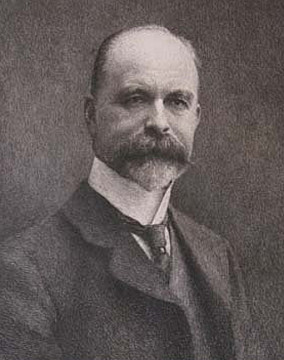
He was born at 680 Broadway in New York City. His birth name was John Stuyvesant Rutherfurd but in 1847 that changed to Rutherfurd Stuyvesant when he was named heir to the $2.5-million Stuyvesant fortune after the death of his mother's great-uncle, Peter Gerard Stuyvesant, in whose household she had been brought up. He graduated from Columbia College (1863), inherited the Stuyvesant-Rutherfurd House, and became a successful developer. In 1869, he commissioned Richard Morris Hunt to build, "the first true apartment building in New York" (see images) at what is today 142 East 18th Street. The Tribune wrote: "It is an attempt to introduce in this city the style of house-building almost universal in Paris, that of including several distinct suites of rooms under a single roof. This is wholly different from the plan of the tenement house."
In 1914, Bashford Dean published The Collection of Arms & Armor of Rutherfurd Stuyvesant, in which he wrote: "For many years Mr. Stuyvesant devoted himself to his art interests; he travelled extensivelv and was a close student of European collections. It was ever his wish to learn things at first hand. Thus, when he devoted himself to classical art, he went to the “type-localities,” and was apt to anchor his yacht for weeks or months in out-of-the-way parts of southern Italy, Sicily, Tunis, and the Greek Islands, for he knew the Mediterranean countries intimately. When his interests turned in the direction of faience and majolicas, he visited the Balearic ports and the island of Rhodes. When he undertook to collect oriental armor he turned to the bazaars of the east, and he is the only collector, so far as I know, who studied the making of sword steel and its incrustation in classical Damascus... He was gentle to his finger-tips, thoughtful, generous, courtly, smiling when others were pleased, thinking instinctively of the interests of those about him. With his collector friends he had ever a delightful way of minimizing his knowledge: and I think often now of his unfailing patience with me when, in my inexperience, I tried to theorize on some difficult point in our favorite subject... And he was ever ready to give wise counsel, to listen to experiences, good or bad, to look over one’s finds, become enthusiastic over a good “discovery” or teach philosophy when things went badly."
He was best known as a collector of arms & armor, but he also collected fine china and paintings too. In 1870, along with the likes of William H. Riggs, he was a vice-president and one of the original trustees of the Metropolitan Museum of Art. By 1909, his collection of arms and armor numbered some 600-pieces and was probably the largest such collection in the United States. He was instrumental in arranging the Met's purchase of the Duke of Dino's collection of arms & armor that numbered 500-pieces and was reckoned to be the most important in private hands. In his early years he lived at 246 East 15th Street at the corner of Second Avenue (near the Stuyvesant/Rutherfurd properties) in New York City. After his second marriage (1902), he lived for half the year at his home in Paris, 19 Rue Dumont-d'Urville, and the other half at Tranquility, his family's 7,000-acre estate in New Jersey where he displayed his collections and entertained lavishly.
Stuyvesant was socially prominent and a member of the Union Club of New York, the Century Club, the City Racquet Club, the New York Yacht Club, the Atlantic Yacht Club, the Seawanhaka Corinthian Yacht Clubs, The Downtown Association, The Columbia College Alumni Association, The New-York Historical Society, and the American Geographical Society. He was a Fellow at the American Museum of Natural History and the National Academy of Design, and a patron/trustee of the Metropolitan Museum of Art.
In 1914, Bashford Dean published The Collection of Arms & Armor of Rutherfurd Stuyvesant, in which he wrote: "For many years Mr. Stuyvesant devoted himself to his art interests; he travelled extensivelv and was a close student of European collections. It was ever his wish to learn things at first hand. Thus, when he devoted himself to classical art, he went to the “type-localities,” and was apt to anchor his yacht for weeks or months in out-of-the-way parts of southern Italy, Sicily, Tunis, and the Greek Islands, for he knew the Mediterranean countries intimately. When his interests turned in the direction of faience and majolicas, he visited the Balearic ports and the island of Rhodes. When he undertook to collect oriental armor he turned to the bazaars of the east, and he is the only collector, so far as I know, who studied the making of sword steel and its incrustation in classical Damascus... He was gentle to his finger-tips, thoughtful, generous, courtly, smiling when others were pleased, thinking instinctively of the interests of those about him. With his collector friends he had ever a delightful way of minimizing his knowledge: and I think often now of his unfailing patience with me when, in my inexperience, I tried to theorize on some difficult point in our favorite subject... And he was ever ready to give wise counsel, to listen to experiences, good or bad, to look over one’s finds, become enthusiastic over a good “discovery” or teach philosophy when things went badly."
He was best known as a collector of arms & armor, but he also collected fine china and paintings too. In 1870, along with the likes of William H. Riggs, he was a vice-president and one of the original trustees of the Metropolitan Museum of Art. By 1909, his collection of arms and armor numbered some 600-pieces and was probably the largest such collection in the United States. He was instrumental in arranging the Met's purchase of the Duke of Dino's collection of arms & armor that numbered 500-pieces and was reckoned to be the most important in private hands. In his early years he lived at 246 East 15th Street at the corner of Second Avenue (near the Stuyvesant/Rutherfurd properties) in New York City. After his second marriage (1902), he lived for half the year at his home in Paris, 19 Rue Dumont-d'Urville, and the other half at Tranquility, his family's 7,000-acre estate in New Jersey where he displayed his collections and entertained lavishly.
Stuyvesant was socially prominent and a member of the Union Club of New York, the Century Club, the City Racquet Club, the New York Yacht Club, the Atlantic Yacht Club, the Seawanhaka Corinthian Yacht Clubs, The Downtown Association, The Columbia College Alumni Association, The New-York Historical Society, and the American Geographical Society. He was a Fellow at the American Museum of Natural History and the National Academy of Design, and a patron/trustee of the Metropolitan Museum of Art.


