
Robert Graves (1821-1886)
Wallpaper Manufacturer, of 215 Lafayette Ave., Brooklyn & "Rockview"Tarrytown, N.Y.
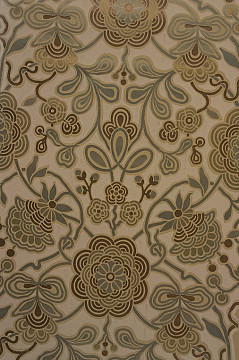
He was born in Dublin, Ireland, to a successful wallpaper manufacturer. He came to New York in about 1843 and set out in the same business on his own account. Not before long, he had a five-story factory that occupied a block on Fulton Street at Carleton Avenue, employing 220-people, and a showroom building on East 35th Street in Manhattan. Shortly before his death, he sold the Robert Graves Company which became part of the National Wall Paper Company with a capital of $25-million, but the firm continued under their umbrella owned by his son, Robert Graves, up until 1929.
Privately, he collected Old Masters and modern paintings, together with porcelains, jades, Japanese swords, ivory carvings, screens, cabinets, bronzes and lacquers. He also amassed a significant amount of real estate in Brooklyn and Manhattan which when sold in 1890 took up four extra pages in the Real Estate Record & Building Guide. He lived between his townhouse at 215 Lafayette Avenue, Brooklyn, and his summer home, "Rockview" (named for his father's country home in Ireland), a hilltop estate overlooking Pennybridge between Tarrytown and Irvington-on-the-Hudson where he kept most of his art collection. It was later sold to H.K. Browning. In 1885, he began building a mansion (see images) at 315 Clifton Avenue, intending it to be the finest residence in Brooklyn with a frontage of 86-feet, a depth of 100-feet, and a large art gallery. But, his beloved wife died just before its completion and he never moved in. When he died the following year it was sold to Alfred J. Pouch. In the year after his death (1887) his art collection was sold for $146,863.
Privately, he collected Old Masters and modern paintings, together with porcelains, jades, Japanese swords, ivory carvings, screens, cabinets, bronzes and lacquers. He also amassed a significant amount of real estate in Brooklyn and Manhattan which when sold in 1890 took up four extra pages in the Real Estate Record & Building Guide. He lived between his townhouse at 215 Lafayette Avenue, Brooklyn, and his summer home, "Rockview" (named for his father's country home in Ireland), a hilltop estate overlooking Pennybridge between Tarrytown and Irvington-on-the-Hudson where he kept most of his art collection. It was later sold to H.K. Browning. In 1885, he began building a mansion (see images) at 315 Clifton Avenue, intending it to be the finest residence in Brooklyn with a frontage of 86-feet, a depth of 100-feet, and a large art gallery. But, his beloved wife died just before its completion and he never moved in. When he died the following year it was sold to Alfred J. Pouch. In the year after his death (1887) his art collection was sold for $146,863.