
Joseph Patrick Kennedy Sr. (1888-1969)
"Joe" Kennedy, U.S. Ambassador to the United Kingdom
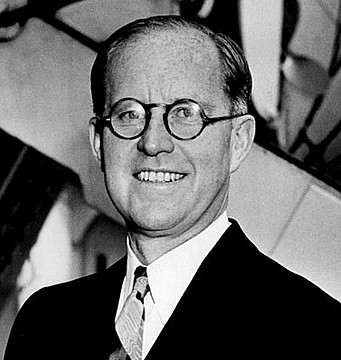
He was born in East Boston, a working-class neighborhood where his father owned several saloons. His father rapidly made money and Joe was educated at the Boston Latin School and Harvard University. Rather than pursue a career in law, he chose to go straight into business. Starting with banking and moving into Hollywood film production, real estate, and stock trading, he quickly lay the foundation of his fortune which was added to significantly by anticipating the end of Prohibition. Travelling to London with James Roosevelt in 1933, he secured the rights to become the sole American distributor of Haig & Co. and Dewar's whisky, as well as Gordon's Gin.
As a leading member of Boston's Irish Catholic community, he became attached to the Democratic Party. Initially as a supporter but then as a financial backer, he threw his weight behind Franklin D. Roosevelt's 1932 presidential campaign. After Roosevelt was elected, he offered Joe the ambassadorship to Ireland, but Joe turned it down. Instead, his political career peaked when Roosevelt appointed him as the first Chairman of the Securities & Exchange Commission in 1934, and then Ambassador to the United Kingdom (1938-40). His ambassadorship ended controversially due to his isolationist stance and opposition to American involvement in WWII, ending his relationship with Roosevelt.
As a leading member of Boston's Irish Catholic community, he became attached to the Democratic Party. Initially as a supporter but then as a financial backer, he threw his weight behind Franklin D. Roosevelt's 1932 presidential campaign. After Roosevelt was elected, he offered Joe the ambassadorship to Ireland, but Joe turned it down. Instead, his political career peaked when Roosevelt appointed him as the first Chairman of the Securities & Exchange Commission in 1934, and then Ambassador to the United Kingdom (1938-40). His ambassadorship ended controversially due to his isolationist stance and opposition to American involvement in WWII, ending his relationship with Roosevelt.
Despite his own political setbacks, Kennedy channeled his ambitions into his children's careers, particularly grooming his sons for public service. He played a crucial behind-the-scenes role in John F. Kennedy's rise to the presidency, using his wealth, connections, and political acumen to ruthlessly advance his family's political dynasty. His legacy remains complex, marked by both business success and controversial political positions, but he died in 1969 worth $500-million, making him one of the richest men in the country. In 1914, at a modest ceremony in the small chapel of the residence of Archbishop William Henry O'Connell in Boston, Joe married Rose Fitzgerald, daughter of the Mayor of Boston and Democratic Congressman "Honey Fitz" Fitzgerald. They had nine children.