
Joseph Edward Davies (1876-1958)
Corporate Lawyer & U.S. Ambassador to the Soviet Union
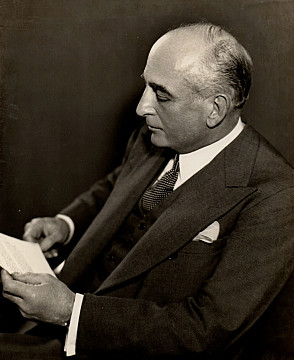
He was born in Wisconsin to Welsh-born parents where he became State Attorney General and Chairman of the State Democratic Central Committee. In 1911 he became actively involved in the nomination of Governor Woodrow Wilson for President and in 1912 moved to Washington D.C. where he practiced labor law and ran (unsuccessfully) for a seat in the Senate. By 1935, he was an established antitrust lawyer and a noted art collector, and despite his limited diplomatic experience, President Franklin D. Roosevelt appointed him U.S. Ambassador to the Soviet Union from 1936 to 1938 at a critical period during Stalin's Great Purge. His time in Moscow was controversial. He attended the notorious show trials and, unlike many Western observers, largely accepted the Soviet government's narrative about the defendants' guilt. His views were later published in his 1941 book "Mission to Moscow," which was adapted into a pro-Soviet propaganda film during World War II when the USSR was an American ally.
When he first came to Moscow, he purchased 96-paintings in the Soviet Socialist Realist tradition to form a representative collection of Soviet paintings and to encourage friendship between the U.S. and U.S.S.R. In 1937, he donated this collection to his alma mater, the University of Wisconsin. However, his more famous art collection involved his wife, the heiress Marjorie Merriweather Post (married 1935, divorced in 1955). When she arrived in Moscow with Davies, she began collecting art that had previously belonged to Russia's Imperial family, taking advantage of the fact that Stalin's government was openly selling the collection in return for cash to build up their armaments. Her collection became much more extensive and valuable than Davies' Socialist Realist paintings and is now housed at Post's Hillwood Estate in Washington, D.C. The collection that includes art, icons, and Fabergé eggs is considered one of the finest outside Russia.
When he first came to Moscow, he purchased 96-paintings in the Soviet Socialist Realist tradition to form a representative collection of Soviet paintings and to encourage friendship between the U.S. and U.S.S.R. In 1937, he donated this collection to his alma mater, the University of Wisconsin. However, his more famous art collection involved his wife, the heiress Marjorie Merriweather Post (married 1935, divorced in 1955). When she arrived in Moscow with Davies, she began collecting art that had previously belonged to Russia's Imperial family, taking advantage of the fact that Stalin's government was openly selling the collection in return for cash to build up their armaments. Her collection became much more extensive and valuable than Davies' Socialist Realist paintings and is now housed at Post's Hillwood Estate in Washington, D.C. The collection that includes art, icons, and Fabergé eggs is considered one of the finest outside Russia.
After leaving Moscow, Davies briefly served as Ambassador to Belgium (1938-39). During World War II, he acted as a special envoy for Roosevelt, undertaking diplomatic missions and advising on Soviet relations. His generally sympathetic stance toward Stalin's regime made him a significant but contentious figure in U.S.-Soviet relations. During the Cold War era, he faced criticism for what many viewed as his naive assessment of Stalin's purges and his overly favorable portrayal of the Soviet system. After his second marriage he lived between "Tregaron" (see images) in Washington D.C. and Mar-a-Lago in Florida, where his family coat-of-arms was added liberally to stained glass windows and metalwork. It was Davies' grandson, U.S. Senator Joseph Tydings who first noticed that President Trump had taken the Davies arms, replaced their motto of "Integrity" with "Trump", and poached it to use as his own coat-of-arms (although the Court of the Lord Lyon rejected the Trump arms and he isn't allowed to use them in the United Kingdom). Davies was married twice and was survived by three children from his first marriage.