
Woodrow Wilson (1856-1924)
28th President of the United States (1913-1921)
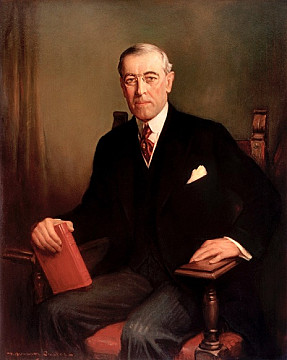
He was preceded in the Presidency by William Howard Taft and after serving two terms in office for the Democratic Party he was succeeded in 1921 by Warren G. Harding. His Vice-President throughout was Thomas R. Marshall and they held office throughout World War I, marking one of the most consequential presidencies in American history. Wilson's victory in 1912 made him the first Southerner to win a presidential election since the Civil War, the first Democratic president since Grover Cleveland left office in 1897, and the first and only president to hold a Ph.D. Born into a Presbyterian household in Staunton, Virginia, he grew up in Columbia, South Carolina, before attending Davidson College in North Carolina and graduating from Princeton University. Before politics, he was a distinguished academic whose scholarly background in political science and history would shape his progressive vision for America.
Having taught at Bryn Mawr College and Wesleyan University, he served as President of Princeton University from 1902 to 1910. His efforts to reform Princeton earned him national fame and in 1910 he was appointed Governor of New Jersey. His academic reputation made him the ideal spokesman against trusts and corruption, becoming a fully-fledged progressive. On defeating Theodore Roosevelt in the 1912 Presidential Election, Wilson pursued a domestic agenda known as the "New Freedom," aimed to restore economic competition and limit corporate power. He successfully pushed through significant legislative reforms including the Federal Reserve Act of 1913, which established the modern banking system, and the Clayton Antitrust Act of 1914, which strengthened antitrust laws. He also supported the Federal Trade Commission's creation and backed constitutional amendments for the federal income tax and direct election of senators.
However, his presidency was dominated by World War I. Initially committed to neutrality, he famously campaigned in 1916 with the slogan "He kept us out of war." However, Germany's unrestricted submarine warfare and the Zimmermann Telegram ultimately led Wilson to ask Congress to declare war in 1917, to keep the world "safe for democracy." Wilson's idealistic vision culminated in his Fourteen Points, a blueprint for post-war peace emphasizing self-determination, free trade, and international cooperation. He personally attended the Paris Peace Conference and championed the League of Nations as a mechanism to prevent future wars. However, the U.S. Senate rejected the Treaty of Versailles and League membership, dealing Wilson a crushing political defeat.
Having taught at Bryn Mawr College and Wesleyan University, he served as President of Princeton University from 1902 to 1910. His efforts to reform Princeton earned him national fame and in 1910 he was appointed Governor of New Jersey. His academic reputation made him the ideal spokesman against trusts and corruption, becoming a fully-fledged progressive. On defeating Theodore Roosevelt in the 1912 Presidential Election, Wilson pursued a domestic agenda known as the "New Freedom," aimed to restore economic competition and limit corporate power. He successfully pushed through significant legislative reforms including the Federal Reserve Act of 1913, which established the modern banking system, and the Clayton Antitrust Act of 1914, which strengthened antitrust laws. He also supported the Federal Trade Commission's creation and backed constitutional amendments for the federal income tax and direct election of senators.
However, his presidency was dominated by World War I. Initially committed to neutrality, he famously campaigned in 1916 with the slogan "He kept us out of war." However, Germany's unrestricted submarine warfare and the Zimmermann Telegram ultimately led Wilson to ask Congress to declare war in 1917, to keep the world "safe for democracy." Wilson's idealistic vision culminated in his Fourteen Points, a blueprint for post-war peace emphasizing self-determination, free trade, and international cooperation. He personally attended the Paris Peace Conference and championed the League of Nations as a mechanism to prevent future wars. However, the U.S. Senate rejected the Treaty of Versailles and League membership, dealing Wilson a crushing political defeat.
Wilson suffered a severe stroke in 1919 while campaigning for the League, leaving him partially incapacitated for his remaining time in office. Despite this setback, his vision of American moral leadership and international engagement would profoundly influence 20th-century foreign policy. Wilson's legacy remains complex, celebrated for progressive reforms and international idealism while criticized for his segregationist policies and paternalistic approach to democracy. In 1885, he married Ellen Axson who was the mother to his three children. She died in 1914 and in the following year he married Edith Bolling.