
John Adams (1735-1826)
Founding Father & 2nd President of the United States (1797-1801)
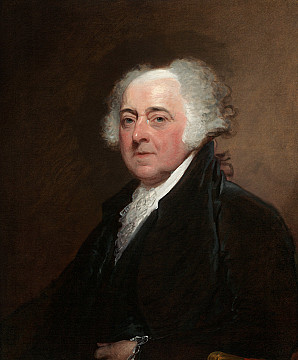
He was preceded in the Presidency by George Washington and after serving one term in office for the Federalists was succeeded in 1801 by his Vice-President, Thomas Jefferson. Born into a Puritan family at Braintree, Massachusetts, he was educated at Harvard after which he determined to become "a great man". Becoming a lawyer, in 1775 he went to Philadelphia as a Delegate from Massachusetts to the Continental Congress. Perhaps more than anyone else, he pushed for an end to British rule and on the outbreak of war he was appointed head of the Board of War & Ordinance. Working up to 18-hours a day, he was described as a, "one man war department".
Between 1777 and 1782, he was on service in Europe, first as a diplomat in France and then as U.S. Minister to the Netherlands. He co-negotiated the Treaty of Paris (1783) that ended the war and saw the United States globally recognized as an independent nation. From 1785, he was 1st U.S. Minister to Britain. Returning to Massachusetts in 1788, America was preparing for its first Presidential election and as the Virginian George Washington was considered a shoe-in, Adams was favored for the Vice-Presidency as many thought it should fall to a northerner. In 1789, Adams was voted the 1st Vice-President of the United States under Washington. During this time, he played a minor role in politics and did not enjoy the inactivity of the role, but nonetheless served two uncontested terms.
The 1796 Presidential Election was the first contested election in the United States and Adams won it for the Federalists, narrowly defeating Thomas Jefferson by 71 votes to 68. His presidency was marked by significant foreign and domestic challenges, notably the XYZ Affair (an attempt by certain members of France's Revolutionary government to bribe an American delegation) and the Quasi-War with France. He followed Washington's example and used his term to promote Republican values, civic virtue, and to avoid war with France which concluded with the Treaty of Mortefontaine. Domestically, Adams signed the controversial Alien & Sedition Acts in 1798, restricting immigration and limiting free speech which drew fierce opposition from Democratic-Republicans. In his bid for re-election in 1800 he contested with accusations of despotism which saw him lose to his Vice-President, Jefferson. He retired to Massachusetts where he resumed his friendship with Jefferson through correspondence and died quietly at his desk at Peacefield. In 1764, he married Abigail Smith, and they had six children, four of whom lived to adulthood.
Between 1777 and 1782, he was on service in Europe, first as a diplomat in France and then as U.S. Minister to the Netherlands. He co-negotiated the Treaty of Paris (1783) that ended the war and saw the United States globally recognized as an independent nation. From 1785, he was 1st U.S. Minister to Britain. Returning to Massachusetts in 1788, America was preparing for its first Presidential election and as the Virginian George Washington was considered a shoe-in, Adams was favored for the Vice-Presidency as many thought it should fall to a northerner. In 1789, Adams was voted the 1st Vice-President of the United States under Washington. During this time, he played a minor role in politics and did not enjoy the inactivity of the role, but nonetheless served two uncontested terms.
The 1796 Presidential Election was the first contested election in the United States and Adams won it for the Federalists, narrowly defeating Thomas Jefferson by 71 votes to 68. His presidency was marked by significant foreign and domestic challenges, notably the XYZ Affair (an attempt by certain members of France's Revolutionary government to bribe an American delegation) and the Quasi-War with France. He followed Washington's example and used his term to promote Republican values, civic virtue, and to avoid war with France which concluded with the Treaty of Mortefontaine. Domestically, Adams signed the controversial Alien & Sedition Acts in 1798, restricting immigration and limiting free speech which drew fierce opposition from Democratic-Republicans. In his bid for re-election in 1800 he contested with accusations of despotism which saw him lose to his Vice-President, Jefferson. He retired to Massachusetts where he resumed his friendship with Jefferson through correspondence and died quietly at his desk at Peacefield. In 1764, he married Abigail Smith, and they had six children, four of whom lived to adulthood.