
Joe Biden (b.1942)
46th President of the United States (2021-2025)
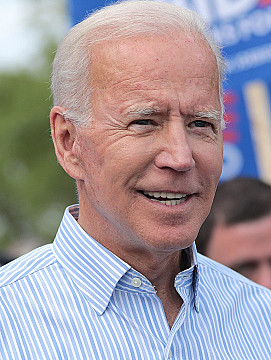
He represented the Democratic Party and defeated Donald Trump in the 2020 Presidential election. He chose Kamala Harris as his Vice-President, who as a concession to age he endorsed as the Democratic presidential nominee in 2024, but she lost to Donald Trump. Biden was born in Scranton, Pennsylvania, and from the age of ten grew up in Mayfield, Delaware. He graduated (1965) with a double-major in history and political science from the University of Delaware, and just about graduated from the Syracuse University College of Law (1968). He clerked at a law firm run by a prominent liberal Republican which prompted local Republicans to try to recruit him, but his distaste for Richard Nixon prompted him to register as an Independent. From 1969, he worked as a public defender in Wilmington, switched his registration to Democratic, and began his political career in 1970 when he was elected to the New Castle County Council.
In 1972, representing Delaware and opposing Nixon's conduct of the war in Vietnam, he was elected to the U.S. Senate - at the age of 29, he became the sixth youngest senator in American history. Tragically, just weeks after his victory, his wife Neilia and daughter Naomi were killed in a car accident while Christmas shopping - his sons Hunter and Beau were seriously injured, but survived. He considered resigning but was persuaded to take his seat in Senate, commuting daily by train from Wilmington to Washington to be home with his sons. The tragedy had a profound effect on Biden's future life and political career.
During his 36-year tenure in the U.S. Senate tenure, Biden served on several key committees, most notably the Senate Judiciary Committee, which he chaired from 1987 to 1995. In this role, he presided over two particularly contentious Supreme Court hearings in the cases of Robert Bork and Clarence Thomas. He also chaired the Senate Foreign Relations Committee (2001-03, and 2007-09), playing significant roles in arms control negotiations, the expansion of NATO, and post-9/11 foreign policy decisions.
Biden made two unsuccessful runs for president in 1988 and 2008. However, his 2008 campaign led to his selection as Barack Obama's running mate. As Vice President from 2009 to 2017, Biden was deeply involved in major policy initiatives, including the economic recovery following the 2008 financial crisis, healthcare reform, and foreign policy matters. After leaving the vice presidency, Biden remained active in Democratic politics and academia. In 2019, he launched his 3rd presidential campaign, ultimately securing the Democratic nomination and defeating incumbent Donald Trump in the 2020 election to become - at age 78 - he was then the oldest person ever sworn in as president, but ironically that record was broken by his successor in 2024, Donald Trump.
Biden won his presidential campaign focusing on restoring democratic norms, rebuilding international alliances, and addressing domestic infrastructure and climate challenges while navigating intense political polarization. But his presidency was severely hampered by several ongoing unprecedented crises: At home, he contended with the COVID-19 pandemic, deep political divisions following the January 6, 2021 Capitol Attack, and grave economic challenges. In response he passed the American Rescue Plan Act (COVID relief) as well as the Infrastructure Investment & Jobs Act, the CHIPS & Science Act (manufacturing semiconductors), and the Inflation Reduction Act (climate and healthcare provisions). On foreign policy, his administration oversaw the chaotic withdrawal of U.S. troops from Afghanistan in 2021, ending, and ultimately losing, America's longest war started after 9/11. However, following Russia's 2022 invasion of Ukraine, he strengthened NATO alliances and led a strong coalition of Western support while facing ongoing challenges with China's ambitions in the Pacific, and deep tensions in the Middle East.
Biden won his presidential campaign focusing on restoring democratic norms, rebuilding international alliances, and addressing domestic infrastructure and climate challenges while navigating intense political polarization. But his presidency was severely hampered by several ongoing unprecedented crises: At home, he contended with the COVID-19 pandemic, deep political divisions following the January 6, 2021 Capitol Attack, and grave economic challenges. In response he passed the American Rescue Plan Act (COVID relief) as well as the Infrastructure Investment & Jobs Act, the CHIPS & Science Act (manufacturing semiconductors), and the Inflation Reduction Act (climate and healthcare provisions). On foreign policy, his administration oversaw the chaotic withdrawal of U.S. troops from Afghanistan in 2021, ending, and ultimately losing, America's longest war started after 9/11. However, following Russia's 2022 invasion of Ukraine, he strengthened NATO alliances and led a strong coalition of Western support while facing ongoing challenges with China's ambitions in the Pacific, and deep tensions in the Middle East.
To the frustration of many, it wasn't until July 2024 that he announced he would not be seeking re-election, and endorsed his Vice-President, Kamala Harris, who lost to Donald Trump. In retirement, he still supports initiatives like the Beau Biden Foundation (his son, Beau, died of brain cancer in 2015) and Cancer Moonshot, and has spoken publicly on protecting Social Security which coincided with national Democratic protests against potential cuts to the program. In 1977, five years after the death of his first wife, Neila, he married Jill Jacobs who was his First Lady while he was in office. He had three children by Neila, of whom only one survives (Hunter), and he has one daughter by Jill, Ashley.



_(cropped).jpg)