
James Atkinson Longridge Esq of Greve d'Azette, Jersey (1817-1896)
British Civil Engineer and Member of Britain's Industrial Elite
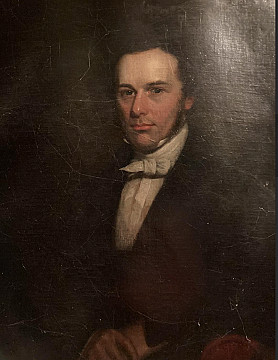
James Atkinson Longridge b.31st May 1817 at his father's home of Hunter's Hall, Bishop's Wearmouth. He began his schooling at Mr Thompson's School, Plessey, Northumberland with his cousin Daniel Gooch (later Sir). He left early and continued with a private tutor. At age thirteen he had mastered latin enabling him to translate "Hermit of Walkworth" into Latin verse and at fourteen the first three books of Euclid. In winter 1833 enrolled at the University of Edinburgh, and carried off first prize for Natural Philosophy. On leaving Edinburgh he was apprenticed to George Stephenson at the works of Robert Stephenson & Co, South Street, Newcastle-on-Tyne. Later he was engaged aiding George Stephenson on railways in Cheshire, Derbyshire and the Midlands. He supervised construction on part of the Midland Railway from Barnsley to the south, then residing at Darfield. The winter of 1842 was spent at Naples and then Russia, Germany and Italy negotiating contracts on behalf of his father's firm at Bedlington Iron Works. In 1844 he entered Trinity College, Cambridge. However shortlived, failing to sit his degree, but returned to engineering, undertaking the construction of the Whitehaven and Furness Railway. In 1846 the line was completed and he went to live in Newcastle-on-Tyne where he met and married Hannah Pembroke Josephine Stanley Hawks, eldest daughter of Rev.William Hawks. In 1852 he was elected a member of the North of England Institute of Mining Engineers. He wrote and presented many papers- “On Steam Jet as a Motive Power for Purposes of Ventilation”., “On Choke Damp and the Means of Counteracting its Effects”., “On the Relative Position of Upcast Shafts and Loss of Temperature in the Same” and later was elected an honorary member. At Newcastle he was appointed by coal owners Armstrong and Richardson to report on the evaporative value and smokelessness of north country coals in comparison to South Wales coals to supply Her Majesty’s Navy. In 1855 he removed to London where he was elected a Member of the Institute of Civil Engineers on February 5th 1856. In October 1856 he left for Calcutta to lay out the Calcutta and South Eastern Railway and later became Consulting Engineer for the line. In 1858 he went to Mauritius to lay out a railway there. In 1859, back in England, he reported on construction of his plan for the North and Midland Railway. Construction started in 1860. Execution of works in Mauritius was entrusted to Brassey, Wythes & Co. Back in London he was involved in contracts for construction of a railway from Bucharest to Giurgovo and iron bridges in Wallachia and Roumania. In 1869 he managed the construction of the Mont Cenis Summit Railway, living at Chambery. He then became involved in construction of railways in Cornwall, Sweden, Hungary, Italy, France, and Argentina.
After all the railway construction, one might think he had little time for anything else. However he had always throughout his life held a great interest in ballistics and gun making. It was in 1855 that his attention was drawn to the many failures of cast iron mortars in the Crimean War. This lead to him making a wire bound gun. The first wire-bound gun invented and made at Belington. Experiments were made with the gun in the Low House. His son Michael as a child remembers it in its lathe in an upper room of the works office with the wires hanging out of the windows with weights attached to keep them at the calculated tension. He remembers the gun being fired across the river. The breech was jammed against a wall. After firing it was sent to Ordnance who, although cautioned to stick the breech against a wall, persisted in securing the gun to a large log of wood by the flange of the muzzle. The consequence of course, was that, on firing, the recoil tore away the flange and the wire wound gun was dammed for many years until the Russian Government, more enterprising than our own, constructed one successfully. However James persisted and eventually designed and built the perfect wire- bound gun. It was a muzzle loader of 2.96 inch bore and 3 feet long. On test it threw a shot of 7½ pounds a distance of 1800 yards. No other gun at the time was able to achieve this. He presented a paper to the Committee at the Institute in 1860, but they were sceptical. He made a further attempt to persuade the committee, on his return from Mauritius in 1867. But Sir John Pakington declined the experiments. In June 1878 for a third time he tried to persuade the Committee but to no avail. He read a second paper to the Institute in 1879- “On the Construction of Heavy Ordnance”. James insisted that his design was without question superior to those being made at Woolwich, failed to persuade the British Government. By 1885 the Russians accepted his designs and they built a gun which was a complete success. The War Office did ask him to supply a 9.2 inch gun to his specification and in 1888 it was tested but failed for another reason. The War Office declined further experiments with his design. However Messrs. Easton & Anderson built and tested a gun to James’s designs which was a total success but the Government would not accept it as a ‘Longridge Gun’. In 1893 they did in fact go some way by awarding him £200 per year in recognition of his thirty years of work on the subject. All future guns were made using the Longridge System. He was then in his 75th year.