Henry Goldman (1857-1937)
of New York City; Partner in Goldman, Sachs & Co., Investment Bank
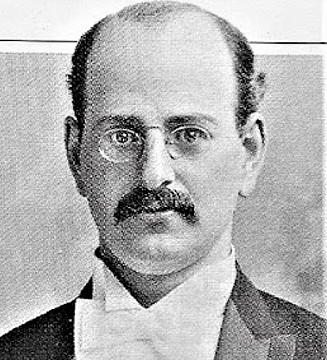
He was born in Philadelphia and attended Harvard but did not graduate. In 1885, he joined the family banking firm, Goldman Sachs & Co. He revolutionized investment banking by developing innovative valuation methods, focusing on future earnings rather than just physical assets when taking companies public. He led Goldman's first IPO in 1906 with United Cigar Manufacturers and other IPOs followed for major retailers such as Sears and F.W. Woolworth, despite their limited hard assets.
His work between 1905-1915 made him a central architect of modern investment banking and American capitalism, but he was a vocal supporter of Germany during WWI and in 1915 he refused to allow Goldman Sachs to participate in a $150-million Anglo-French bond issue arranged by J.P. Morgan and H.H. Harjes. As he continued to assert "his allegiance to Germany and his ancestral roots," a rift was created among the partners at Goldman Sachs and his pro-German stance began to cost the firm business that led to his departure in 1917. He remained supportive of Germany until 1933, when during his yearly trip to Berlin he witnessed the increasingly brutal treatment of the Jews under Hitler's regime. This "radically revised his opinion" about the country and he never returned to Germany again, spending the remaining four years of his life helping Jewish refugees.
Outside of work, he amassed a significant private art collection and despite not enjoying Harvard, he gave an endowment of $150,000 for a chair in German Art and Culture. In 1890, he married Babette Kaufman and they had three children. In the same year, they built 26 West 76th Street in New York City, before moving to an apartment at 998 Fifth Avenue in 1912. They also built a summer home at South Elberon, New Jersey.
His work between 1905-1915 made him a central architect of modern investment banking and American capitalism, but he was a vocal supporter of Germany during WWI and in 1915 he refused to allow Goldman Sachs to participate in a $150-million Anglo-French bond issue arranged by J.P. Morgan and H.H. Harjes. As he continued to assert "his allegiance to Germany and his ancestral roots," a rift was created among the partners at Goldman Sachs and his pro-German stance began to cost the firm business that led to his departure in 1917. He remained supportive of Germany until 1933, when during his yearly trip to Berlin he witnessed the increasingly brutal treatment of the Jews under Hitler's regime. This "radically revised his opinion" about the country and he never returned to Germany again, spending the remaining four years of his life helping Jewish refugees.
Outside of work, he amassed a significant private art collection and despite not enjoying Harvard, he gave an endowment of $150,000 for a chair in German Art and Culture. In 1890, he married Babette Kaufman and they had three children. In the same year, they built 26 West 76th Street in New York City, before moving to an apartment at 998 Fifth Avenue in 1912. They also built a summer home at South Elberon, New Jersey.