
Franklin Pierce (1804-1869)
14th President of the United States (1853-1857)
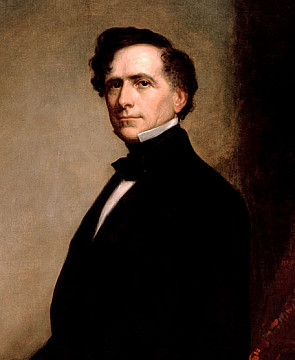
He was preceded in the Presidency by Millard Fillmore and after serving one term in office for the Democrats with William R. King as his Vice President, he was succeeded in 1857 by James Buchanan. His great-great-grandfather, Stephen Pierce, was the brother of James Pierce whose great-great-grandson, General James Pierce, was the great-great-grandfather of First Lady Barbara (Pierce) Bush. He was born in a log cabin in Hillsborough, New Hampshire, and became a lawyer before entering politics. He served in the New Hampshire legislature in the 1830s, then represented his state in the U.S. House of Representatives from 1833 to 1837 and in the Senate from 1837 to 1842.
After leaving the Senate, Pierce returned to New Hampshire to practice law but remained active in Democratic politics. He served as a Brigadier-General during the Mexican-American War, though his military service was brief and marked by controversy after he was injured in battle. He emerged as a dark horse candidate for President in 1852, securing the Democratic nomination on the 49th ballot as a compromise choice. He won the presidency decisively against whig Winfield Scott.
After leaving the Senate, Pierce returned to New Hampshire to practice law but remained active in Democratic politics. He served as a Brigadier-General during the Mexican-American War, though his military service was brief and marked by controversy after he was injured in battle. He emerged as a dark horse candidate for President in 1852, securing the Democratic nomination on the 49th ballot as a compromise choice. He won the presidency decisively against whig Winfield Scott.
His presidency was marked by significant challenges, particularly regarding slavery. He believed that the abolitionist movement was a fundamental threat to the nation's unity and alienated anti-slavery groups by enforcing the Fugitive Slave Act and in 1854 signing the Kansas-Nebraska Act - allowing territories to decide the slavery question through popular sovereignty - which led violent conflict in "Bleeding Kansas." His administration's pro-Southern policies and failure to address growing sectional tensions made him deeply unpopular in the North. The Democratic Party denied him renomination in 1856, and he retired from politics. He and his wife had three sons who all died in childhood.