
Florence Griswold (1850-1937)
Founder of the Old Lyme Art Colony & the Florence Griswold Museum, Connecticut
She was born and raised in what was generally acknowledged to be the finest house (see images) on the main street of Old Lyme, Connecticut. The town's importance as a center of shipbuilding and commerce rapidly fell into decline after the Civil War and to maintain their home her family ran it as a school for young women and then a boarding house. By the end of the 1890s, "Miss Florence" was the only family member left and she transformed it into what would become the Florence Griswold Museum by founding the Old Lyme Art Colony which was America's center of Impressionism.
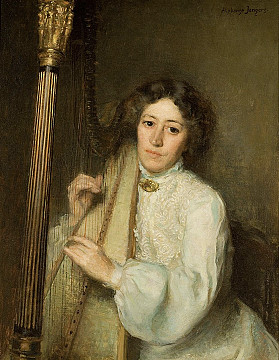
During the summer of 1899, she and the artist Henry Ward Ranger saw Old Lyme as the ideal setting for a new American school of landscape painting, and her house as the ideal home. Other artists - notably Childe Hassam, William Howe, Gifford Beal, Henry R. Poore, Edward Rook and Alphonse Jongers - quickly followed and the Lyme Art Colony was born. Some of the country's most accomplished artists gathered in Florence's home, spending their days in friendship, painting the local countryside and exchanging ideas. Her own most famous portrait (pictured) was painted ca. 1903 by Jongers, entitled "The Harpist".
Florence became the very soul of the colony, devoting herself to the artists by creating an atmosphere where, as one artist put it, "every day is so in line with work." She helped to sell their paintings, tolerated their high jinks, and lent respectability to this bohemian group of painters. Describing her role as "the keeper of the artist colony," her house became the center of America's best-known Impressionist art colony. The New York Times wrote in their obituary of Florence: "this generous spirit survives; and not in the Griswold House alone, but as part of no inconsiderable chapter in the history of our native art."
During the summer of 1899, she and the artist Henry Ward Ranger saw Old Lyme as the ideal setting for a new American school of landscape painting, and her house as the ideal home. Other artists - notably Childe Hassam, William Howe, Gifford Beal, Henry R. Poore, Edward Rook and Alphonse Jongers - quickly followed and the Lyme Art Colony was born. Some of the country's most accomplished artists gathered in Florence's home, spending their days in friendship, painting the local countryside and exchanging ideas. Her own most famous portrait (pictured) was painted ca. 1903 by Jongers, entitled "The Harpist".
Florence became the very soul of the colony, devoting herself to the artists by creating an atmosphere where, as one artist put it, "every day is so in line with work." She helped to sell their paintings, tolerated their high jinks, and lent respectability to this bohemian group of painters. Describing her role as "the keeper of the artist colony," her house became the center of America's best-known Impressionist art colony. The New York Times wrote in their obituary of Florence: "this generous spirit survives; and not in the Griswold House alone, but as part of no inconsiderable chapter in the history of our native art."