
Charles Tracy Barney (1851-1907)
of 103 East 38th Street, New York; President of the Knickerbocker Trust Company
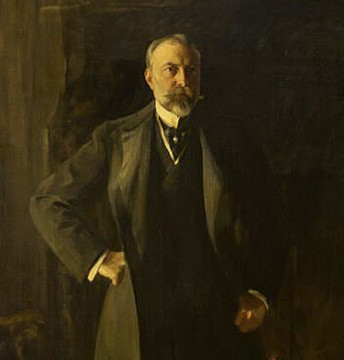
Born in Cleveland, Ohio, he graduated from Williams College and on coming to New York he pursued a career in banking that saw him become the director of 33-corporations, one of the founding investors of New York's subway system, and President of the Knickerbocker Trust Co. He was known as, "one of the most imperious of Wall Street's bankers, who ruled every undertaking that he had anything to do with," making his fall from grace all the more dramatic. In 1907, the Knickerbocker entered into a deal organized by speculators F. Augustus Heinze and Charles W. Morse to corner the market of the United Copper Company. On Tuesday, October 15, 1907, their plan failed spectacularly when the share price of United Copper collapsed. Heinze's brokerage firm failed two days later and he was forced to resign as President of the Mercantile National Bank while Morse was forced out of the banks with which he had been associated.
On realizing that the Knickerbocker was involved in the failed cornering, depositors began to remove their deposits from the bank. Barney admitted involvement with the scheme and was forced to resign a week later, a few hours before the National Bank of Commerce announced it would no longer clear checks for the Knickerbocker. On October 22, a massive bank run forced the Knickerbocker to suspend operations and its failure was the keystone of the Panic of 1907. Personally disgraced, Barney shot himself in the abdomen at his home on the morning of November 14, and died early that afternoon. He had belonged to the Metropolitan, Grolier, Century, Players’, Union, University, City, Colonial, Whist, Down Town, Riding, New York Athletic, New York Yacht, and Westminster Kennel clubs. He and his widow (Lilly, a sister of U.S. Secretary of the Navy - no saint himself - William C. Whitney) were the parents five children - not six, Marie Barney was not his daughter.
Barney lived with his family in his father's old home at 103 (previously numbered 101) East 38th Street, on the corner of Park Avenue in New York. In 1886, he paid $20,000 to William Sprague Hoyt for "Windy Barn" (see images) on First Neck Lane overlooking on Lake Agawam in Southampton, L.I. Having enlarged the house and added a ballroom among other improvements, it was described as, "one of the finest residences on the Long Island Coast, and was the first Summer home to be built at Southampton." In November, 1901, a devastating fire caused $250,000 in damages and forced the Barney family to flee in the middle of the night. Rather than pay to restore the ruin, in 1901 Barney bought "Annandale" (see images) at Westbury, L.I., from the late Charles Albert Stevens.
On realizing that the Knickerbocker was involved in the failed cornering, depositors began to remove their deposits from the bank. Barney admitted involvement with the scheme and was forced to resign a week later, a few hours before the National Bank of Commerce announced it would no longer clear checks for the Knickerbocker. On October 22, a massive bank run forced the Knickerbocker to suspend operations and its failure was the keystone of the Panic of 1907. Personally disgraced, Barney shot himself in the abdomen at his home on the morning of November 14, and died early that afternoon. He had belonged to the Metropolitan, Grolier, Century, Players’, Union, University, City, Colonial, Whist, Down Town, Riding, New York Athletic, New York Yacht, and Westminster Kennel clubs. He and his widow (Lilly, a sister of U.S. Secretary of the Navy - no saint himself - William C. Whitney) were the parents five children - not six, Marie Barney was not his daughter.
Barney lived with his family in his father's old home at 103 (previously numbered 101) East 38th Street, on the corner of Park Avenue in New York. In 1886, he paid $20,000 to William Sprague Hoyt for "Windy Barn" (see images) on First Neck Lane overlooking on Lake Agawam in Southampton, L.I. Having enlarged the house and added a ballroom among other improvements, it was described as, "one of the finest residences on the Long Island Coast, and was the first Summer home to be built at Southampton." In November, 1901, a devastating fire caused $250,000 in damages and forced the Barney family to flee in the middle of the night. Rather than pay to restore the ruin, in 1901 Barney bought "Annandale" (see images) at Westbury, L.I., from the late Charles Albert Stevens.