
William McKinley (1843-1901)
25th President of the United States (1897-1901)
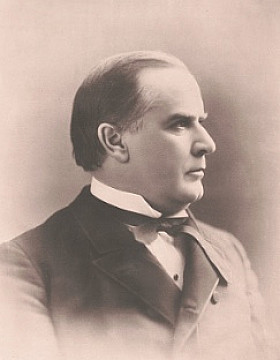
He was preceded in the Presidency by Grover Cleveland and after serving one term in office for the Republican Party he was re-elected again in 1900 only to be assassinated in 1901. His first Vice-President was Garret A. Hobart but he died in 1899 and was replaced by Theodore Roosevelt who succeeded McKinley to become President. Born in Niles, Ohio, he began his political career after serving as a Union officer in the Civil War. McKinley served in the House of Representatives (1877-91), where he championed protective tariffs, most notably the McKinley Tariff of 1890. He then served as Governor of Ohio from 1892 to 1896. He won the presidency in 1896, defeating William Jennings Bryan in a campaign that emphasized economic prosperity, advocating "sound money" (ie., the Gold Standard, unless altered by international agreement).
His presidency was marked by significant events including the Spanish-American War in 1898, which resulted in American territorial acquisitions of Puerto Rico, Guam, and the Philippines. For the first time, this conflict established the United States as a global imperial power from which it has not looked back. Domestically, McKinley presided over a period of economic growth and industrial expansion. He maintained high protective tariffs and supported business interests. His administration also oversaw the annexation of Hawaii in 1898. He was re-elected in 1900, defeating Bryan again. However, his second term was cut short barely before it got off the ground when he was shot by anarchist Leon Czolgosz at the Pan-American Exposition in Buffalo, New York, on September 6, 1901. He died eight days later. In 1871, McKinley married Ida Saxton, and they lived in the Saxton-McKinley House (see images) in Canton, Ohio. Both their daughters died young.
His presidency was marked by significant events including the Spanish-American War in 1898, which resulted in American territorial acquisitions of Puerto Rico, Guam, and the Philippines. For the first time, this conflict established the United States as a global imperial power from which it has not looked back. Domestically, McKinley presided over a period of economic growth and industrial expansion. He maintained high protective tariffs and supported business interests. His administration also oversaw the annexation of Hawaii in 1898. He was re-elected in 1900, defeating Bryan again. However, his second term was cut short barely before it got off the ground when he was shot by anarchist Leon Czolgosz at the Pan-American Exposition in Buffalo, New York, on September 6, 1901. He died eight days later. In 1871, McKinley married Ida Saxton, and they lived in the Saxton-McKinley House (see images) in Canton, Ohio. Both their daughters died young.