
Gen. William Alexander (1726-1783)
Major-General in the Continental Army aka "Lord Stirling"
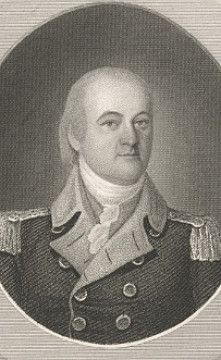
He was born in New York City and became a successful merchant, a pioneer winemaker, a Governor of King's College (Columbia University) and a member of the King's Council for the Colony of New Jersey. While in England, he successfully claimed (in the Scottish courts) the Scottish title of "Earl of Stirling" and although the House of Lords rejected his claim in 1762 he continued to use the title throughout his life, signing his name "Stirling". As a colonel in the militia and having already seen action in the French & Indian War, on the outbreak of Revolution he was commissioned into the Continental Army as a Brigadier General and quickly became one of Washington's most trusted generals. He played crucial roles in several major battles, notably the Battle of Long Island (1776), where his courageous rearguard action allowed Washington's army to escape encirclement, which likely saved the revolutionary cause.
He commanded troops at Trenton, Brandywine, Germantown, and Monmouth, earning a reputation for bravery and tactical skill, although in private he struggled with alcoholism which sometimes affected his performance on the battlefield. He died suddenly in Albany, just months before the war's end. Despite never being officially recognized as a British peer, he's remembered as one of the Revolution's most revered leaders, and for his celebrated victory at Long Island. In 1748, he married Sarah, sister of his good friend William Livingston, 1st Governor of the State of New Jersey, and they had two daughters.
He commanded troops at Trenton, Brandywine, Germantown, and Monmouth, earning a reputation for bravery and tactical skill, although in private he struggled with alcoholism which sometimes affected his performance on the battlefield. He died suddenly in Albany, just months before the war's end. Despite never being officially recognized as a British peer, he's remembered as one of the Revolution's most revered leaders, and for his celebrated victory at Long Island. In 1748, he married Sarah, sister of his good friend William Livingston, 1st Governor of the State of New Jersey, and they had two daughters.