
Sir Harry Oakes (1874-1943)
1st Bt., Gold Mine Owner, Investor & Member of the Bahamas House of Assembly
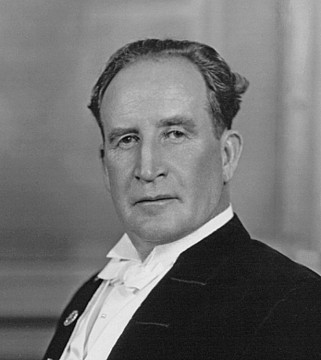
He was born in Sangerville, Maine, the son of Maine's most prominent surveyor. After graduating from Bowdoin College (Brunswick, Maine), he worked for a paper manufacturer in New York. On hearing about the discovery of gold in the Yukon he joined the rush, but failed to find any gold. For the next 13-years he searched for gold in Alaska, the Philippines, Australia, New Zealand, West Africa, the Belgian Congo, South Africa, Mexico, California, and Nevada, but found nothing. By 1911, he was back in Canada. Broke, a conductor kicked him off a train at a stop called Swastika in Northern Ontario. There, he told an equally destitute Chinese man that he was a gold prospector, and the Chinese man told him that if it was gold that he wanted, it was all around the place. Oakes found it and staked out the Lake Shore Mine in Kirkland that became the second-richest gold mine in the world, and the largest in the western hemisphere. By 1927, it had made him $28-million, and thereafter it yielded him roughly $3-million a year.
He built "Oak Hall" (see images) at Niagara Falls in Canada and in England he bought a townhouse at 24 Queen Street, London, and a country estate "Oak Hall" in Heathfield, East Sussex. In the States, he bought summer houses in Bar Harbor ("The Willows") and North Palm Beach. In 1937 he moved to Nassau in the Bahamas for the cheaper tax rate. He built "Westbourne," a beachfront glass & stucco mansion around a saltwater swimming pool and bought the Bahamas’ largest hotel and Nassau’s water works; built a private airport, rebuilt the Bahamas Country Club, and got himself elected to the Bahamas House of Assembly. Having become a British citizen, and in recognition of his munificent contributions to St. George’s Hospital in London, he was created a Baronet in 1939. He was married to Eunice McIntyre in 1923, and they were the parents of five children.
For all his wealth, Sir Harry Oakes is best remembered as the victim in, "the greatest murder mystery of all time". His body was found on his bed in his home in the Bahamas. He had been struck four times on the head with a silver ice pick and his corpse was left partially incinerated and strewn with feathers. His son-in-law, Alfred de Marigny (who eloped with his daughter, Nancy, two days after she turned 18), was tried for his murder but was acquitted by the jury and the murder remains unsolved. One theory put forward was that he was murdered by an intelligence agency (OSS, SOE, or MI6) as a message to scare the Windsors (the Duke was then Governor of the Bahamas) and their other American friends who were known to harbor sympathy for the Nazis. Other suspects have included his indebted business partner, Harold Christie, and in 1959 the U.S. Legal Attaché in London sent a dossier to Scotland Yard in which the FBI pointed a finger at Oakes' lawyer, Walter Foskett, who had allegedly swindled his client and shortly before his death it was alleged that Oakes had let it be known that he was going to straighten Foskett out.