
Samuel Rodman (1800-1882)
Landowner and Politician
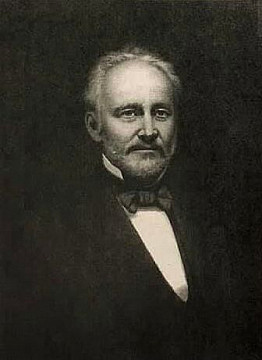
Samuel Rodman, son of Robert and Elizabeth (Hazard) Rodman, the latter the daughter of Stephen Hazard, of South Kingstown, RI, was born in South Kingstown May 3, 1800. Both in personal appearance and in character he was said to resemble his great-grandfather, Samuel, while he inherited from his mother a strain of the Hazard blood, and with it the will and energy that are necessary to success. He was born in the house that his great-uncle, William Rodman, had builded, and in the great west chamber that had been made historic as being also the birthplace of Oliver Hazard Perry, the hero of Lake Erie.
"In 1821 he made his first purchase of real estate, "buying of Elisha Watson, for four hundred and ninety dollars, six acres of land with a house thereon." This land was once a part of the old Rodman estate, and in this house his eldest son, Isaac Peace Rodman, was born Aug 18, 1822. Year by year Samuel Rodman added to his property, gathering up acre after acre of the old paternal lands. About 1830 he leased the Peace Dale Mills from Isaac Hazard, and began manufacturing; and in 1835, with Attmore Robinson, he bought the tract of land with the wharf at Narragansett Pier since called the "Old Pier," where a break-water costing twenty-five thousand dollars was afterward built. "During the progress of the work on the breakwater an accomplished French engineer, on examining it, said that it was built on a wrong principle, and that the dock would fill with sand. Time has proved the truth of this prediction, for children now play on the sands where was once from fifteen to twenty feet of water."
"In 1838 Samuel Rodman sold his rights in the "Pier" property and bought of Thomas R. Hazard 125 or 130 acres in the village of Rocky Brook; and in the same year he built the homestead, where seven of his children were born. There were on the property at the time four small houses, and a small mill containing one or two sets of machinery. In this mill he began the manufacture of woolen goods. During the following year (1839) he bought thirty acres, on a part of which stood the old Rodman mansion house and a woolen-mill. In 1853 he bought thirty acres more with several houses and a woolen-mill, and about the same time he added to his own farm the Freeman Watson farm adjoining it. This farm once belonged to his great-uncle, William Rodman, who in the last century had built the house already mentioned as the one in which Samuel Rodman was born. The small mills on the Rocky Brook estate Mr. Rodman soon replaced by substantial stone buildings, taking all the stone that he used from his own meadows, which were well named "Rocky," His success as a manufacturer was uninterrupted until the war of 1861, and he became one of the richest mill owners in the State, owning in addition to the "Rocky Brook" property mills in Wakefield and in Newport. He built pretty cottages for his operatives, made roads, set out trees and beautified the place until his became, both in appearance and in reality, one of the thriftiest as well as one of the most picturesque villages in New England."
"In politics Samuel Rodman was an old-time Whig and subsequently an anti-slavery Whig. He represented his town several times in the General Assembly. In 1854, when a nomination was equivalent to an election, he was asked to take the nomination for lieutenant-governor, but he declined it. He was never defeated with the exception of once in any election in which he stood as a candidate. In 1873 he received the nomination for Congress, but declined to run. In 1841 he entered enthusiastically upon the total abstinence reform, and its measure of success in his own and the neighboring villages was largely attributable to his zeal."
"For over forty years Samuel Rodman was a member of the Baptist Church and an hone to his communion. He contributed largely toward the building of the new Baptist house of worship in Wakefield in 1852 and was one of its chief benefactors. He was not in any sense a sectarian. He was liberal in his religious views and tolerant toward all Christian denominations, and aided, by liberal contributions, in the building of no less than twenty six churches besides his own, not confining his benevolence to his own denomination."
"Mr. Rodman's character was one of great natural energy, yet there were no hard lines in it. He had a certain gentleness of manner, combined with decision, which made him greatly beloved and trusted by all who came in contact with him, especially his employees, who during his last illness came to the house in numbers, begging to be allowed the privilege of watching through the nights with him. No "strike" was ever thought of in his mills. The relations between him and his employees were those of mutual confidence. He perceived that the truest method of elevating the laborer was to make him independent, and to this end, by the sale of lands to his employees at nominal prices, he encouraged his laborers to become land owners."
"His hospitality was proverbial. Rarely were the guest chambers tenantless, or were there vacant seats at his hospitable board; while the distinguished guest received no more cordial welcome than the poor and needy friend or relation. A friend writing to his widow after his death said: "Mr. Rodman was the most generous man I ever knew, and I have reason to know how generous. He conferred a favor in such a way that the recipient might well question whether he had received or conferred the favor."
"Samuel Rodman married (first) July 15, 1821, Mary Peckham, daughter of Benjamin and Abigail (Oatley) Peckham, and in direct descent from John Peckham, Archbishop of Canterbury; from Richard Warren, one of the twelve signers of the "Mayflower" Compact; from the Colonial Governors John Coggeshall (May, 1647, to May 1648), John Easton (King's attorney-general for the Colony, 1656-1674, and governor, 1690-1695), Benedict Arnold (President of the Colony from May, 1657, until June 20, 1678, when he died in office), John Greene (King's attorney-general, 1660-1690; member of Governor Andros' Council; Governor, 1690-May, 1700), and Caleb Carr (May 1695, died in office); and from John Coggeshall, Jr., Deputy, 1686-1690."
"Mary (Peckham) Rodman was the mother of all Samuel Rodman's children. The influence of her character and teaching was seen clearly in her eldest con, Gen. Isaac Peace Rodman. To her husband she was truly a helpmate, not only in forming the character of the older children, who came especially under her influence, but as a wise and faithful counselor in all his business relations. He took no important step without her advice. She was born September 23, 1803 and died February 16, 1853. Mr. Rodman married (second) Feb. 16, 1853, Mary Antis, daughter of Wilkins Upidike, Esq., of South Kingstown, and author of the "History of the Narragansett Church," "Memoirs of the Rhode Island Bar," and other works."
"Mr. Rodman died May 9, 1882, in South Kingstown, on the Rodman land where he was born, and was buried in the family burying ground. Eight of his grandsons, obeying his request, were his pall-bearers. They were: Isaac Peace Rodman, Thomas Rodman, Rowland Rodman, S.A. Rodman, B.F. Robinson, Jr., Samuel R. Robinson, Samuel Rodman Thompson and William H. Baldwin, Jr. We may conclude by sayin, in the words of one who knew him so well: "A larger hearted, more whole souled man than Samuel Rodman Rhode Island has never produced.