
Robert Carter III (1728-1803)
"The Councillor" of Nomini Hall, Westmoreland Co., Virginia
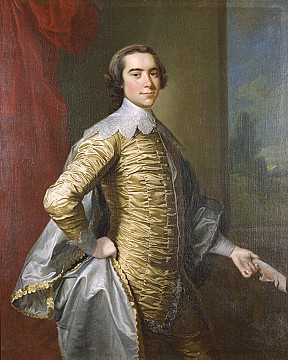
Born at Nomini Hall, Virginia, he was a grandson of "King" Carter and became one of the largest landholders in the Chesapeake region, inheriting 6,500-acres and 100-slaves by the time he came of age in 1749. He was educated at the College of William & Mary in Williamsburg before studying at the Inner Temple in London. Returning to Virginia in 1751, he took up residence at Nomony Hall (as he preferred to spell it) and became a Justice but failed to get himself elected to the House of Burgesses. Instead, in 1758 he used his influential contacts to be named to the Virginia Governor's Council. He associated with many of Virginia's most forward-thinking academics and became known for his humane attitude towards his slaves, never whipping them nor allowing them to be whipped - although he did whip his own children.
In 1778, he became a Baptist and horrified his neighbors by joining the Morattico Baptist Church which had a mixed congregation of white and black, free and slave. This spiritual awakening culminated in an extraordinary decision that set him apart from all of his contemporaries. In 1791, he filed a deed of manumission to gradually free all of his enslaved people - approximately 452 in total. This made him the largest individual emancipator in American history before the Civil War. His decision shocked Virginia society and strained relationships with his family and friends, but demonstrated that even those most deeply embedded in the slavery system could undergo profound change, making him a unique figure in early American history. He and his wife, Frances Ann Tasker, were the parents of seventeen children of whom twelve (listed) survived childhood.
In 1778, he became a Baptist and horrified his neighbors by joining the Morattico Baptist Church which had a mixed congregation of white and black, free and slave. This spiritual awakening culminated in an extraordinary decision that set him apart from all of his contemporaries. In 1791, he filed a deed of manumission to gradually free all of his enslaved people - approximately 452 in total. This made him the largest individual emancipator in American history before the Civil War. His decision shocked Virginia society and strained relationships with his family and friends, but demonstrated that even those most deeply embedded in the slavery system could undergo profound change, making him a unique figure in early American history. He and his wife, Frances Ann Tasker, were the parents of seventeen children of whom twelve (listed) survived childhood.
Parents (2)


Children (12)



Associated Books (1)


Categories
Share
Image Courtesy of the Virginia Historical Society, Wiki Commons