
Philip Clayton Rogers (1829-1902)
of Staatsburgh, Dutchess Co., New York; Captain of the 39th New York Regiment
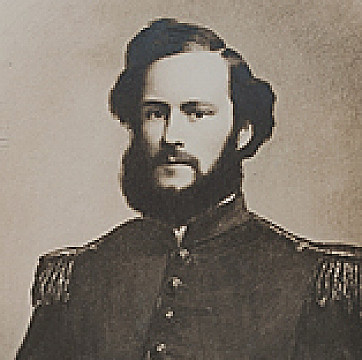
He was educated at Dr. Huddart's school in New York City and Columbia College, leaving in his junior year (1845) to take a position in the counting room of Robert Kermit, of the Red Star Line. In 1853, he was appointed secretary of the Second Avenue Railroad Co., but after a change of management in 1856 he left the job and removed to Hyde Park. In 1859, he took a trip to China, going out as a passenger and coming back, "before the mast, having a strong wish to see strange climes and people." In 1861, he enlisted as a private in the famous New York Seventh Regiment (Old 8th Company, Captain of Shumway), and went to Washington, returning in June of that year with his brother, Edmund, "to whom he was devotedly attached." The following August, h was made 2nd Lieutenant in the 55th New York Volunteers which then became Company H, 39th Regiment, of which he became Captain, and was appointed an aide-de-camp.
On the second day of fighting at the Battle of the Wilderness (May 6th 1864), he was taken prisoner and carried to Macon, Georgia., from where he was to be sent to jail in Charleston. On the way, he and eighty other officers jumped from the cars at Pocataligo Station and made a run for it, but they were hunted down by hounds, and only one of the group managed to escape. He was afterwards exchanged by special order of Gen. Foster and sent back to New York on the steamer Arago in August, 1864. He resumed staff duties with the First Battalion, First Division, Second Corps, remaining at his post until February 20th, 1865, when he was honorably discharged. He always wore the bronze cross of the 7th Regiment, N.Y.S.V. with pride, and it was among "his choicest treasures." In 1865, he married Julia Kavanagh, of New Rochelle, N.Y., and they had four children.
On the second day of fighting at the Battle of the Wilderness (May 6th 1864), he was taken prisoner and carried to Macon, Georgia., from where he was to be sent to jail in Charleston. On the way, he and eighty other officers jumped from the cars at Pocataligo Station and made a run for it, but they were hunted down by hounds, and only one of the group managed to escape. He was afterwards exchanged by special order of Gen. Foster and sent back to New York on the steamer Arago in August, 1864. He resumed staff duties with the First Battalion, First Division, Second Corps, remaining at his post until February 20th, 1865, when he was honorably discharged. He always wore the bronze cross of the 7th Regiment, N.Y.S.V. with pride, and it was among "his choicest treasures." In 1865, he married Julia Kavanagh, of New Rochelle, N.Y., and they had four children.