Otto Hermann Kahn (1867-1934)
Financier & Patron of the Arts, of New York, New Jersey & Palm Beach
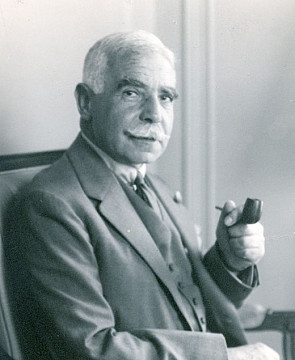
He was the dapper and irresistibly charming figure on whom it is rumored "Mr. Monopoly" was modelled. Born in Mannheim in the Grand Duchy of Baden (Germany), he started his career in London where he became a British citizen while working for Deutsche Bank. While there, he lived with his celebrated uncle, the solicitor Sir George Henry Lewis, who introduced him to liberal high society and the arts, but his father was determined that he should pursue a career in finance. Five years later (1893), he accepted a role with Speyer & Co. in New York and after his marriage in 1896 he joined Kuhn, Loeb & Co. with whom he remained for 37-years as a senior partner.
On arriving in America in 1893, the famously cold James Stillman remarked of Kahn: "a promising chap, if only he will forget that art nonsense." He didn't, but his natural financial acumen and exacting character made him indispensable to Ned Harriman as he reorganized and consolidated six railroad systems, including the Union Pacific and the Baltimore & Ohio. A contemporary of Felix Warburg, he was later able to blend banking with the arts by supporting and developing the early American film industry.
Beyond finance, he was an extraordinary cultural philanthropist, and his Fifth Avenue mansion was a gathering place for artists and intellectuals as well as business leaders. He was known for his progressive views on labor relations and his efforts to bridge cultural divides between America and Europe. He supported countless artists, musicians, and theatrical productions, often providing personal financial assistance to struggling performers and creative institutions. He gave liberally to various museums, established prizes for New York’s black artists, financed an American tour of the Moscow Arts Theatre, helped build the New Theatre in New York, and supported the restoration of the Parthenon in Athens. In 1903, he became a stockholder in the floundering Metropolitan Opera Company and for several years made good on its losses. In 1908, he brought in director Giulio Gatti-Casazza and conductor Arturo Toscanini from La Scala in Milan, and he went on to serve as the opera's president from 1918 to 1931, eventually owning 84% of the company’s stock. He accrued an impressive collection of paintings, notably Old Masters, but it was in fact his wife who was chiefly responsible for their collection.
In 1896, he married his beloved wife, Addie, daughter of Abraham Wolff, a partner in Kuhn, Loeb & Co. They had four children (listed), and in 1973 their granddaughter, the Countess of Airlie, became the first American to be appointed Lady-in-Waiting to a British monarch. In America, the Kahns lived between several famously opulent mansions: Cedar Court in Morristown, New Jersey, a wedding present from Kahn's father-in-law; Oheka Castle, the largest private house ever built in New York; the Kahn Mansion in Manhattan, modelled after the Palazzo della Cancelleria in Rome; and their first of two winter homes in Palm Beach, Oheka Cottage (see images) completed in 1918 at 122 North Ocean Boulevard, Palm Beach. They replaced their last home with a larger version, Oheka, (O-tto, HE-rmann, KA-hn) on North Country Road, Palm Beach, that was completed c.1932.
Often overlooked was their brief sojourn in England. Having been snubbed by society on account of their ethnicity at Cedar Court (Kahn declared he was Jewish by race, not by religion), in 1911 they relocated to London when Kahn was very seriously considering taking a seat in Parliament. On their arrival, they leased Cassiobury House in Watford from the Countess of Essex. One year later in 1912, they purchased a townhouse at 2 Carlton House Terrace in London but almost immediately afterwards swapped it for St. Dunstan’s Lodge sited on 15-acres in London's Regent’s Park. When WWI erupted in 1914, he gifted the property as a rehabilitation home for blind servicemen. Returning to the States in 1917, he resumed his banking career and traded his British citizenship for an American passport. He was reputed to have lost in the region of $50-million after the Wall Street Crash (1929) and died in 1934 leaving a net taxable estate of just $3,970,869.
On arriving in America in 1893, the famously cold James Stillman remarked of Kahn: "a promising chap, if only he will forget that art nonsense." He didn't, but his natural financial acumen and exacting character made him indispensable to Ned Harriman as he reorganized and consolidated six railroad systems, including the Union Pacific and the Baltimore & Ohio. A contemporary of Felix Warburg, he was later able to blend banking with the arts by supporting and developing the early American film industry.
Beyond finance, he was an extraordinary cultural philanthropist, and his Fifth Avenue mansion was a gathering place for artists and intellectuals as well as business leaders. He was known for his progressive views on labor relations and his efforts to bridge cultural divides between America and Europe. He supported countless artists, musicians, and theatrical productions, often providing personal financial assistance to struggling performers and creative institutions. He gave liberally to various museums, established prizes for New York’s black artists, financed an American tour of the Moscow Arts Theatre, helped build the New Theatre in New York, and supported the restoration of the Parthenon in Athens. In 1903, he became a stockholder in the floundering Metropolitan Opera Company and for several years made good on its losses. In 1908, he brought in director Giulio Gatti-Casazza and conductor Arturo Toscanini from La Scala in Milan, and he went on to serve as the opera's president from 1918 to 1931, eventually owning 84% of the company’s stock. He accrued an impressive collection of paintings, notably Old Masters, but it was in fact his wife who was chiefly responsible for their collection.
In 1896, he married his beloved wife, Addie, daughter of Abraham Wolff, a partner in Kuhn, Loeb & Co. They had four children (listed), and in 1973 their granddaughter, the Countess of Airlie, became the first American to be appointed Lady-in-Waiting to a British monarch. In America, the Kahns lived between several famously opulent mansions: Cedar Court in Morristown, New Jersey, a wedding present from Kahn's father-in-law; Oheka Castle, the largest private house ever built in New York; the Kahn Mansion in Manhattan, modelled after the Palazzo della Cancelleria in Rome; and their first of two winter homes in Palm Beach, Oheka Cottage (see images) completed in 1918 at 122 North Ocean Boulevard, Palm Beach. They replaced their last home with a larger version, Oheka, (O-tto, HE-rmann, KA-hn) on North Country Road, Palm Beach, that was completed c.1932.
Often overlooked was their brief sojourn in England. Having been snubbed by society on account of their ethnicity at Cedar Court (Kahn declared he was Jewish by race, not by religion), in 1911 they relocated to London when Kahn was very seriously considering taking a seat in Parliament. On their arrival, they leased Cassiobury House in Watford from the Countess of Essex. One year later in 1912, they purchased a townhouse at 2 Carlton House Terrace in London but almost immediately afterwards swapped it for St. Dunstan’s Lodge sited on 15-acres in London's Regent’s Park. When WWI erupted in 1914, he gifted the property as a rehabilitation home for blind servicemen. Returning to the States in 1917, he resumed his banking career and traded his British citizenship for an American passport. He was reputed to have lost in the region of $50-million after the Wall Street Crash (1929) and died in 1934 leaving a net taxable estate of just $3,970,869.