
Morris Ketchum (1796-1880)
Banker, of New York City & "Hokanum" Westport, Connecticut
He was born in Waterford, Saratoga Co., New York, and began his career in 1812 in his father's brokerage firm in New York City before moving to Savannah as a cotton broker. His success was immediate and he returned to New York where he opened his own commission house, backed by his father. In 1832, he was invited to become a partner in what became Rogers, Ketchum & Grosvenor, subsequently the Rogers Locomotive Works, “the most progressive builder (of locomotives) in the country” during the 1850s, and after the Baldwin Locomotive Works in Philadelphia, the second most popular steam locomotive manufacturing company in North America. As a director of the Illinois Central Railroad, he was able to win several important contracts for Rogers. In 1864, he partnered with, among others, Peter Cooper, John Jacob Astor and Hamilton Fish to create the Special Council of Hygiene & Public Health. By this time, he was President of the Fourth National Bank of New York, a director of the Union Bank and described as, "a man of spotless reputation, highly respected in banking and brokerage circles."
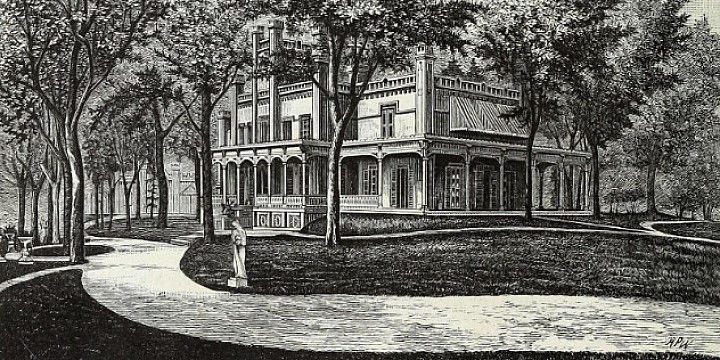
He was also in partnership with his son, Edward, as Ketchum, Son & Co., which specialized in inland banking and exchanges, and at one time was estimated to have resources equal to $10-million. But in 1865 a scandal erupted when it was discovered that his son had lost $2.5 million of his investor's money speculating in gold, and to cover his tracks he attempted to forge several sizeable checks before absconding with the firm's remaining money. Not only did the firm go under, Morris had to resign his position at the Fourth National. But, nonetheless, he honored all of his son's debts. This all but cleared him out and he moved south, investing what little remained in the Savannah Banking & Trust Company and the Georgia Central Railroad, and "by his indomitable pluck and energy again acquired a comfortable fortune." He was married three times and had six sons and two daughters. He lived between 19 Washington Square in New York City (where he died) and his country estate (see images), "Hokanum" Westport, Connecticut. He had been a personal friend and a great admirer of Daniel Webster, and his pallbearers included Junius S. Morgan, William E. Dodge, W.W. Phelps, Willard Parker & Gouverneur Morris.
He was also in partnership with his son, Edward, as Ketchum, Son & Co., which specialized in inland banking and exchanges, and at one time was estimated to have resources equal to $10-million. But in 1865 a scandal erupted when it was discovered that his son had lost $2.5 million of his investor's money speculating in gold, and to cover his tracks he attempted to forge several sizeable checks before absconding with the firm's remaining money. Not only did the firm go under, Morris had to resign his position at the Fourth National. But, nonetheless, he honored all of his son's debts. This all but cleared him out and he moved south, investing what little remained in the Savannah Banking & Trust Company and the Georgia Central Railroad, and "by his indomitable pluck and energy again acquired a comfortable fortune." He was married three times and had six sons and two daughters. He lived between 19 Washington Square in New York City (where he died) and his country estate (see images), "Hokanum" Westport, Connecticut. He had been a personal friend and a great admirer of Daniel Webster, and his pallbearers included Junius S. Morgan, William E. Dodge, W.W. Phelps, Willard Parker & Gouverneur Morris.